


Taiwanese and US officials yesterday reiterated their commitment to strengthening bilateral relations as they celebrated the dedication of the American Institute in Taiwan’s (AIT) new office compound in Taipei’s Neihu District (內湖).
President Tsai Ing-wen (蔡英文), former president Ma Ying-jeou (馬英九), Minister of Foreign Affairs Joseph Wu (吳釗燮) and Taipei Mayor Ko Wen-je (柯文哲) topped the list of Taiwanese guests, while US officials included US Assistant Secretary of State for Educational and Cultural Affairs Marie Royce, US Department of State Bureau of Overseas Buildings Operations Principal Deputy Director Ambassador William Moser, US Representative Gregg Harper, AIT Chairman James Moriarty and AIT Director Kin Moy.
Former AIT directors Richard Bush, Raymond Burghardt, William Stanton and Stephen Young also attended.
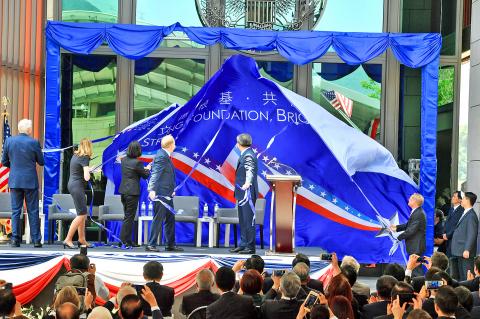
Photo: CNA
The compound represents much more than just steel, glass and concrete — it is a symbol of the strength and vibrancy of the Taiwan-US partnership in the 21st century, said Royce, the highest-ranking State Department official to visit Taiwan since then-US assistant secretary of state for economic and business affairs Charles Rivkin in 2015.
“We may be separated by a great ocean, but our shared convictions, values and trust form a strong foundation for cooperation,” Royce said, adding that the AIT’s new home would enable even greater cooperation for many years to come.
Construction of the complex began in 2009 under Ma’s Chinese Nationalist Party (KMT) administration and was completed under Tsai from the Democratic Progressive Party, Moriarty said.
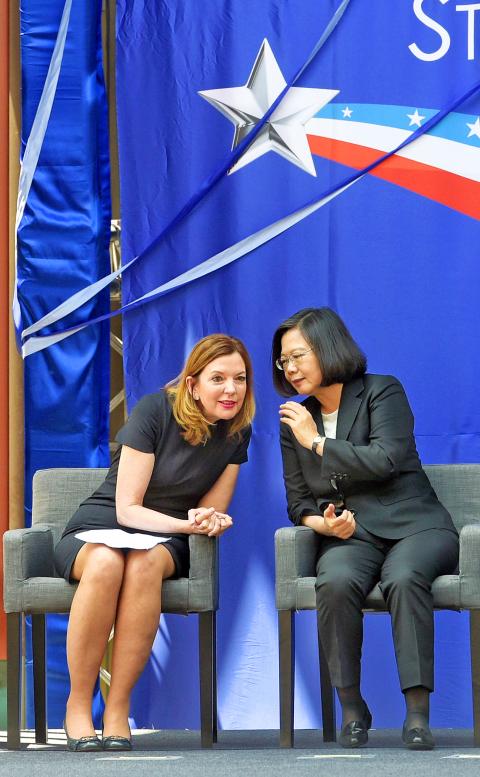
Photo: Chang Chia-ming, Taipei Times
“[It] reflects the support throughout Taiwanese society for close ties with the US,” Moriarty said. “That broad support is mirrored in the US by the wide affection Americans have for Taiwan: across the political aisle, in the executive and legislative branches alike, at all levels of government and throughout American society.”
Reiterating the US’ commitment to its Taiwan Relations Act, Moriarty said that the US would continue to advance bilateral relations, and support Taiwan’s ability to defend itself and make positive contributions to the international community.
Moy said that during his three years as AIT director, he has often said that Taiwan has no better friend than the US.
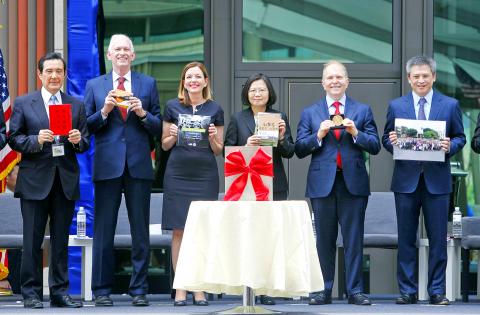
Photo: Chiang Ying-ying, AP
“As a testament to this friendship, to the US commitment to Taiwan and to our staying power in Taiwan, I offer you this: a tangible symbol that the US is here to stay,” Moy said, referring to the compound that cost Washington US$255.6 million.
Expressing gratitude to all the people who made the building possible, Tsai said she was pleased that through combined efforts, this milestone in the Taiwan-US relationship is now complete.
“The friendship between Taiwan and the US has never been more promising. The great story of Taiwan-US relations remains to be filled with the efforts of those who will one day occupy this building,” she said.
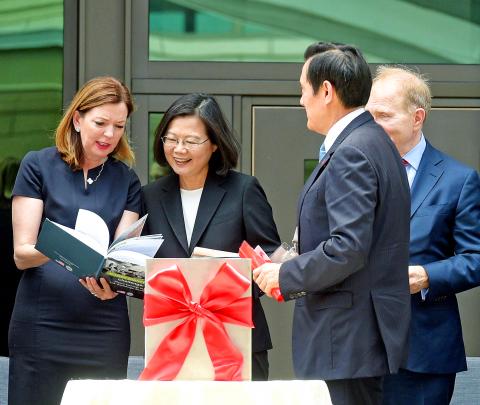
Photo: Chang Chia-ming, Taipei Times
Moriarty, Royce, Tsai, Moser and Moy then pulled on ribbons attached to a curtain covering the building’s main entrance, below a metal US national seal made in the US for the complex.
They placed items into a time capsule to be buried, including a photograph of Tsai and Moy, a copy of documentary filmmaker Chi Po-lin’s (齊柏林) Beyond Beauty: Taiwan From Above (看見台灣), a ceramic plate from former president Lee Teng-hui (李登輝) and calligraphy by Ma.
Prior to the ceremony, Moy dismissed a Wall Street Journal article that cited an anonymous US official as attributing the absence of a senior US Cabinet secretary at the event to Chinese diplomats’ warnings to Washington that such a move would “violate an understanding that Washington should have only unofficial relations with Taiwan.”
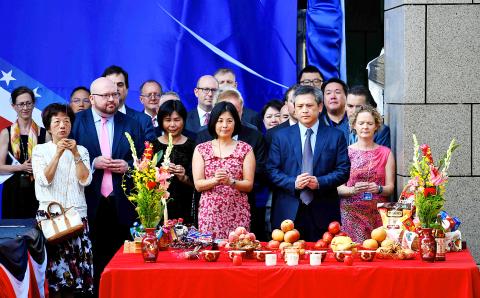
Photo: Sam Yeh, AFP
“In addition to the chairman of AIT, we also have a special guest: Royce... She is absolutely a perfect candidate, a perfect guest to come here, because she reflects about 40 years of educational and cultural cooperation between both sides,” Moy said.
Moy also shrugged off questions about whether the compound would be guarded by US Marines.
“We do not make political statements with our security. What we do is we bring a sufficient number of people to coordinate with local staff to ensure that the people inside our buildings are very safe,” he said.
Asked about media reports that former AIT deputy director Brent Christensen would succeed Moy, Moriarty did not confirm, but said that Christensen was not only a good friend, but also “a very good friend of Taipei.”
Speaking on the US Senate floor on Monday, senators Cory Gardner and Marco Rubio sent congratulatory messages for the dedication, saying that the new facility shows the strong friendship between the US and Taiwan.
Additional reporting by CNA

A signaling system malfunction disrupted high-speed rail (HSR) services beginning at 8am today, with trains temporarily reduced to three northbound and three southbound trains per hour as authorities conduct inspections. The malfunction occurred on a section of track in Miaoli County during pre-operation checks early this morning, forcing northbound and southbound trains to use a single track, the HSR operator said. The regular schedule has been replaced with three hourly trains offering only nonreserved seating in each direction, stopping at every station, it said, adding that business class cars would still have reserved seating. Departures from terminal stations are scheduled at the top
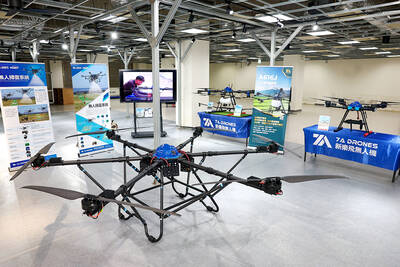
DRONE CENTRAL: Taiwan aims to become Asia’s democratic hub for drones, with most exports focused on high-quality military-grade models, an official said Taiwan’s drone industry is expected to expand significantly by 2030, producing 100,000 units per month and exporting half of them, the Ministry of Economic Affairs said yesterday. Current drone production capacity is about 15,000 units per month, but the industry can quickly scale up as demand increases, Industrial Development Administration Director-General Chiou Chyou-huey (邱求慧) told a news conference in Taipei. Taiwan’s drone output grew 2.5-fold last year to NT$12.9 billion (US$408.3 million) under a government program to develop the uncrewed vehicle sector, he said. The Executive Yuan in October last year approved plans to invest NT$44.2 billion into domestic production of uncrewed aerial

VERBOSE VESSELS: A CGA cutter and a China Coast Guard exchanged verbal barbs for more than a day in Taiwanese-controlled waters before the Chinese vessel left The Taiwanese and Chinese coast guards had a standoff near the strategically located Pratas Islands (Dongsha Islands, 東沙群島) in the north of the South China Sea, the Coast Guard Administration (CGA) said yesterday. The two sides engaged in intense radio exchanges over sovereignty claims during the 33-hour standoff. China Coast Guard vessel 3501 eventually left the restricted waters, 26.6 nautical miles (49.2km) west of the Pratas Islands, at 5pm yesterday, the CGA said. Lying approximately between southern Taiwan and Hong Kong, the Taiwan-controlled Pratas are seen by some security experts as vulnerable to Chinese attack due to their distance — more than
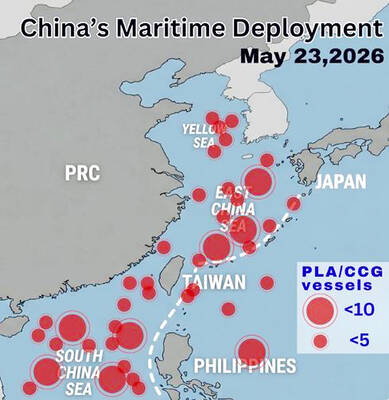
WARNING: China should stop engaging in actions that undermine regional peace and stability, as it would only build resentment among people across the Strait, the CGA said China has deployed more than 100 navy, coast guard and other vessels in waters from the Yellow Sea to the South China Sea and the western Pacific since US President Donald Trump and Chinese President Xi Jinping (習近平) met in Beijing, National Security Council Secretary-General Joseph Wu (吳釗燮) said yesterday. “In this part of the world, #China is the one & only PROBLEM wrecking the #StatusQuo & threatening regional peace & stability,” Wu wrote on X. In a separate post, he said Beijing was coercing Taiwan’s maritime domain, calling it illegal and provocative, after the Coast Guard Administration (CGA) expelled a


 RSS
RSS