


The nation’s first 3D printing industrial cluster for medical devices has taken shape in Kaohsiung, the Ministry of Science and Technology said yesterday, adding that medical devices for body parts from head to toe can be created there.
The ministry in December last year unveiled the first demonstration site for 3D-printed medical devices and smart manufacturing at the Southern Taiwan Science Park’s (南部科學工業園) branch campus in Kaohsiung’s Lujhu District (路竹).
The Food and Drug Administration on Jan. 12 launched a set of guidelines governing 3D-printed medical devices, making Taiwan the first Asian nation to establish regulations on such devices, the ministry said.
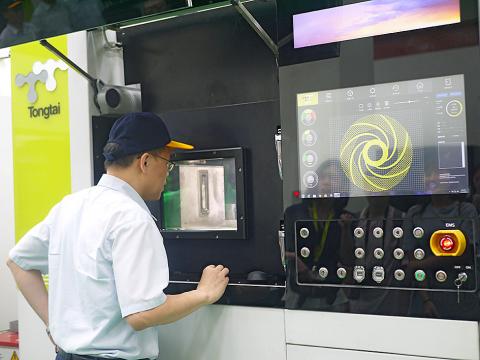
Photo: Chien Hui-ju, Taipei Times
The ministry is this year to help local medical device developers obtain ISO 13485:2016 certification, which specifies requirements for medical devices, Deputy Minister of Science and Technology Hsu Yu-chin (許有進) said.
There are 54 medical device developers at the science park, which has a campus in Tainan and another in Kaohsiung, with more than NT$9.28 billion (US$310.1 million) invested, the Southern Taiwan Science Park Bureau said.
The Kaohsiung campus has attracted key players in 3D printing and medical devices, such as dental implant maker Alliance Global Technology Co (全球安聯), joint prosthesis maker United Orthopedic Corp (聯合骨科) and machine manufacturer Tongtai Machine and Tool Co (東台精機), the ministry said.

Photo: Chien Hui-ju, Taipei Times
Medical devices — especially dental implants — are one of the most popular applications for 3D printing, which can produce customized devices, Tongtai chairman Yen Jui-hsiung (嚴瑞雄) said.
While 3D printing cannot replace all traditional methods of manufacturing, it can boost the efficiency of materials, such as making aircraft components lighter or shoe soles more elastic by using printing powders made of different materials, he said.
While the aerospace industry has proven to be a niche market for 3D printing in other nations, Taiwan still lacks “bolder” industrial designers, as well as investors who are willing to support designers with groundbreaking ideas, he added.
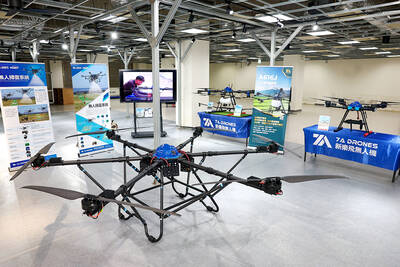
DRONE CENTRAL: Taiwan aims to become Asia’s democratic hub for drones, with most exports focused on high-quality military-grade models, an official said Taiwan’s drone industry is expected to expand significantly by 2030, producing 100,000 units per month and exporting half of them, the Ministry of Economic Affairs said yesterday. Current drone production capacity is about 15,000 units per month, but the industry can quickly scale up as demand increases, Industrial Development Administration Director-General Chiou Chyou-huey (邱求慧) told a news conference in Taipei. Taiwan’s drone output grew 2.5-fold last year to NT$12.9 billion (US$408.3 million) under a government program to develop the uncrewed vehicle sector, he said. The Executive Yuan in October last year approved plans to invest NT$44.2 billion into domestic production of uncrewed aerial
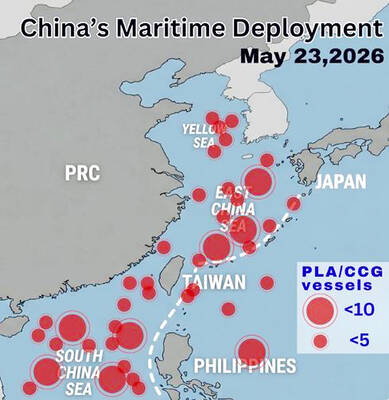
WARNING: China should stop engaging in actions that undermine regional peace and stability, as it would only build resentment among people across the Strait, the CGA said China has deployed more than 100 navy, coast guard and other vessels in waters from the Yellow Sea to the South China Sea and the western Pacific since US President Donald Trump and Chinese President Xi Jinping (習近平) met in Beijing, National Security Council Secretary-General Joseph Wu (吳釗燮) said yesterday. “In this part of the world, #China is the one & only PROBLEM wrecking the #StatusQuo & threatening regional peace & stability,” Wu wrote on X. In a separate post, he said Beijing was coercing Taiwan’s maritime domain, calling it illegal and provocative, after the Coast Guard Administration (CGA) expelled a
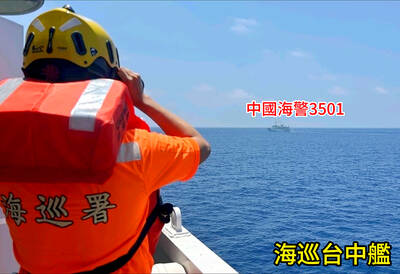
VERBOSE VESSELS: A CGA cutter and a China Coast Guard exchanged verbal barbs for more than a day in Taiwanese-controlled waters before the Chinese vessel left The Taiwanese and Chinese coast guards had a standoff near the strategically located Pratas Islands (Dongsha Islands, 東沙群島) in the north of the South China Sea, the Coast Guard Administration (CGA) said yesterday. The two sides engaged in intense radio exchanges over sovereignty claims during the 33-hour standoff. China Coast Guard vessel 3501 eventually left the restricted waters, 26.6 nautical miles (49.2km) west of the Pratas Islands, at 5pm yesterday, the CGA said. Lying approximately between southern Taiwan and Hong Kong, the Taiwan-controlled Pratas are seen by some security experts as vulnerable to Chinese attack due to their distance — more than
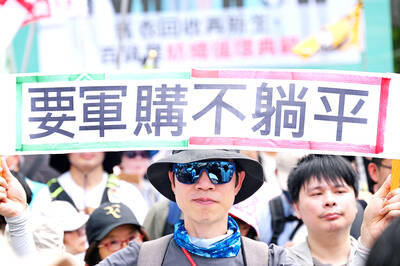
More than 8,000 people took part in a rally in Taipei yesterday to express support for more defense spending, after the opposition slashed the Cabinet’s proposed NT$1.25 trillion (US$39.6 billion) special defense budget and capped it at NT$780 billion. The demonstrators urged the Cabinet to propose another bill. Taiwan Economic Democracy Union convener Lai Chung-chiang (賴中強) said the main problem of the passed budget plan is the removal of funding for critical items, not just that the total amount is smaller. Critical budget items included purchasing or developing uncrewed vehicles, Strong Bow (強弓) missile systems, additional ammunition, artificial intelligence-powered combat systems and Taiwan-US


 RSS
RSS