


Leofoo Tourism Group (六福旅遊集團) said that its premier property, Westin Taipei (台北威斯汀六福皇宮), is to cease operations at the end of this year because it has failed to make positive earnings contributions for the past 20 years.
The group announced its decision on Tuesday after receiving notice from the property’s landlord, Cathay Life Insurance Co (國泰人壽), that the lease, due to expire on Dec. 31, would be terminated.
“We are grateful to all employees and customers for the past 20 years and will apply the experience and know-how we have learned to the group’s other hotel brands,” chief operating officer Lulu Chuang (莊豐如) said in a statement.
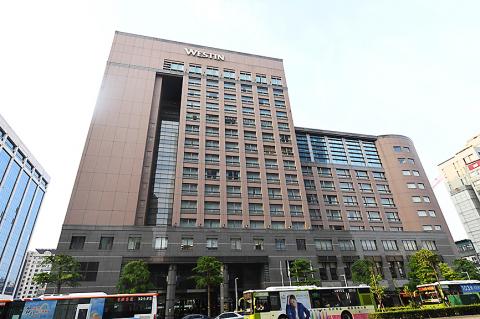
Photo: CNA
The high-end facility on Taipei’s Nanjing E Road had an occupancy rate of nearly 70 percent last year, with an average daily room rate of NT$6,387 (US$219), outperforming its local peers, Chuang said.
Despite the strong showing and assorted awards it has received, the hotel failed to make earnings contributions since its establishment in 1999, the statement said.
Westin Taipei has formed a task force to ensure the rights of customers would not be affected before the closure, it said, adding that it would continue to roll out discounts and promotions.
The group last month ended a contract to build an upscale resort hotel in Tainan.
Chuang last week said the group is seeking to restructure its finances this year in the hope of returning to profit next year.
Although Westin Taipei generated 39.74 percent, or NT$1.29 billion, of Leofoo Tourism Group’s annual revenue last year, it has been operating in the red, Chuang said.
Shuttering the lossmaking facility would not affect the company’s operations, but would free up resources for other endeavors, she said.
Apart from a slump in Taiwan’s tourism sector, the hotel has also been pressured by annual rental increases, leading to a net loss of NT$240 million last year, Chuang said.
In addition, Leofoo Tourism Group is facing NT$400 million in breach of contract penalties for its failure to meet dining revenue targets set by its landlord.
Cathay Life yesterday denied claims of rent increases.
The life insurer said that since the 20-year lease agreement with Westin Taipei was inked in 1999, the company had voluntarily cut the rent by 7.3 percent in 2004 in consideration of a SARS outbreak that year.
The rent was further reduced by 20 percent from 2009 to last year, the life insurer said.
Cathay Life said that it has committed significant resources to supply the land and build Westin Taipei, and that its leasing and profit-sharing arrangement are typical and structured to account for the risks it has taken on.
The life insurer, which is also a landlord to other hotels, said that it would renovate the 20-year-old property and seek new partnerships to improve asset utilization.
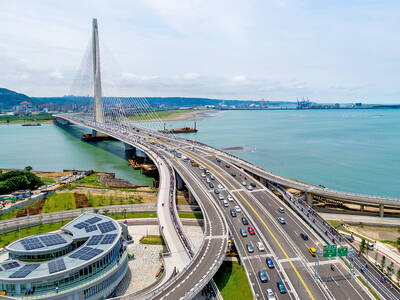
The Ministry of Transportation and Communications yesterday inaugurated the Danjiang Bridge across the Tamsui River in New Taipei City, saying that the structure would be an architectural icon and traffic artery for Taiwan. Feted as a major engineering achievement, the Danjiang Bridge is 920m long, 211m tall at the top of its pylon, and is the longest single-pylon asymmetric cable-stayed bridge in the world, the government’s Web site for the structure said. It was designed by late Iraqi-British architect Zaha Hadid. The structure, with a maximum deck of 70m, accommodates road and light rail traffic, and affords a 200m navigation channel for boats,
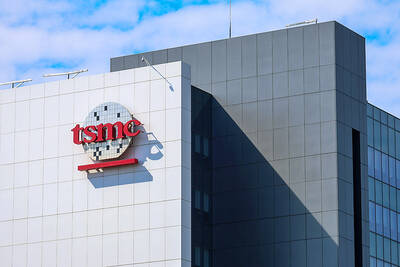
Taiwan Semiconductor Manufacturing Co (TSMC, 台積電), the world’s largest foundry service provider, yesterday said that global semiconductor revenue is projected to hit US$1.5 trillion in 2030, after the figure exceeds US$1 trillion this year, as artificial intelligence (AI) demand boosts consumption of token and compute power. “We are still at the beginning of the AI revolution, but we already see a significant impact across the whole semiconductor ecosystem,” TSMC deputy cochief operating officer Kevin Zhang (張曉強) said at the company’s annual technology symposium in Hsinchu City. “It is fair to say that in the past decade, smartphones and other mobile devices were
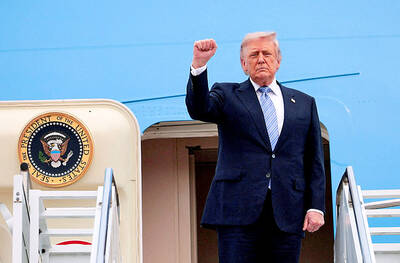
US-CHINA SUMMIT: MOFA welcomed US reassurance of no change in its Taiwan policy; Trump said he did not comment when Xi talked of opposing independence US President Donald Trump yesterday said he has not made a decision on whether to move forward with a major arms package for Taiwan after hearing concerns about it from Chinese President Xi Jinping (習近平). Trump’s comments on Taiwan came as he flew back to Washington after wrapping up critical talks in which both leaders said important progress was made in stabilizing US-China relations even as deep differences persist between the world’s two biggest powers on Iran and Taiwan. “I will make a determination,” Trump said, adding: “I’ll be making decisions. But, you know, I think the last thing we need right
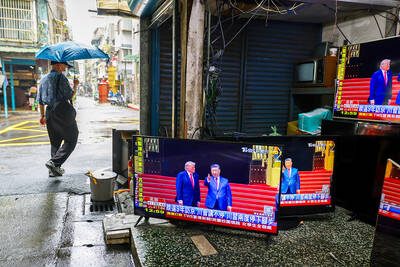
TAIWAN ISSUE: US treasury secretary Scott Bessent said on the first day of meetings that ‘it wouldn’t be a US-China summit without the Taiwan issue coming up’ There were no surprises on the first day of the summit between US President Donald Trump and Chinese President Xi Jinping (習近平), the Mainland Affairs Council (MAC) said yesterday, as the government reiterated that cross-strait stability is crucial to the Asia-Pacific region, as well as the world. As the two presidents met for a highly anticipated summit yesterday, Chinese state media reported that Xi warned Trump that missteps regarding Taiwan could push their two countries into “conflict.” Trump arrived in China with accolades for his host, calling Xi a “great leader” and “friend,” and extending an invitation to visit the White House


 RSS
RSS