


Taiwan is to join the international race to develop quantum technology, with one of the field’s key players — IBM Corp — agreeing to work with Taiwanese businesses, Minister of Science and Technology Chen Liang-gee (陳良基) said yesterday.
The Ministry of Science and Technology is to seek an annual budget of NT$70 million (US$2.4 million) over three to five years for quantum technology development, Chen said at a news conference in Taipei.
While digital computing encodes data into binary digits, quantum computation uses quantum bits that can exist in superposition states and process information more efficiently, Chen said, adding that the new technology could replace conventional computers based on silicon transistors in non-linear computing.
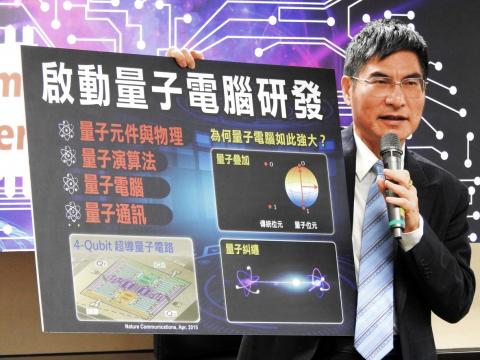
Photo courtesy of the Ministry of Science and Technology
Quantum technology development is mostly theoretical, but is expected to become widely applicable in code encryption and decryption, artificial intelligence, space technology, transportation and meteorology in the next 10 years, he said.
The technology can also be applied to analyze atomic and molecular structures, which is conducive to scientists developing new materials, the ministry’s Department of Engineering and Technologies Director-General Shawn Hsu (徐碩鴻) said.
It is likely that a scientist doing quantum research would win a Nobel prize this decade, Hsu added.
Developing quantum technology has turned into a global race.
In May 2016, the EU launched a “Quantum Manifesto,” calling on its member states to join its 1 billion euros (US$1.2 billion at the current exchange rate) “flagship-scale initiative” in quantum technology, due to begin this year.
US-funded research in the area is about US$200 million a year, while China — although its overall budget is unclear — is spending US$10 billion building its National Laboratory for Quantum Information Science, Bloomberg reported on Monday.
While Taiwan cannot compete with other nations in terms of research budget, it has the world’s largest industrial cluster of semiconductor firms, as well as a pool of technology talent, Chen said.
In addition to IBM, the ministry is seeking collaboration with Google LLC, Intel Corp and the nation’s key semiconductor suppliers, he said, while declining to name local firms that have expressed an interest in the project.
Academics and students of physics, electrical engineering and computer science are encouraged to join the initiative, Hsu said.
The ministry is to hold two seminars on quantum technology at National Cheng Kung University on Thursday next week and at National Taiwan University (NTU) on April 23, it said.
It also plans to invite US and Japanese professors to lecture on quantum technology later this year, Hsu said, adding that the lectures are likely to take place at NTU and National Tsing Hua University.

AGING: As of last month, people aged 65 or older accounted for 20.06 percent of the total population and the number of couples who got married fell by 18,685 from 2024 Taiwan has surpassed South Korea as the country least willing to have children, with an annual crude birthrate of 4.62 per 1,000 people, Ministry of the Interior data showed yesterday. The nation was previously ranked the second-lowest country in terms of total fertility rate, or the average number of children a woman has in her lifetime. However, South Korea’s fertility rate began to recover from 2023, with total fertility rate rising from 0.72 and estimated to reach 0.82 to 0.85 by last year, and the crude birthrate projected at 6.7 per 1,000 people. Japan’s crude birthrate was projected to fall below six,
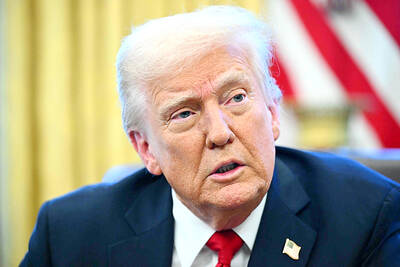
US President Donald Trump in an interview with the New York Times published on Thursday said that “it’s up to” Chinese President Xi Jinping (習近平) what China does on Taiwan, but that he would be “very unhappy” with a change in the “status quo.” “He [Xi] considers it to be a part of China, and that’s up to him what he’s going to be doing, but I’ve expressed to him that I would be very unhappy if he did that, and I don’t think he’ll do that. I hope he doesn’t do that,” Trump said. Trump made the comments in the context
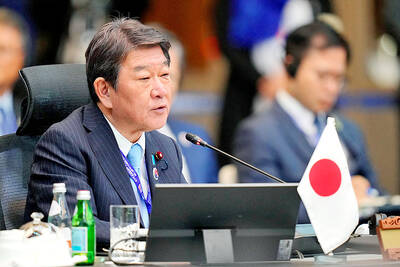
SELF-DEFENSE: Tokyo has accelerated its spending goal and its defense minister said the nation needs to discuss whether it should develop nuclear-powered submarines China is ramping up objections to what it sees as Japan’s desire to acquire nuclear weapons, despite Tokyo’s longstanding renunciation of such arms, deepening another fissure in the two neighbors’ increasingly tense ties. In what appears to be a concerted effort, China’s foreign and defense ministries issued statements on Thursday condemning alleged remilitarism efforts by Tokyo. The remarks came as two of the country’s top think tanks jointly issued a 29-page report framing actions by “right-wing forces” in Japan as posing a “serious threat” to world peace. While that report did not define “right-wing forces,” the Chinese Ministry of Foreign Affairs was

PREPAREDNESS: Given the difficulty of importing ammunition during wartime, the Ministry of National Defense said it would prioritize ‘coproduction’ partnerships A newly formed unit of the Marine Corps tasked with land-based security operations has recently replaced its aging, domestically produced rifles with more advanced, US-made M4A1 rifles, a source said yesterday. The unnamed source familiar with the matter said the First Security Battalion of the Marine Corps’ Air Defense and Base Guard Group has replaced its older T65K2 rifles, which have been in service since the late 1980s, with the newly received M4A1s. The source did not say exactly when the upgrade took place or how many M4A1s were issued to the battalion. The confirmation came after Chinese-language media reported


 RSS
RSS