


Author, politician and historian Li Ao (李敖) yesterday passed away peacefully after a battle with brain cancer, Taipei Veterans General Hospital said.
Li was 83 years old.
He had sought treatment at the hospital in July 2015, saying he had an unsteady gait, and was later diagnosed with brainstem gliomas.
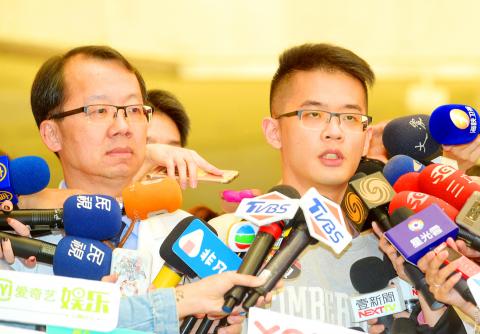
Photo: Chang Chia-ming, Taipei Times
His condition had stabilized after initial treatment, but he was readmitted to hospital several times last year.
In October last year, he was hospitalized for pneumonia, but a subsequent magnetic resonance imaging brain scan showed that his tumors had worsened.
Li began receiving targeted therapy in November and his condition improved.
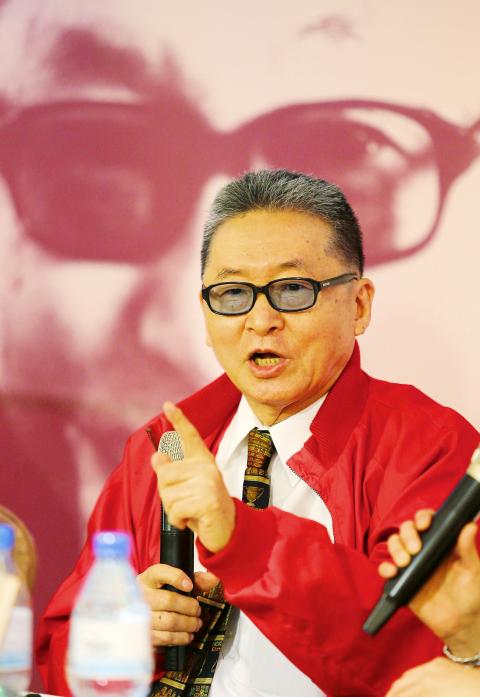
Photo: CNA
However, the therapy started to lose effect in January and his overall condition began to deteriorate, the hospital said.
His son, Li Kan (李戡), yesterday said his father had remained strong and resilient during his illness, adding that he discussed his disease with medical personnel jokingly.
Li Ao’s family would make his funeral as simple as possible and does not plan to hold any public remembrance activities, Li Kan said.
As a versatile writer with a piercing and critical style, Li Ao was best known for his studies on history, in addition to his political commentaries, biographies and literary works.
During the Chinese Nationalist Party’s (KMT) authoritarian regime, he was regarded as an intellectual heretic who fought for freedom of speech and publication.
His 96 works were banned by the KMT during the Martial Law period.
“Li Ao epitomizes a wish, an action, a symbol of rebellion for people in that era,” said Chen Fang-ming (陳芳明), a professor at National Chengchi University’s Graduate Institute of Taiwanese Literature.
“The era’s intellectuals were eager to watch his performance, but none dared to join his company,” Chen said. “He was more critical and radical than any self-esteemed leftists.”
“Without Li Ao, Taiwan under [the KMT’s] authoritarian regime might have had a harder time,” he added.
Li Ao worked for a while in real estate, served as editor-in-chief of Wen Hsing (文星) magazine, founded a publishing house named after himself, was a TV host and taught history at Soochow University.
He ran for president in the 2000 election on the New Party ticket, and was elected as a lawmaker in 2004.
Li Ao is a legend among his contemporaries, former legislative speaker Wang Jin-pyng (王金平) said yesterday, adding that he had “lost a good friend.”
Democratic Progressive Party caucus whip Ker Chien-ming (柯建銘) said he admired Li Ao’s polished, critical and solid writing, and that he inspired rebellious movements against the government.
People First Party caucus whip Lee Hung-chun (李鴻鈞) expressed his sorrow over Li Ao’s death.
The Executive Yuan offered its condolences to Li Ao’s family.
Executive Yuan spokesman Hsu Kuo-yung (徐國勇) said he and Premier William Lai (賴清德) served at the Legislative Yuan with Li Ao in 2004, and expressed sadness over his death.

LEVERAGE: China did not ‘need to fire a shot’ to deny Taiwan airspace over Africa when it owns ‘half the continent’s debt,’ a US official said, calling it economic warfare The EU has raised concerns about overflight rights following the delay of President William Lai’s (賴清德) planned state visit to the Kingdom of Eswatini after three African nations denied overflight clearance for his charter at the last minute. Taiwanese allies Paraguay and Saint Kitts and Nevis, as well as several US lawmakers and the Inter-Parliamentary Alliance on China (IPAC) condemned China for allegedly pressuring the countries. Lai was scheduled to fly directly to Taiwan’s only African ally from yesterday to Sunday to celebrate the 40th anniversary of King Mswati III’s accession and his 58th birthday, but Seychelles, Mauritius and Madagascar suddenly revoked
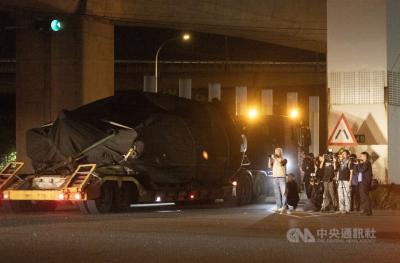
The final batch of 28 M1A2T Abrams tanks purchased from the US arrived at Taipei Port last night and were transported to the Armor Training Command in Hsinchu County’s Hukou Township (湖口), completing the military’s multi-year procurement of 108 of the tanks. Starting at 12:10am today, reporters observed more than a dozen civilian flatbed trailers departing from Taipei Port, each carrying an M1A2T tank covered with black waterproof tarps. Escorted by military vehicles, the convoy traveled via the West Coast Expressway to the Armor Training Command, with police implementing traffic control. The army operates about 1,000 tanks, including CM-11 Brave Tiger
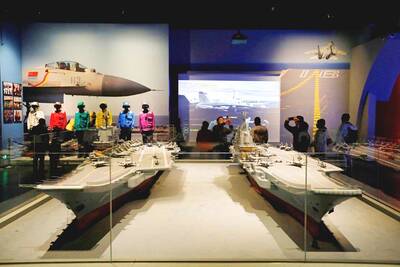
China on Wednesday teased in a video an aircraft carrier that could be its fourth, and the first using nuclear power, while making an allusion to Taiwan and vowing to further build up its islands, as it looks to boost maritime power, secure resources and bolster territorial claims. The video, issued on the eve of the 77th founding anniversary of the Chinese People’s Liberation Army Navy, featured fictional officers with names that are homophones of three commissioned aircraft carriers, the Liaoning (遼寧), Shandong (山東) and Fujian (福建). Titled Into the Deep, it showed a 19-year-old named “Hejian” (何劍) joining the group, sparking
BIG YEAR: The company said it would also release its A12 chip the same year to keep a ‘reliable stream of new silicon technologies’ flowing to its customers Taiwan Semiconductor Manufacturing Co (TSMC, 台積電) yesterday said its newest A13 chip is to enter volume production in 2029 as the chipmaker seeks to hold onto its tech leadership and demand for next-generation chips used in artificial intelligence (AI), high-performance-computing (HPC) and mobile applications. TSMC, the world’s biggest contract chipmaker, also unveiled its A12 chip at its annual technology symposium in Santa Clara, California. The A12 chip, which features TSMC’s super-power-rail technology to provide backside power delivery for AI and HPC applications, is also to enter volume production in 2029, a year after the scheduled release of the A14 chip. The technology moves


 RSS
RSS