


Controversial amendments to the Labor Standards Act (勞動基準法) yesterday cleared the legislature, with President Tsai Ing-wen (蔡英文) apologizing for the inconvenience caused by her administration’s two revisions of the act within a year.
Under the amended act, overtime pay is to remain at least 1.33 times a worker’s normal hourly wage for the first two hours and at least 1.66 times from the third hour onward on weekdays.
The rates are to remain at 2.33 and 2.66 times a worker’s normal rates if they are asked to work on their weekly “flexible” day off.
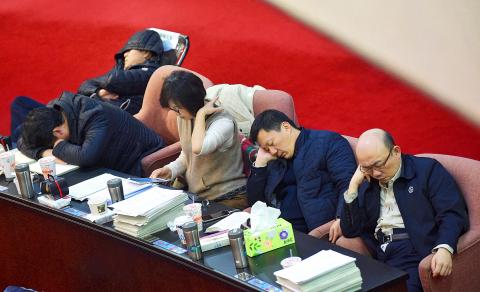
Photo: Liu Hsin-de, Taipei Times
However, workers would no longer be paid overtime in blocks of four hours, but by the actual number of hours they work.
Employers are allowed to raise the monthly overtime cap from 46 to 54 hours after gaining the consent of unions or their employees during employer-staff meetings and notifying the local labor authorities, with the proviso that employees must not be allowed to work more than 138 hours in three months.
Employees would also have the option of converting their overtime into compensatory leave, but if they are unable to use the compensatory in an agreed period of time or before their contract expires, their employer would be required to convert it back into an overtime payment.
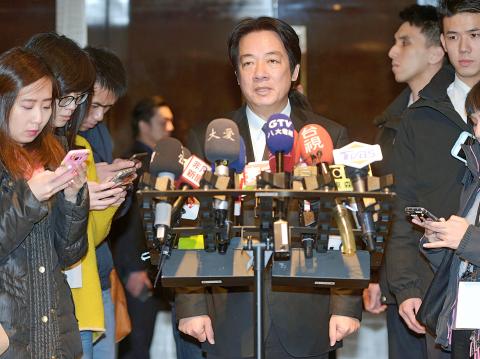
Photo: Chang Chia-ming, Taipei Times
The amended act stipulates that employees can roll unused annual leave over to the next year and that employers should convert remaining annual leave days into wages at the end of the second year.
Employers would be allowed to move an employee’s fixed weekly day off within a period of 14 days with the prerequisite that they have gained the approval of unions or employees.
Sectors wishing to adopt the measure would need to pass a review by the local authority and be designated by the Ministry of Labor as a sector that qualifies.
The aforementioned provisos also apply to an amendment that allows employers in approved sectors to shorten the rest time between shifts from 11 to eight hours.
The amendments are to take effect on March 1.
Following the bill being passed at 8:44am, Tsai issued a formal apology to the public for the social unrest caused by the second amendment to the act in a year.
While Premier William Lai (賴清德) has already apologized, Tsai said she felt she owed the public an apology as the head of her administration.
Tsai also thanked police for their hard work due to the protests the amendment provoked.
The controversy surrounding the bill, while causing some turmoil, nonetheless shows that Taiwan is a society willing to accommodate a plurality of opinions, she said.
The act would benefit employers and employees alike, and offer a substantial foundation for industrial transition, she said.
Chinese Nationalist Party (KMT) legislators apologized to workers nationwide over their failure to block the bill.
“We would like to apologize to more than 9 million workers nationwide. Despite our greatest efforts, we were unable to stop the Labor Standards Act from being sabotaged,” KMT caucus secretary-general Lin Wei-chou (林為洲) said.
“We could only do so much, but we truly hope that we can return to power in this year’s local elections and achieve what the central government could not,” KMT Legislator Chen Yi-ming said.

CHAOS: Iranians took to the streets playing celebratory music after reports of Khamenei’s death on Saturday, while mourners also gathered in Tehran yesterday Iranian Supreme Leader Ayatollah Ali Khamenei was killed in a major attack on Iran launched by Israel and the US, throwing the future of the Islamic republic into doubt and raising the risk of regional instability. Iranian state television and the state-run IRNA news agency announced the 86-year-old’s death early yesterday. US President Donald Trump said it gave Iranians their “greatest chance” to “take back” their country. The announcements came after a joint US and Israeli aerial bombardment that targeted Iranian military and governmental sites. Trump said the “heavy and pinpoint bombing” would continue through the week or as long
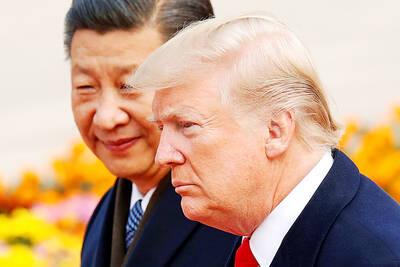
TRUST: The KMT said it respected the US’ timing and considerations, and hoped it would continue to honor its commitments to helping Taiwan bolster its defenses and deterrence US President Donald Trump is delaying a multibillion-dollar arms sale to Taiwan to ensure his visit to Beijing is successful, a New York Times report said. The weapons sales package has stalled in the US Department of State, the report said, citing US officials it did not identify. The White House has told agencies not to push forward ahead of Trump’s meeting with Chinese President Xi Jinping (習近平), it said. The two last month held a phone call to discuss trade and geopolitical flashpoints ahead of the summit. Xi raised the Taiwan issue and urged the US to handle arms sales to
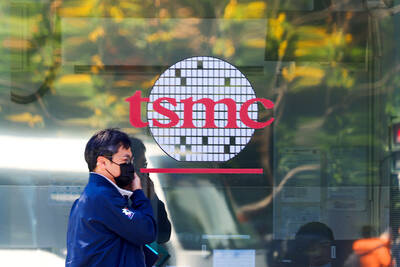
BIG SPENDERS: Foreign investors bought the most Taiwan equities since 2005, signaling confidence that an AI boom would continue to benefit chipmakers Taiwan Semiconductor Manufacturing Co’s (TSMC, 台積電) market capitalization swelled to US$2 trillion for the first time following a 4.25 percent rally in its American depositary receipts (ADR) overnight, putting the world’s biggest contract chipmaker sixth on the list of the world’s biggest companies by market capitalization, just behind Amazon.com Inc. The site CompaniesMarketcap.com ranked TSMC ahead of Saudi Aramco and Meta Platforms Inc. The Taiwanese company’s ADRs on Tuesday surged to US$385.75 on the New York Stock Exchange, as strong demand for artificial intelligence (AI) applications led to chip supply constraints and boost revenue growth to record-breaking levels. Each TSMC ADR represents

State-run CPC Corp, Taiwan (CPC, 台灣中油) yesterday said that it had confirmed on Saturday night with its liquefied natural gas (LNG) and crude oil suppliers that shipments are proceeding as scheduled and that domestic supplies remain unaffected. The CPC yesterday announced the gasoline and diesel prices will rise by NT$0.2 and NT$0.4 per liter, respectively, starting Monday, citing Middle East tensions and blizzards in the eastern United States. CPC also iterated it has been reducing the proportion of crude oil imports from the Middle East and diversifying its supply sources in the past few years in response to geopolitical risks, expanding


 RSS
RSS