


New Power Party (NPP) Executive Chairman Huang Kuo-chang (黃國昌) and four other NPP legislators yesterday continued their hunger strike in front of the Presidential Office Building, demanding that President Tsai Ing-wen (蔡英文) retract a draft amendment to the Labor Standards Act (勞動基準法), despite cold and rainy weather, pressure from police and no response from the president.
“Nothing has changed our minds,” Huang said, adding that they will continue to urge Tsai, who is also the Democratic Progressive Party (DPP) chairperson, and the DPP to retract the amendment in a peaceful and rational manner.
There was intermittent rain throughout the day. Huang, NPP caucus convener Hsu Yung-ming (徐永明) and NPP legislators Kawlo Iyun Pacidal, Hung Tsu-yung (洪慈庸) and Freddy Lim (林昶佐) all wore raincoats.
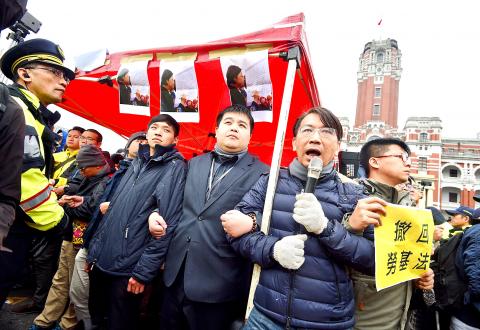
Photo: Peter Lo, Taipei Times
Behind them, the sentence “Retract the labor law amendment” was projected onto the Presidential Office Building.
The legislators arrived on Ketagalan Boulevard on Friday evening after their plan to stop the amendment by blocking access to the legislative chamber had failed.
Earlier yesterday, the legislators set up five tents with the help of party staffers, but four were soon removed by police.
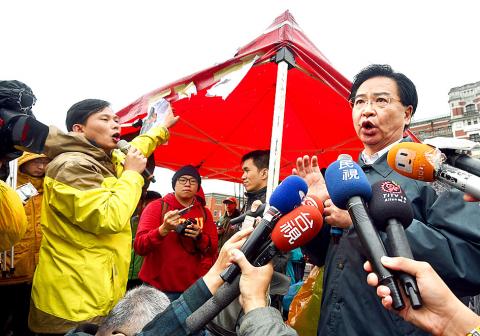
Photo: Peter Lo, Taipei Times
At about 11am, Presidential Office Secretary-General Joseph Wu (吳釗燮) arrived at the site of the protest and urged the legislators to end their demonstration and return to the Legislative Yuan.
Huang and other legislators refused, saying that the DPP has been abusing its legislative majority, preventing the amendment from being properly reviewed.
Police repeatedly asked the legislators to leave on the grounds that they were violating the Road Traffic Management and Penalty Act (道路交通管理處罰條例) and the Assembly and Parade Act (集會遊行法).
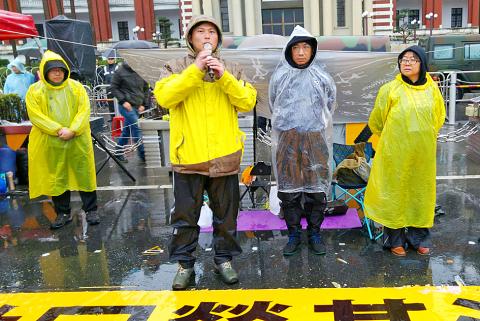
Photo: CNA
Demonstrations are restricted in the area, said Taipei City Police Department’s Zhongzheng First Precinct head Liao Tsai-chen (廖才楨). According to Article six of the Assemble and Parade Act, demonstrations near the Presidential Office are banned, unless approved by the Ministry of the Interior.
Police erected barriers along Hengyang Road (衡陽路), Gongyuan Road (公園路), Aiguo W Road (愛國西路) and Taiyuan Street (桃源街) to prevent more people from joining the protest.
As of press time last night, the hunger strike was still going on and the barricades were still in place.

FALSE DOCUMENTS? Actor William Liao said he was ‘voluntarily cooperating’ with police after a suspect was accused of helping to produce false medical certificates Police yesterday questioned at least six entertainers amid allegations of evasion of compulsory military service, with Lee Chuan (李銓), a member of boy band Choc7 (超克7), and actor Daniel Chen (陳大天) among those summoned. The New Taipei City District Prosecutors’ Office in January launched an investigation into a group that was allegedly helping men dodge compulsory military service using falsified medical documents. Actor Darren Wang (王大陸) has been accused of being one of the group’s clients. As the investigation expanded, investigators at New Taipei City’s Yonghe Precinct said that other entertainers commissioned the group to obtain false documents. The main suspect, a man surnamed

The government is considering polices to increase rental subsidies for people living in social housing who get married and have children, Premier Cho Jung-tai (卓榮泰) said yesterday. During an interview with the Plain Law Movement (法律白話文) podcast, Cho said that housing prices cannot be brought down overnight without affecting banks and mortgages. Therefore, the government is focusing on providing more aid for young people by taking 3 to 5 percent of urban renewal projects and zone expropriations and using that land for social housing, he said. Single people living in social housing who get married and become parents could obtain 50 percent more

DEMOGRAPHICS: Robotics is the most promising answer to looming labor woes, the long-term care system and national contingency response, an official said Taiwan is to launch a five-year plan to boost the robotics industry in a bid to address labor shortages stemming from a declining and aging population, the Executive Yuan said yesterday. The government approved the initiative, dubbed the Smart Robotics Industry Promotion Plan, via executive order, senior officials told a post-Cabinet meeting news conference in Taipei. Taiwan’s population decline would strain the economy and the nation’s ability to care for vulnerable and elderly people, said Peter Hong (洪樂文), who heads the National Science and Technology Council’s (NSTC) Department of Engineering and Technologies. Projections show that the proportion of Taiwanese 65 or older would

Democracies must remain united in the face of a shifting geopolitical landscape, former president Tsai Ing-wen (蔡英文) told the Copenhagen Democracy Summit on Tuesday, while emphasizing the importance of Taiwan’s security to the world. “Taiwan’s security is essential to regional stability and to defending democratic values amid mounting authoritarianism,” Tsai said at the annual forum in the Danish capital. Noting a “new geopolitical landscape” in which global trade and security face “uncertainty and unpredictability,” Tsai said that democracies must remain united and be more committed to building up resilience together in the face of challenges. Resilience “allows us to absorb shocks, adapt under


 RSS
RSS