


The Iranian government yesterday warned people against further protests after two days of demonstrations sparked by anger over an array of economic problems.
“We urge all those who receive these calls to protest not to participate in these illegal gatherings, as they will create problems for themselves and other citizens,” Iranian Minister of the Interior Abdolreza Rahmani Fazli said.
State broadcaster Islamic Republic of Iran News Network said it had been banned from covering the protests that on Thursday spread from Iran’s second city, Mashhad, to other areas.
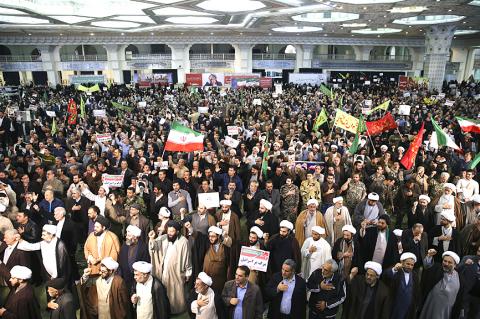
Photo: AP
The protests initially targeted economic problems, but quickly turned against the Muslim regime as a whole.
US President Donald Trump said “the world is watching” after dozens of demonstrators were arrested.
Media coverage inside Iran focused almost exclusively on pro-regime rallies held yesterday to mark the defeat of the last major protest movement in 2009.
The timing was coincidental, as the rallies are held every year on Dec. 30, but offered a handy show of strength to the regime as huge crowds of black-clad supporters gathered across the country.
“The enemy wants once again to create a new plot and use social media and economic issues to foment a new sedition,” Ayatollah Mohsen Araki told a crowd in Tehran, the conservative Fars news agency reported.
Video footage on social media showed hundreds marching through the holy city of Qom on Friday evening, with people chanting “Death to the dictator” and “Free political prisoners.”
There were even chants in favor of the monarchy toppled by the 1979 Islamic revolution, while others criticized the regime over its support of the Palestinians and other regional movements rather than focusing on problems at home.
Footage showed thousands gathered in cities including Rasht, Hamadan, Kermanshah and Qazvin, with police responding with water cannons.
Officials were quick to blame outside forces for the unrest.
“Although people have a right to protest, protesters must know how they are being directed,” Iranian Vice President for Women and Family Affairs Masoumeh Ebtekar said on Twitter.
Since the 2009 protests were ruthlessly put down by the Islamic Revolutionary Guard Corps, many middle-class Iranians have abandoned hope of pressing for change from the streets.
However, low-level strikes and demonstrations have continued, often on a sector-by-sector basis, as bus drivers, teachers or workers from specific factories protest against unpaid wages or poor conditions.
Some of this week’s protests were directed against financial scandals linked to unauthorized lending institutions that collapsed with the loss of hundreds of thousands of accounts.
Payam Parhiz, editor-in-chief of reformist Nazar media network that broke the news of the Mashhad protests, said they were more focused on the economy than those in 2009, which were sparked by allegations of election-rigging.
“Then, they were middle-class and their slogans went beyond economic matters to things like cultural liberties,” he told reporters. “Today, the concerns are economic. There are people who have lost their life savings. They will protest until their problems are resolved.”
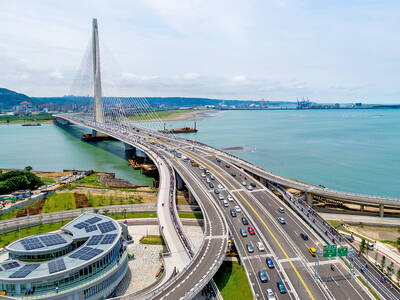
The Ministry of Transportation and Communications yesterday inaugurated the Danjiang Bridge across the Tamsui River in New Taipei City, saying that the structure would be an architectural icon and traffic artery for Taiwan. Feted as a major engineering achievement, the Danjiang Bridge is 920m long, 211m tall at the top of its pylon, and is the longest single-pylon asymmetric cable-stayed bridge in the world, the government’s Web site for the structure said. It was designed by late Iraqi-British architect Zaha Hadid. The structure, with a maximum deck of 70m, accommodates road and light rail traffic, and affords a 200m navigation channel for boats,
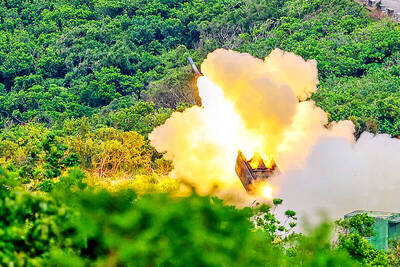
PRECISION STRIKES: The most significant reason to deploy HIMARS to outlying islands is to establish a ‘dead zone’ that the PLA would not dare enter, a source said A High Mobility Artillery Rocket System (HIMARS) would be deployed to Penghu County and Dongyin Island (東引) in Lienchiang County (Matsu) to force the Chinese military to retreat at least 100km from the coastline, a military source said yesterday. Taiwan has been procuring HIMARS and Army Tactical Missile Systems (ATACMS) from the US in batches. Once all batches have been delivered, Taiwan would possess 111 HIMARS units and 504 ATACMS, which have a range of 300km. Considering that “offense is the best defense,” the military plans to forward-deploy the systems to outlying islands such as Penghu and Dongyin so that
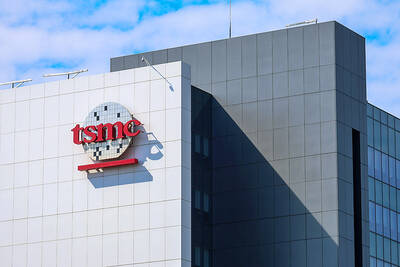
Taiwan Semiconductor Manufacturing Co (TSMC, 台積電), the world’s largest foundry service provider, yesterday said that global semiconductor revenue is projected to hit US$1.5 trillion in 2030, after the figure exceeds US$1 trillion this year, as artificial intelligence (AI) demand boosts consumption of token and compute power. “We are still at the beginning of the AI revolution, but we already see a significant impact across the whole semiconductor ecosystem,” TSMC deputy cochief operating officer Kevin Zhang (張曉強) said at the company’s annual technology symposium in Hsinchu City. “It is fair to say that in the past decade, smartphones and other mobile devices were

‘CLEAR MESSAGE’: The bill would set up an interagency ‘tiger team’ to review sanctions tools and other economic options to help deter any Chinese aggression toward Taiwan US Representative Young Kim has introduced a bill to deter Chinese aggression against Taiwan, calling for an interagency “tiger team” to preplan coordinated sanctions and economic measures in response to possible Chinese military or political action against Taiwan. “[Chinese President] Xi Jinping [習近平] has directed the People’s Liberation Army to be ready to invade Taiwan by 2027. China has a plan. America should have one too,” Kim said in a news release on Thursday last week. She introduced the “Deter PRC [People’s Republic of China] aggression against Taiwan act” to “ensure the US has a coordinated sanctions strategy ready should


 RSS
RSS