


The government should investigate the source of funding for the New Party’s plans to set up a liaison office in China and its legality, lawmakers said.
After leading a New Party delegation on a tour of China earlier this month, party Chairman Yok Mu-ming (郁慕明) wrote on Facebook that the party would set up an office in Shanghai.
Talks between the New Party and China’s Taiwan Affairs Office (TAO) have produced concrete results and they have reached a consensus on setting up a mechanism for timely communication on issues that involve the rights and interests of people on both sides of the Taiwan Strait, Yok wrote.
The party is to establish an ad hoc division that will deal with a corresponding unit on the Chinese side, Yok wrote.
It will prioritize serving Taiwanese who have “placed their hopes on the mainland,” Yok wrote, referring to China.
These people share the New Party’s ideals, are on the same path as the New Party and agree that both sides of the Taiwan Strait are one family, he wrote.
They seek peaceful unification with China and are against Taiwanese independence, he said, adding that the establishment of a liaison office would respect the boundaries and laws on both sides of the Taiwan Strait.
A government official who declined to be named said that the New Party’s establishment of a liaison office in Shanghai does not touch on public power and political issues.
The plan does not breach the Act Governing Relations Between the People of the Taiwan Area and the Mainland Area (兩岸人民關係條例) and is not regulated by the Political Party Act (政黨法), the official added.
It would be difficult to investigate whether Chinese resources are involved in the planned Shanghai office, but given that TAO officials have often been seen at election fundraising events held for Taiwanese businesspeople, it would be hard for people not to make the connection, the official said.
According to the Act Governing Relations Between the People of the Taiwan Area and the Mainland Area, agreements that involve the two sides of the Taiwan Strait must only be done by the central government, Democratic Progressive Party Legislator Wang Ding-yu (王定宇) said, adding that the New Party might be breaking the law.
Although the New Party and the TAO did not sign an agreement, the New Party said that talks between the two sides “produced concrete results” and “reached a consensus,” Wang said.
The New Party is obviously using other terms to avoid the word “agreement,” he said.
If the New Party bypasses and therefore nullifies the national government, it is China’s accomplice and pawn, he said.
If the government indulges the New Party now, the consequences will be severe in the future, he said.
The New Party claims government subsidies and if it uses those subsidies in its Chinese office, it would violate the law and the government should investigate, Wang said.
According to the Political Party Act, parties must declare their final accounts to the managing agency every year, he said.
As such, the Ministry of the Interior should ask the New Party to explain the revenue, expenditure and sources of its funds for the Shanghai office, Wang said.
The New Party wants those it services to declare their political stance, New Power Party Legislator Hsu Yung-ming (徐永明) said.
This is obviously a political differentiation and also part of China’s “united front” tactics, Hsu said.
With the functions of the Straits Exchange Foundation and the Mainland Affairs Council shrinking, the New Party might not only be providing a service to Taiwanese businesspeople and students in China in the future, he said.
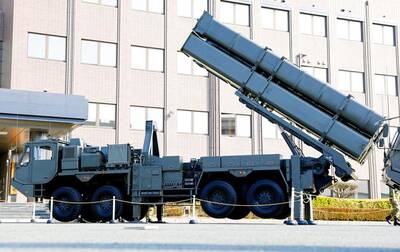
Japan has deployed long-range missiles in a southwestern region near China, the Japanese defense minister said yesterday, at a time when ties with Beijing are at their lowest in recent years. The missiles were installed in Kumamoto in the southern region of Kyushu, as Japan is attempting to shore up its military capacity as China steps up naval activity in the East China Sea. “Standoff defense capabilities enable us to counter the threat of enemy forces attempting to invade our country ... while ensuring the safety of our personnel,” Japanese Minister of Defense Shinjiro Koizumi said. “This is an extremely important initiative for
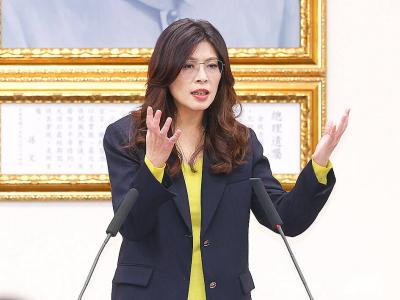
Chinese Nationalist Party (KMT) Chairwoman Cheng Li-wun (鄭麗文) today accepted an invitation from Chinese President Xi Jinping (習近平) to lead a delegation to China next month, saying she hopes to promote the peaceful development of cross-strait relations and bring stability to the Taiwan Strait. “I am grateful and happy to accept this invitation,” Cheng said in a statement from the KMT chairperson’s office. Cheng said she hopes both sides can work together to promote the peaceful development of cross-strait relations, enhance exchange and cooperation, bring stability to the Taiwan Strait and improve people’s livelihoods. At today's news conference, Cheng said any efforts to
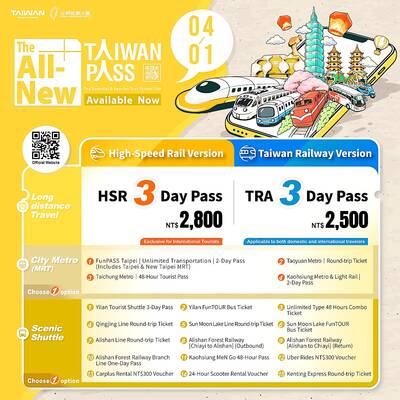
MORE POPULAR: Taiwan Pass sales increased by 59 percent during the first quarter compared with the same period last year, the Tourism Administration said The Tourism Administration yesterday said that it has streamlined the Taiwan Pass, with two versions available for purchase beginning today. The tourism agency has made the pass available to international tourists since 2024, allowing them to access the high-speed rail, Taiwan Railway Corp services, four MRT systems and four Taiwan Tourist Shuttles. Previously, five types of Taiwan Pass were available, but some tourists have said that the offerings were too complicated. The agency said only two types of Taiwan Pass would be available, starting from a three-day pass with the high-speed rail and a three-day pass with Taiwan Railway Corp. The former costs NT$2,800

The nation’s fastest supercomputer, Nano 4 (晶創26), is scheduled to be launched in the third quarter, and would be used to train large language models in finance and national defense sectors, the National Center for High-Performance Computing (NCHC) said. The supercomputer, which would operate at about 86.05 petaflops, is being tested at a new cloud computing center in the Southern Taiwan Science Park in Tainan. The exterior of the server cabinet features chip circuitry patterns overlaid with a map of Taiwan, highlighting the nation’s central position in the semiconductor industry. The center also houses Taiwania 2, Taiwania 3, Forerunner 1 and


 RSS
RSS