


In an impassioned address, Spanish Prime Minister Mariano Rajoy yesterday urged the Spanish Senate to grant special constitutional measures that would allow the central government to take control of Catalonia’s autonomous powers to halt the region’s independence bid.
However, in Barcelona, separatist lawmakers filed a proposal for Catalonia’s regional parliament to vote later in the day on whether to establish an independent republic, as Spain’s biggest political crisis in decades appeared headed for a showdown.
Thousands of pro-secession supporters gathered near the Barcelona’s parliament building in anticipation.

Photo: AFP
Rajoy, who received rapturous applause before and after his speech in the Senate in Madrid, told the chamber that Spain was facing a challenge not seen in its recent history.
What is happening in Catalonia is “a clear violation of the laws, of democracy, of the rights of all, and that has consequences,” he said.
Should the Senate approve the Spanish government’s use of Article 155 of the constitution in a vote scheduled for later yesterday, Madrid’s first move would be to dismiss Generalitat of Catalonia President Carles Puigdemont and his regional ministers, Rajoy said.
The special measures are the only way out of the crisis, he said, adding that Spain is not trying to take away liberties from Catalans, but instead protect them.
Catalonia’s government has rejected the moves by Madrid, and the region’s parliament was yesterday afternoon also to hold a special session.
Pro-independence lawmakers have submitted a proposal for declaring independence to the regional parliament.
“We establish the Catalan Republic as an independent and sovereign state of democratic and social rule of law,” the proposal submitted by the ruling Catalan coalition Junts pel Si (Together for Yes) and its allies of the far-left Candidatura d’Unitat Popular said.
Lawmakers from both parliamentary groups have a slim majority that would in theory allow them to pass the motion, if the parliament’s advisory board would allow it.
The motion calls for opening the constituent process, which includes drafting Catalonia’s new top laws, and to open negotiations “on equal footing” with Spanish authorities “aimed at establishing a mutually beneficial regime of cooperation.”
“Today is the day that many Catalans’ long-held desire will be fulfilled, but tomorrow the cruel reality will set in, with the Spanish state armed with its interpretation of Article 155,” said Joan Rigol i Roig, former speaker of the Catalan parliament. “We can only hope that the conflict remains in the political realm.”
If Rajoy’s measures are granted, it would be the first time in four decades of democratic rule that the Madrid-based national government would directly run the affairs of one of Spain’s 17 semi-autonomous regions.
As lawmakers headed to the regional parliament in Barcelona, large crowds of independence supporters gathered outside in a park, waving Catalan flags and chanting slogans in favor of a new state being proclaimed.
Puigdemont scrapped hopes of a possible end to the political deadlock on Thursday, when he opted not to call an early election and halt the drift toward independence.

Japan has deployed long-range missiles in a southwestern region near China, the Japanese defense minister said yesterday, at a time when ties with Beijing are at their lowest in recent years. The missiles were installed in Kumamoto in the southern region of Kyushu, as Japan is attempting to shore up its military capacity as China steps up naval activity in the East China Sea. “Standoff defense capabilities enable us to counter the threat of enemy forces attempting to invade our country ... while ensuring the safety of our personnel,” Japanese Minister of Defense Shinjiro Koizumi said. “This is an extremely important initiative for
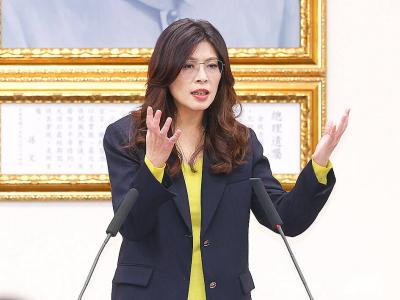
Chinese Nationalist Party (KMT) Chairwoman Cheng Li-wun (鄭麗文) today accepted an invitation from Chinese President Xi Jinping (習近平) to lead a delegation to China next month, saying she hopes to promote the peaceful development of cross-strait relations and bring stability to the Taiwan Strait. “I am grateful and happy to accept this invitation,” Cheng said in a statement from the KMT chairperson’s office. Cheng said she hopes both sides can work together to promote the peaceful development of cross-strait relations, enhance exchange and cooperation, bring stability to the Taiwan Strait and improve people’s livelihoods. At today's news conference, Cheng said any efforts to

MORE POPULAR: Taiwan Pass sales increased by 59 percent during the first quarter compared with the same period last year, the Tourism Administration said The Tourism Administration yesterday said that it has streamlined the Taiwan Pass, with two versions available for purchase beginning today. The tourism agency has made the pass available to international tourists since 2024, allowing them to access the high-speed rail, Taiwan Railway Corp services, four MRT systems and four Taiwan Tourist Shuttles. Previously, five types of Taiwan Pass were available, but some tourists have said that the offerings were too complicated. The agency said only two types of Taiwan Pass would be available, starting from a three-day pass with the high-speed rail and a three-day pass with Taiwan Railway Corp. The former costs NT$2,800

The nation’s fastest supercomputer, Nano 4 (晶創26), is scheduled to be launched in the third quarter, and would be used to train large language models in finance and national defense sectors, the National Center for High-Performance Computing (NCHC) said. The supercomputer, which would operate at about 86.05 petaflops, is being tested at a new cloud computing center in the Southern Taiwan Science Park in Tainan. The exterior of the server cabinet features chip circuitry patterns overlaid with a map of Taiwan, highlighting the nation’s central position in the semiconductor industry. The center also houses Taiwania 2, Taiwania 3, Forerunner 1 and


 RSS
RSS