


Cheng Chao-tsun (鄭兆村) yesterday added another gold medal to Taiwan’s tally at the Taipei Summer Universiade and set a Universiade javelin record of 91.36m, while Yang Chun-han (楊俊瀚) failed to live up to expectations after winning the men’s 100m on Thursday, finishing seventh in the men’s 200m final.
At press time last night, the nation’s athletes had won 17 gold medals, 22 silvers and 14 bronzes.
Huang Shih-feng (黃士鋒) took bronze in the men’s javelin final with a score of 86.64, while Germany’s Andreas Emil Hofmann took silver.
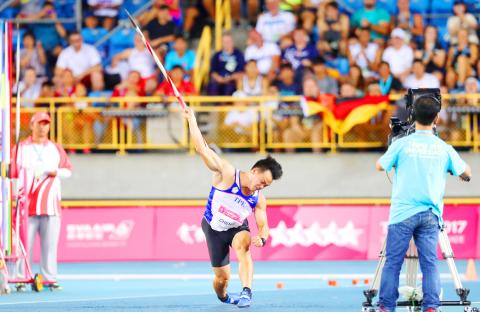
Photo: CNA
Cheng’s throw broke the previous Universiade record set by Italy’s Marius Corbett in 1997.
In the men’s 200m, Yang finished in 21.07 seconds.
The gold medal went to France’s Jeffrey John with a run of 20.93 seconds. Canada’s James Kenneth Linde took silver with 20.96 seconds, while Slovakia’s Jan Volko took bronze with 20.99 seconds.
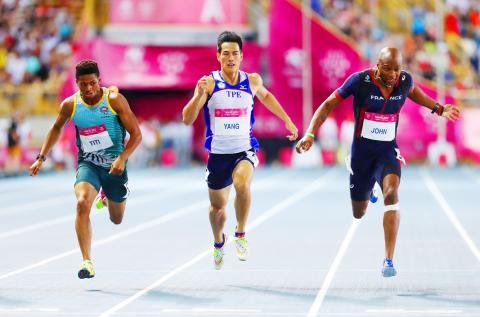
Photo: CNA
Chen Chieh (陳傑) won silver for Taiwan in the men’s 400m hurdles, clocking in at 49.05 seconds — tying his personal best.
The gold went to the Dominican Republic’s Juander Santos Aquino, who finished in 48.65 seconds.
In the women’s 200m final, Italy’s Irene Siragusa won gold with a personal best of 22.96 seconds, followed by Latvia’s Gunta Latiseva Cudare, who took silver with a personal best of 23.15 seconds, and Italy’s Anna Bongiorni won bronze with 23.47 seconds.
Photo: Lin Cheng-kung, Taipei Times
Chang Chia-feng’s (張珈鳳) time of 1 hour, 51 minutes, 31 seconds landed her in 12th place in the women’s 20km walk, which Ukraine’s Inna Kashyna won in 1 hour, 39 minutes, 44 seconds.
Taiwan had no representative in the men’s 20km walk, which was won by Japan’s Toshikazu Yamanishi in 1 hour, 27 minutes, 30 seconds.
Taiwan finished with one gold, five silver and three bronze medals in taekwondo after securing silver in men’s team kyorugi, losing to Russia in the final.
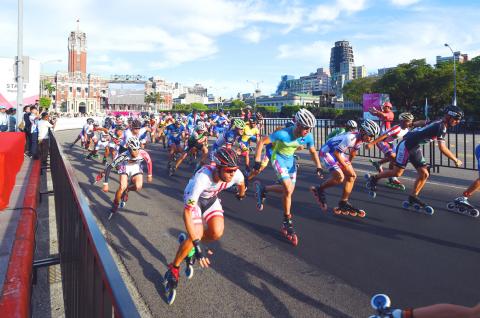
Photo: Chien Jung-fong Taipei Times
Yang Tsung-hua (楊宗燁), Liu Wei-ting (劉威廷), Huang Yu-jen (黃鈺仁) and Ho Chia-hsin (何嘉欣) faced off against Russia’s Maksat Allalyev, Bogdan Grechkin, Rafail Aiukaev and Bulat Magomedov, suffering a 20-34 loss.
Earlier yesterday in roller sports, Taiwan’s Yang Ho-chen (楊合貞) and Li Meng-chu (李孟竹) bagged gold and silver respectively in the women’s marathon final.
Yang finished the race in 1 hour, 27 minutes, 43.622 seconds, followed by Li in 1 hour, 27 minutes, 43.705 seconds and Colombia’s Maria Camila Guerra Guevara in third with 1 hour, 27 minutes, 44.399 seconds.
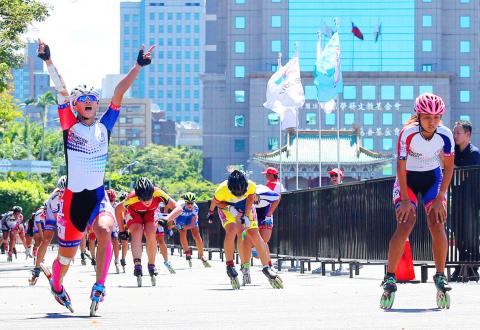
Photo: Chien Jung-fong, Taipei Times
In the women’s pole vault final, Belarus’ Iryna Zhuk took gold, while Germany’s Annika Roloff took silver and Portugal’s Marta Onofre won bronze. All three were tied with a score of 4.40.
In the women’s 100m hurdles final, the Netherlands’ Nadine Johanna Visser took gold with 12.98 seconds, followed by Belarus’ Elvira Herman in 13.17 seconds and Hungary’s Luca Kozak in 13.19 seconds.
Poland’s Malwina Kopron won gold in the women’s hammer final with a score of 76.85. Silver went to Belarus’ Hanna Malyshchyk with 74.93, while Poland’s Joanna Fiodorow took bronze with 71.33.
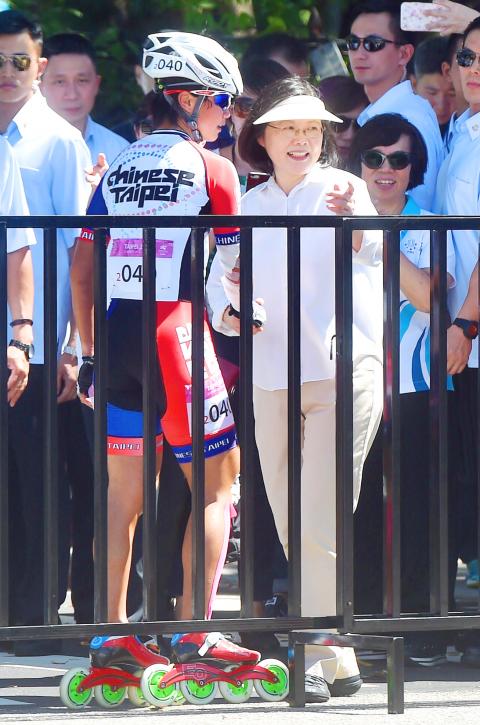
Photo: Chien Jung-fong Taipei Times
Korpron broke a record of 75.83 set by Germany’s Betty Heidler in 2009.
In women’s 3,000m steeplechase, Turkey’s Tugba Guvenc won gold in 9 minutes, 51.27 seconds, followed by Hungary’s Viktoria Gyuerkes in 9 minutes, 52.17 seconds and Turkey’s Ozlem Kaya in 9 minutes, 52.59 seconds.

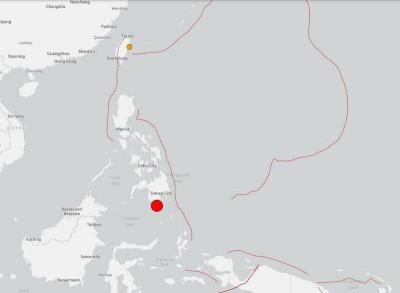
A magnitude 7.8 earthquake struck off the southern coast of Mindanao in the Philippines at 7:38am today, prompting the US Tsunami Warning System to issue an alert for neighboring countries, including Taiwan. The system issued a purple alert indicating a "tsunami threat." The potential threat zone includes Taiwan, the Philippines, Papua New Guinea, Yap and Palau. There were no immediate reports of major damage in the Philippines or Indonesia. The quake struck at a depth of 10km, said the German Research Centre for Geosciences, which had earlier pegged the earthquake at magnitude 8.2. Phivolcs, the Philippine agency, said the quake was magnitude 7 and
RESILIENCE: Taiwan plays a key role in semiconductors, energy, information infrastructure and advanced manufacturing, AIT Director Raymond Greene said Taiwan’s continued investment in deterrence and resilience remains vital, especially in uncrewed systems and other emerging technologies, American Institute in Taiwan (AIT) Director Raymond Greene said yesterday. Greene made the remarks at the annual National Strategic Summit on Supply Chain Resilience held by the Research Institute for Democracy, Society and Emerging Technology (DSET), a government-backed think tank. As Taiwan last year became the US’ fourth-largest trading partner and supply chain security is becoming more important, cooperation in emerging technologies continues to deepen between the two countries, he said. The US is committed to accelerating innovation, building key infrastructure, strengthening cooperation

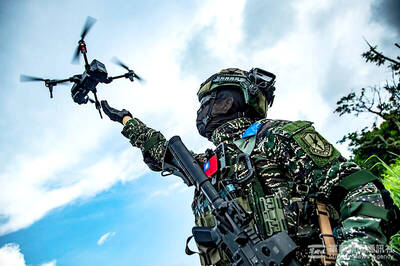
The National Chungshan Institute of Science and Technology yesterday showcased its locally developed variants of the Vision 60 robotic patrol dog, which it plans to deploy on the nation’s outlying territories in the South China Sea. The variants were produced under the Joint Lab project — created by the institute and domestic companies — and assembled with domestically produced motors, lenses and artificial intelligence (AI) systems alongside licensed tech from the US, Missile and Rocket Systems Research Division deputy director Jen Kuo-kang (任國光) told the media event at a military base in Taipei’s Dazhi (大直) area. Taiwan has built up its strengths

RIGHT DIRECTION: Taiwan’s efforts to prevent forced labor include a proposal to ‘fully prohibit’ employers from withholding workers’ documents, an official said Taiwan is to establish a mechanism to restrict imports of goods linked to forced labor, the Executive Yuan said yesterday, after the US proposed imposing additional tariffs on Taiwanese goods over labor concerns. “The Ministry of Labor and the Ministry of Economic Affairs are to establish an interministerial review procedure,” Executive Yuan spokesperson Michelle Lee (李慧芝) said at a news briefing in Taipei. “The government is to use the Foreign Trade Act [貿易法] as the legal basis to restrict imports of goods produced with forced labor” and bring its supply chain governance more in line with international standards on human rights, resilience


 RSS
RSS