


China has partially blocked the WhatsApp messaging service, as authorities tighten their grip on the Internet ahead of a major leadership reshuffle in Beijing.
Photographic, video and voice messages sent by the Guardian from Beijing were all blocked yesterday, but text messages were not affected. Dozens of users in China complained of a total ban on sending any type of messages on WhatsApp.
The ban comes as Chinese officials prepare for a twice-a-decade leadership shuffle later this year, with various factions within the Chinese Communist Party jockeying for control of key positions and Chinese President Xi Jinping (習近平) likely to further consolidate power.
China operates the world’s largest censorship system, known as the Great Firewall, blocking thousands of Web sites including platforms such as Facebook, Google, Instagram, YouTube and a host of foreign news outlets.
Xi, who came to power five years ago, has pushed for tighter government controls on what information Chinese citizens inside the country can access in the name of “cybersovereignty.”
In China, WhatsApp pales in popularity compared with homegrown messaging service WeChat, which has more than 900 million users, but the US app is increasingly being used by Chinese concerned about privacy or those communicating with friends or business contacts abroad.
While WhatsApp encrypts all messages, WeChat conversations are routinely monitored.
“It would not be surprising to find that everything on WhatsApp gets blocked, forcing users in China to use unencrypted, monitored and censored services like WeChat,” a Chinese censorship researcher known only by the pseudonym Charlie Smith said.
Before this week’s ban, WhatsApp was the only service owned by Facebook still accessible within China.
The social network has been blocked since ethnic riots in China’s far west in 2009, and Instagram was banned during pro-democracy protests in Hong Kong in 2014.
Facebook chief executive officer Mark Zuckerberg has made a high-profile push to get the company’s services unblocked, showering praise on Xi and other Chinese officials, but has little to show for his efforts so far.
Chinese authorities previously blocked messaging app Telegram after it became popular with the country’s human-rights lawyers.
Chinese censors were able to block messages and images in real time sent in private one-on-one chats in WeChat, a report by the University of Toronto’s Citizen Lab said.

Japan has deployed long-range missiles in a southwestern region near China, the Japanese defense minister said yesterday, at a time when ties with Beijing are at their lowest in recent years. The missiles were installed in Kumamoto in the southern region of Kyushu, as Japan is attempting to shore up its military capacity as China steps up naval activity in the East China Sea. “Standoff defense capabilities enable us to counter the threat of enemy forces attempting to invade our country ... while ensuring the safety of our personnel,” Japanese Minister of Defense Shinjiro Koizumi said. “This is an extremely important initiative for

Chinese Nationalist Party (KMT) Chairwoman Cheng Li-wun (鄭麗文) today accepted an invitation from Chinese President Xi Jinping (習近平) to lead a delegation to China next month, saying she hopes to promote the peaceful development of cross-strait relations and bring stability to the Taiwan Strait. “I am grateful and happy to accept this invitation,” Cheng said in a statement from the KMT chairperson’s office. Cheng said she hopes both sides can work together to promote the peaceful development of cross-strait relations, enhance exchange and cooperation, bring stability to the Taiwan Strait and improve people’s livelihoods. At today's news conference, Cheng said any efforts to
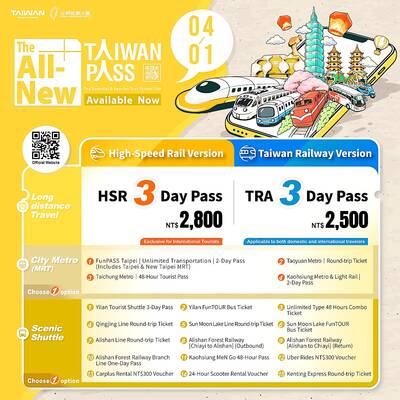
MORE POPULAR: Taiwan Pass sales increased by 59 percent during the first quarter compared with the same period last year, the Tourism Administration said The Tourism Administration yesterday said that it has streamlined the Taiwan Pass, with two versions available for purchase beginning today. The tourism agency has made the pass available to international tourists since 2024, allowing them to access the high-speed rail, Taiwan Railway Corp services, four MRT systems and four Taiwan Tourist Shuttles. Previously, five types of Taiwan Pass were available, but some tourists have said that the offerings were too complicated. The agency said only two types of Taiwan Pass would be available, starting from a three-day pass with the high-speed rail and a three-day pass with Taiwan Railway Corp. The former costs NT$2,800

The nation’s fastest supercomputer, Nano 4 (晶創26), is scheduled to be launched in the third quarter, and would be used to train large language models in finance and national defense sectors, the National Center for High-Performance Computing (NCHC) said. The supercomputer, which would operate at about 86.05 petaflops, is being tested at a new cloud computing center in the Southern Taiwan Science Park in Tainan. The exterior of the server cabinet features chip circuitry patterns overlaid with a map of Taiwan, highlighting the nation’s central position in the semiconductor industry. The center also houses Taiwania 2, Taiwania 3, Forerunner 1 and


 RSS
RSS