


A commemorative event was held in Taipei last night to mourn the passing of Chinese Nobel Peace Prize laureate Liu Xiaobo (劉曉波) as politicians stressed the importance of democracy and human rights.
Liu, sentenced to 11 years in jail in 2009 for “inciting subversion of state power” after he helped write a petition entitled Charter 08, which called for sweeping political reforms, died on Thursday after battling liver cancer. He was 61.
The commemoration, held in Liberty Square, was initiated by the New School for Democracy, an institution chaired by exiled Chinese democracy activist Wang Dan (王丹).
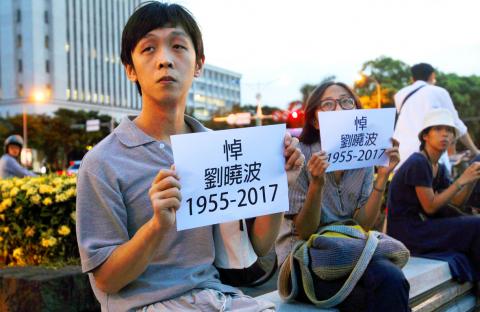
Photo: Chiang Ying-ying, AP
The group called for Beijing to release all those imprisoned for speaking out against the Chinese Communist Party.
Earlier, Kaohsiung Mayor Chen Chu (陳菊) said it was sad to hear of Liu’s passing, offering her condolences for Liu’s 28 years of house arrest and imprisonment, adding that “only those who have been in jail can understand.”
Chen herself served six years and two months in prison for her participation in the Formosa Incident, a pro-democracy demonstration organized by Formosa Magazine on Dec. 10, 1979.
“No one should be imprisoned for expressing a different view using any method,” she said. “Liu’s struggles and his adherence to his ideals reminds us that freedom and democracy do not fall out of the sky. Freedom and democracy cannot be retained without effort spent to safeguard it.”
Taipei Mayor Ko Wen-je (柯文哲) said that China is constantly criticized by other nations for being “barbaric” and that it should endeavor to improve its human rights record.
“Should China be willing, Taiwan is an excellent example of a success story and we hope that Chinese, one day, will enjoy freedom and democracy,” Ko said. “This is what [China] needs to work on.”
Former president Ma Ying-jeou (馬英九) wrote on Facebook that while the world mourned the passing of Liu, China should seek to improve its record on freedom and human rights, both to live up to its position as a “great power” and the “Chinese dream.”
Meanwhile, in response to President Tsai Ing-wen’s (蔡英文) remarks on Thursday that Taiwan hoped China could show self-confidence and promote political reform following the death of the Nobel laureate, Beijing yesterday accused Tsai of aggravating tension across the Taiwan Strait.
China’s Taiwan Affairs Office spokesman Ma Xiaoguang (馬曉光) was quoted by Xinhua news agency as saying that such “reckless” comments were “very dangerous” for cross-strait relations and were an example of Tsai’s “repeated arbitrary attacks.”
He said Tsai and the Democratic Progressive Party had “lifted the deceptive veil” of maintaining the “status quo” in cross-strait relations and that the repeated attacks were an attempt to regress ties to “tension and turbulence.”
“Such behavior is very dangerous,” he said, according to the Xinhua report, which was published only in English.
Additional reporting by Peng Wan-hsin and agencies
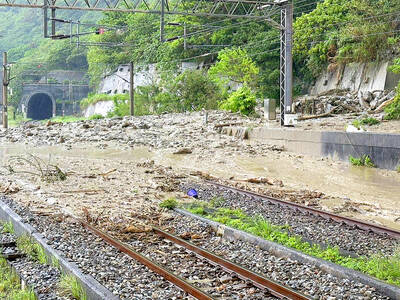
ROLLER-COASTER RIDE: More than five earthquakes ranging from magnitude 4.4 to 5.5 on the Richter scale shook eastern Taiwan in rapid succession yesterday afternoon Back-to-back weather fronts are forecast to hit Taiwan this week, resulting in rain across the nation in the coming days, the Central Weather Administration said yesterday, as it also warned residents in mountainous regions to be wary of landslides and rockfalls. As the first front approached, sporadic rainfall began in central and northern parts of Taiwan yesterday, the agency said, adding that rain is forecast to intensify in those regions today, while brief showers would also affect other parts of the nation. A second weather system is forecast to arrive on Thursday, bringing additional rain to the whole nation until Sunday, it
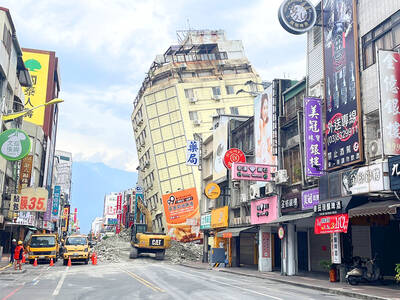
LANDSLIDES POSSIBLE: The agency advised the public to avoid visiting mountainous regions due to more expected aftershocks and rainfall from a series of weather fronts A series of earthquakes over the past few days were likely aftershocks of the April 3 earthquake in Hualien County, with further aftershocks to be expected for up to a year, the Central Weather Administration (CWA) said yesterday. Based on the nation’s experience after the quake on Sept. 21, 1999, more aftershocks are possible over the next six months to a year, the agency said. A total of 103 earthquakes of magnitude 4 on the local magnitude scale or higher hit Hualien County from 5:08pm on Monday to 10:27am yesterday, with 27 of them exceeding magnitude 5. They included two, of magnitude

CONDITIONAL: The PRC imposes secret requirements that the funding it provides cannot be spent in states with diplomatic relations with Taiwan, Emma Reilly said China has been bribing UN officials to obtain “special benefits” and to block funding from countries that have diplomatic ties with Taiwan, a former UN employee told the British House of Commons on Tuesday. At a House of Commons Foreign Affairs Committee hearing into “international relations within the multilateral system,” former Office of the UN High Commissioner for Human Rights (OHCHR) employee Emma Reilly said in a written statement that “Beijing paid bribes to the two successive Presidents of the [UN] General Assembly” during the two-year negotiation of the Sustainable Development Goals. Another way China exercises influence within the UN Secretariat is

Taiwan’s first drag queen to compete on the internationally acclaimed RuPaul’s Drag Race, Nymphia Wind (妮妃雅), was on Friday crowned the “Next Drag Superstar.” Dressed in a sparkling banana dress, Nymphia Wind swept onto the stage for the final, and stole the show. “Taiwan this is for you,” she said right after show host RuPaul announced her as the winner. “To those who feel like they don’t belong, just remember to live fearlessly and to live their truth,” she said on stage. One of the frontrunners for the past 15 episodes, the 28-year-old breezed through to the final after weeks of showcasing her unique


 RSS
RSS