


A group of US-based activists has started searching the official archives of the US government and the UN for Taiwanese historical materials to publish them for free on the Internet.
Technology is the centerpiece of the project, as the software the group is developing would enable volunteers to scan and upload historical documents with their mobile devices, Lin Yu-Cheng (林育正), a project leader and a self-styled house-husband, said on Sunday.
Funded via the Web-based transparency activism platform G0V and other private sources, the Taiwan National Treasure initiative was formally launched at the New York G0V Hackathon event in September last year.
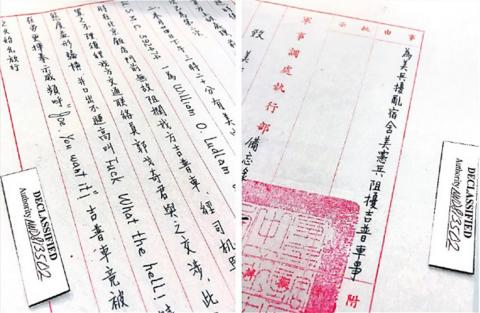
Photo courtesy of Taiwan National Treasure
The initiative uses Facebook — via the page Taiwan National Treasure (國家寶藏) — to communicate with volunteers and donors.
The aim of the project is help Taiwanese gain a better understanding of their history by seeing the nation from the perspective of foreign governments through primary-source documents, Lin said.
The project’s leaders include tech entrepreneur Hsiao Hsin-cheng (蕭新晟) and assistant research professor of pharmacology at State University of New York Downstate Medical Center Abraham Chuang (莊士杰).
Since most of the volunteers are US-based, they are focusing on the depositories of the US National Archives and Records and Administration (NARA) and the UN Archives and Management Section (ARMS), Lin said.
When asked to comment on the project, Chuang said he had friends were affected by the wansei controversy that erupted last year.
He was referring to Chen Hsuan-ju (陳宣儒), who falsely claimed Japanese ancestry to promote her 2014 book Wansei Back Home (灣生回家) — written using the nom de plume Mika Tanaka — and a resulting documentary about Japanese born in Taiwan during the Japanese colonial era.
“Following the incident, my friends in New York and I began to wonder about the veracity of Taiwanese history — from the colonial period to the lifting of martial law — as it is told to us by textbooks, popular titles and the media. Who are the interpreters of Taiwanese history? Should we trust them uncritically?” Chuang said.
The Taiwan National Treasure initiative is a long-term project aimed at collecting important historical documents about Taiwan that are in foreign archives, guided by open data and democratic participation, he said.
Volunteers, including professional historians, have visited the National Archive in College Park, Maryland, in search of declassified documents about Taiwan, tens of millions of which are believed to be in the collection, he said.
The College Park depository, which is close to Washington, collects and stores documents flowing into the US government in the Washington area.
The records range from intelligence reports, records on Taiwan’s geography and hydrography and complications of statistics and surveys gathered from the Taiwanese media during the 1950s, to reports on Taiwanese literary figures, he said.
While some documents might repeat familiar findings, more data must have derived from the original collection efforts by the US government that promise new insights into Taiwanese history, he said.
Some of the data is likely to diverge from the accounts of Taiwanese authorities or interpret events from an outside perspective, with assessments that are likely to be more objective at times, Chuang said.
A mobile app — described as a work in progress — is aimed at helping volunteers digitize documents and transform them into an open data resource, which would help other people and institutions who are researching Taiwanese history, he said.
Volunteers are making regular research trips to the National Archive and the UN ARMS office in New York, Chuang said.
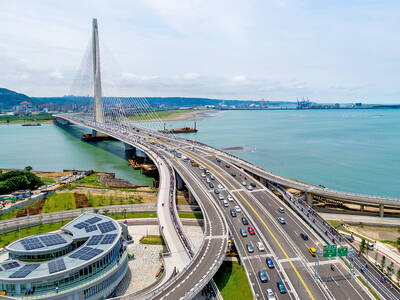
The Ministry of Transportation and Communications yesterday inaugurated the Danjiang Bridge across the Tamsui River in New Taipei City, saying that the structure would be an architectural icon and traffic artery for Taiwan. Feted as a major engineering achievement, the Danjiang Bridge is 920m long, 211m tall at the top of its pylon, and is the longest single-pylon asymmetric cable-stayed bridge in the world, the government’s Web site for the structure said. It was designed by late Iraqi-British architect Zaha Hadid. The structure, with a maximum deck of 70m, accommodates road and light rail traffic, and affords a 200m navigation channel for boats,
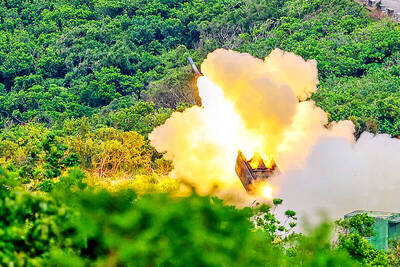
PRECISION STRIKES: The most significant reason to deploy HIMARS to outlying islands is to establish a ‘dead zone’ that the PLA would not dare enter, a source said A High Mobility Artillery Rocket System (HIMARS) would be deployed to Penghu County and Dongyin Island (東引) in Lienchiang County (Matsu) to force the Chinese military to retreat at least 100km from the coastline, a military source said yesterday. Taiwan has been procuring HIMARS and Army Tactical Missile Systems (ATACMS) from the US in batches. Once all batches have been delivered, Taiwan would possess 111 HIMARS units and 504 ATACMS, which have a range of 300km. Considering that “offense is the best defense,” the military plans to forward-deploy the systems to outlying islands such as Penghu and Dongyin so that
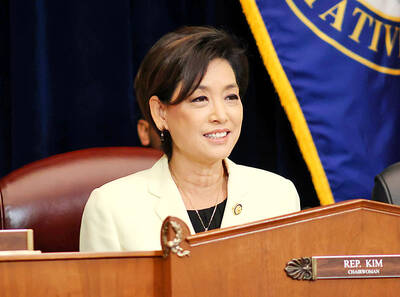
‘CLEAR MESSAGE’: The bill would set up an interagency ‘tiger team’ to review sanctions tools and other economic options to help deter any Chinese aggression toward Taiwan US Representative Young Kim has introduced a bill to deter Chinese aggression against Taiwan, calling for an interagency “tiger team” to preplan coordinated sanctions and economic measures in response to possible Chinese military or political action against Taiwan. “[Chinese President] Xi Jinping [習近平] has directed the People’s Liberation Army to be ready to invade Taiwan by 2027. China has a plan. America should have one too,” Kim said in a news release on Thursday last week. She introduced the “Deter PRC [People’s Republic of China] aggression against Taiwan act” to “ensure the US has a coordinated sanctions strategy ready should

TAIWAN ISSUE: US treasury secretary Scott Bessent said on the first day of meetings that ‘it wouldn’t be a US-China summit without the Taiwan issue coming up’ There were no surprises on the first day of the summit between US President Donald Trump and Chinese President Xi Jinping (習近平), the Mainland Affairs Council (MAC) said yesterday, as the government reiterated that cross-strait stability is crucial to the Asia-Pacific region, as well as the world. As the two presidents met for a highly anticipated summit yesterday, Chinese state media reported that Xi warned Trump that missteps regarding Taiwan could push their two countries into “conflict.” Trump arrived in China with accolades for his host, calling Xi a “great leader” and “friend,” and extending an invitation to visit the White House


 RSS
RSS