


Publisher and former national policy adviser Rex How (郝明義) yesterday called for a public debate with Premier Lin Chuan (林全) over the government’s Forward-looking Infrastructure Development Program, whose review process he said lacked in transparency, while the Executive Yuan criticized How for “stigmatizing” the plan with false accusations.
A signature drive launched by How and a group of campaigners to petition for an open debate on the NT$882.49 billion (US$29 billion) project has collected more than 5,000 signatures, and How yesterday invited Premier Lin Chuan (林全) to debate the project with experts.
The government has failed to explain its plans in detail and in the program’s official document a description of just 313 characters was provided for an MRT project in Kaohsiung that would cost NT$145.47 billion, How said.

Photo: CNA
A draft act on the program received the approval of a legislative committee, but not a single word of the act was modified, How said.
In the next phase of the legislative review, the draft is to be discussed at cross-caucus negotiations, a process criticized for its lack of transparency, so a public debate with the premier is needed to ensure transparency and sufficient discussion, How said.
At a meeting last month, How asked Lin to report to the legislature during the extraordinary legislative session, but Lin refused, saying it would “disrupt the [legislative] system” and his report would be “obstructed by opposition parties.”
He invited Lin to take part in a televised debate, where there would be no interference from opposition parties, How said.
The Forward-looking Infrastructure Development Program does not exclude the possibility of large-scale expropriations, despite Lin promising no such actions would be taken, New Power Party Executive Chairman Huang Kuo-chang (黃國昌) said, adding that the premier should answer doubts raised regarding the project.
Meanwhile, Executive Yuan spokesman Hsu Kuo-yung (徐國勇) said the official document of the project is a 370-page report with detailed descriptions of each infrastructure project, but How had cited a simplified version to create a false impression and “stigmatize” the plans.
The premier would not dodge public scrutiny and would report to the Legislative Yuan when the plan’s budget proposals are being reviewed, but not when the draft act for the project is being reviewed, Hsu said.
Only two MRT projects involve large-scale expropriations — an MRT line in New Taipei City’s Sindian District (新店) and another in Taoyuan — but those projects and the expropriations were approved prior to the program, Hsu said.
No large-scale expropriation is required for other infrastructure projects, he said.
Cross-caucus negotiation is a formal legislative discussion with review functions, Hsu said, calling on critics of the plan to be rational when debating the project.
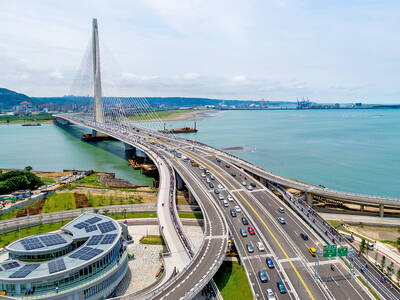
The Ministry of Transportation and Communications yesterday inaugurated the Danjiang Bridge across the Tamsui River in New Taipei City, saying that the structure would be an architectural icon and traffic artery for Taiwan. Feted as a major engineering achievement, the Danjiang Bridge is 920m long, 211m tall at the top of its pylon, and is the longest single-pylon asymmetric cable-stayed bridge in the world, the government’s Web site for the structure said. It was designed by late Iraqi-British architect Zaha Hadid. The structure, with a maximum deck of 70m, accommodates road and light rail traffic, and affords a 200m navigation channel for boats,
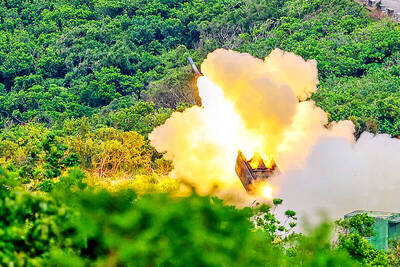
PRECISION STRIKES: The most significant reason to deploy HIMARS to outlying islands is to establish a ‘dead zone’ that the PLA would not dare enter, a source said A High Mobility Artillery Rocket System (HIMARS) would be deployed to Penghu County and Dongyin Island (東引) in Lienchiang County (Matsu) to force the Chinese military to retreat at least 100km from the coastline, a military source said yesterday. Taiwan has been procuring HIMARS and Army Tactical Missile Systems (ATACMS) from the US in batches. Once all batches have been delivered, Taiwan would possess 111 HIMARS units and 504 ATACMS, which have a range of 300km. Considering that “offense is the best defense,” the military plans to forward-deploy the systems to outlying islands such as Penghu and Dongyin so that

Taiwan Semiconductor Manufacturing Co (TSMC, 台積電), the world’s largest foundry service provider, yesterday said that global semiconductor revenue is projected to hit US$1.5 trillion in 2030, after the figure exceeds US$1 trillion this year, as artificial intelligence (AI) demand boosts consumption of token and compute power. “We are still at the beginning of the AI revolution, but we already see a significant impact across the whole semiconductor ecosystem,” TSMC deputy cochief operating officer Kevin Zhang (張曉強) said at the company’s annual technology symposium in Hsinchu City. “It is fair to say that in the past decade, smartphones and other mobile devices were

‘CLEAR MESSAGE’: The bill would set up an interagency ‘tiger team’ to review sanctions tools and other economic options to help deter any Chinese aggression toward Taiwan US Representative Young Kim has introduced a bill to deter Chinese aggression against Taiwan, calling for an interagency “tiger team” to preplan coordinated sanctions and economic measures in response to possible Chinese military or political action against Taiwan. “[Chinese President] Xi Jinping [習近平] has directed the People’s Liberation Army to be ready to invade Taiwan by 2027. China has a plan. America should have one too,” Kim said in a news release on Thursday last week. She introduced the “Deter PRC [People’s Republic of China] aggression against Taiwan act” to “ensure the US has a coordinated sanctions strategy ready should


 RSS
RSS