


Former vice president Wu Den-yih (吳敦義) yesterday became the new Chinese Nationalist Party (KMT) chairman after securing more than 140,000 votes of the 272,682 cast in the election.
The KMT announced that Wu had garnered 144,408 votes, representing 52.24 percent of those cast, to win the six-way election.
Wu is to assume the position on Aug. 20 for a term of four years.

Photo: Chien Jung-fong, Taipei Times
Outgoing KMT Chairwoman Hung Hsiu-chu (洪秀柱), the runner-up, obtained 53,063 votes, followed by former KMT vice chairman Hau Lung-bin (郝龍斌) with 44,301 votes.
Former KMT vice chairman Steve Chan (詹啟賢) had 12,332 votes, while former Taipei Agricultural Products Marketing Corp (台北農產公司) general manager Han Kuo-yu (韓國瑜) and former KMT legislator Pan Wei-kang (潘維剛) obtained 16,141 votes and 2,437 votes respectively.
KMT headquarters said that voter turnout was 58.03 percent — a 1.71 percent increase compared with last year’s KMT chairperson election, which had a turnout of 56.34 percent, the lowest in the party’s history.
Yesterday’s election saw the lowest-ever voter turnout among 12,724 KMT members living overseas, with only 5,127 voting.
The party has a total of 476,147 members.
Hung led Wu in the overseas vote by a razor-thin margin by winning 2,323 votes, compared with Wu’s 2,069 votes, while Hau trailed in third with 409 votes.
Hau last night issued a statement conceding defeat and saying that he hopes the KMT would promote harmony among its members and that the party has a prosperous future.
Hung also conceded defeat last night, calling on party members to unit behind the new party chairman.
On Facebook, Chan issued a statement saying that “the members have voted” and that he would like to wish the party “all the best.”
Chan hinted that he is preparing his next career move in the KMT, saying that he would “see his supporters soon.”
Han thanked his supporters, and said that he had not fought hard enough in the campaign.
According to the KMT’s charter, if no single candidate obtains 50 percent of the votes, a run-off election would have to be held between the top two candidates. Democratic Progressive Party (DPP) spokesman Chang Chih-hao (張志豪) congratulated Wu on behalf of the DPP, saying that the party hopes Wu would adopt a nonpartisan stance in his endeavors to help the nation bring about reform.
After his win, Wu declared in a speech that the KMT would adhere to the “1992 consensus” if it wins the 2020 national elections.
The “1992 consensus” refers to a supposed understanding reached during the cross-strait talks in 1992 that Beijing and the Chinese Nationalist Party acknowledge that there is “one China,” with each side having its own interpretation of what that means.
In 2006, former Mainland Affairs Council chairman Su Chi (蘇起) admitted he made up the term “1992 consensus” in 2000, before the KMT handed power to the Democratic Progressive Party.
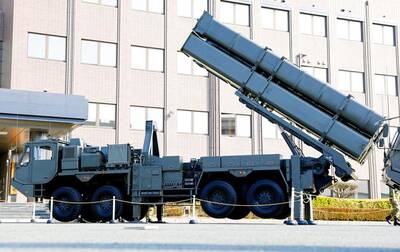
Japan has deployed long-range missiles in a southwestern region near China, the Japanese defense minister said yesterday, at a time when ties with Beijing are at their lowest in recent years. The missiles were installed in Kumamoto in the southern region of Kyushu, as Japan is attempting to shore up its military capacity as China steps up naval activity in the East China Sea. “Standoff defense capabilities enable us to counter the threat of enemy forces attempting to invade our country ... while ensuring the safety of our personnel,” Japanese Minister of Defense Shinjiro Koizumi said. “This is an extremely important initiative for
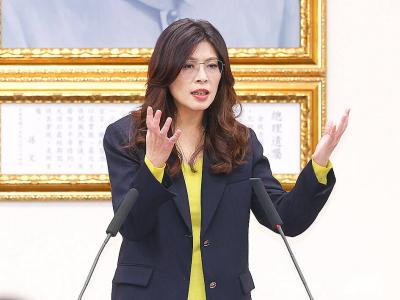
Chinese Nationalist Party (KMT) Chairwoman Cheng Li-wun (鄭麗文) today accepted an invitation from Chinese President Xi Jinping (習近平) to lead a delegation to China next month, saying she hopes to promote the peaceful development of cross-strait relations and bring stability to the Taiwan Strait. “I am grateful and happy to accept this invitation,” Cheng said in a statement from the KMT chairperson’s office. Cheng said she hopes both sides can work together to promote the peaceful development of cross-strait relations, enhance exchange and cooperation, bring stability to the Taiwan Strait and improve people’s livelihoods. At today's news conference, Cheng said any efforts to
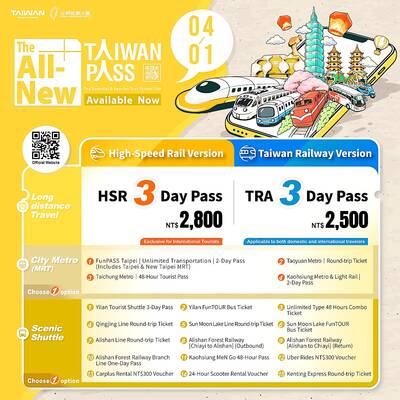
MORE POPULAR: Taiwan Pass sales increased by 59 percent during the first quarter compared with the same period last year, the Tourism Administration said The Tourism Administration yesterday said that it has streamlined the Taiwan Pass, with two versions available for purchase beginning today. The tourism agency has made the pass available to international tourists since 2024, allowing them to access the high-speed rail, Taiwan Railway Corp services, four MRT systems and four Taiwan Tourist Shuttles. Previously, five types of Taiwan Pass were available, but some tourists have said that the offerings were too complicated. The agency said only two types of Taiwan Pass would be available, starting from a three-day pass with the high-speed rail and a three-day pass with Taiwan Railway Corp. The former costs NT$2,800

The nation’s fastest supercomputer, Nano 4 (晶創26), is scheduled to be launched in the third quarter, and would be used to train large language models in finance and national defense sectors, the National Center for High-Performance Computing (NCHC) said. The supercomputer, which would operate at about 86.05 petaflops, is being tested at a new cloud computing center in the Southern Taiwan Science Park in Tainan. The exterior of the server cabinet features chip circuitry patterns overlaid with a map of Taiwan, highlighting the nation’s central position in the semiconductor industry. The center also houses Taiwania 2, Taiwania 3, Forerunner 1 and


 RSS
RSS