


The US Navy abandoned efforts to convict a Taiwan-born US Navy officer of spying for Taiwan or China, on Thursday striking a plea deal that instead portrays him as arrogant and willing to reveal military secrets to impress women.
The agreement was a marked retreat from last year’s accusations that Lieutenant Commander Edward Lin (林介良) gave or attempted to give classified information to representatives of a foreign government.
However, it still appears to end the impressive military career of a man who immigrated to the US at 14.
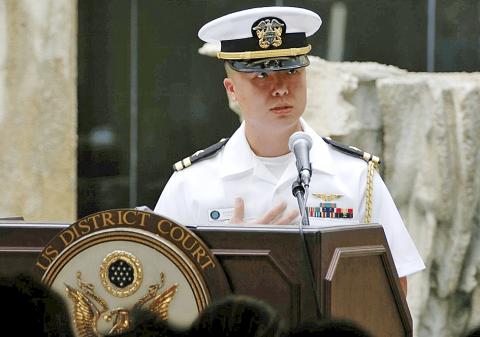
Photo: Sarah Murphy/U.S. Navy via AP
Lin joined the staff of an assistant secretary of the navy in Washington and was later assigned to a unit in Hawaii that flies reconnaissance aircraft.
Lin, 40, now faces dismissal from the navy and up to 36 years in prison at his sentencing, scheduled for early next month.
At the day-long court martial in Norfolk, Lin admitted that he failed to disclose friendships with people in Taiwan’s military and connected to its government.
He also conceded that he shared defense information with women he said he was trying to impress. One of them is Janice Chen, an American registered in the US as a foreign agent of Taiwan’s government, specifically the Democratic Progressive Party.
Lin said he and Chen often discussed news articles she e-mailed him about military affairs.
He admitted that he shared classified information about the navy’s Pacific Fleet with her.
He also divulged secrets to a woman named “Katherine Wu,” whom he believed worked as a contractor for the Ministry of Foreign Affairs. She was actually an undercover FBI agent.
“I was trying to let her know that the military profession in the United States is an honorable and noble one,” Lin told US Navy Commander Robert Monahan, the military judge.
He said the military is less prestigious in Taiwan.
Lin also had friends with other connections, including a woman living in China whom he met online, and a Chinese massage therapist who moved to Hawaii.
Lin said he gave the massage therapist a “large sum of money” at one point, although he did not say why.
He also admitted to lying to superiors about flying to Taiwan and planning to visit China.
However, Lin said he did it only to avoid the bureaucracy that a US military official must endure when traveling to a foreign nation.
“Sir, I was arrogant,” he told Monahan.
A navy news release about Lin’s attendance at his naturalization ceremony in Hawaii in December 2008 said he was 14 when he and his family left Taiwan.
“I always dreamed about coming to America, the ‘promised land,’” Lin was quoted as saying. “I grew up believing that all the roads in America lead to Disneyland.”

FREEDOM OF NAVIGATION: The UK would continue to reinforce ties with Taiwan ‘in a wide range of areas’ as a part of a ‘strong unofficial relationship,’ a paper said The UK plans to conduct more freedom of navigation operations in the Taiwan Strait and the South China Sea, British Secretary of State for Foreign, Commonwealth and Development Affairs David Lammy told the British House of Commons on Tuesday. British Member of Parliament Desmond Swayne said that the Royal Navy’s HMS Spey had passed through the Taiwan Strait “in pursuit of vital international freedom of navigation in the South China Sea.” Swayne asked Lammy whether he agreed that it was “proper and lawful” to do so, and if the UK would continue to carry out similar operations. Lammy replied “yes” to both questions. The
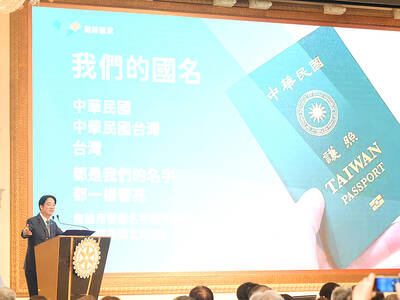
‘OF COURSE A COUNTRY’: The president outlined that Taiwan has all the necessary features of a nation, including citizens, land, government and sovereignty President William Lai (賴清德) discussed the meaning of “nation” during a speech in New Taipei City last night, emphasizing that Taiwan is a country as he condemned China’s misinterpretation of UN Resolution 2758. The speech was the first in a series of 10 that Lai is scheduled to give across Taiwan. It is the responsibility of Taiwanese citizens to stand united to defend their national sovereignty, democracy, liberty, way of life and the future of the next generation, Lai said. This is the most important legacy the people of this era could pass on to future generations, he said. Lai went on to discuss
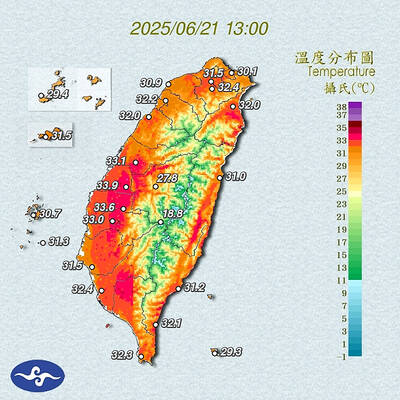
AMENDMENT: Climate change is expected to increase the frequency of high-temperature days, affecting economic productivity and public health, experts said The Central Weather Administration (CWA) is considering amending the Meteorological Act (氣象法) to classify “high temperatures” as “hazardous weather,” providing a legal basis for work or school closures due to extreme heat. CWA Administrator Lu Kuo-chen (呂國臣) yesterday said the agency plans to submit the proposed amendments to the Executive Yuan for review in the fourth quarter this year. The CWA has been monitoring high-temperature trends for an extended period, and the agency contributes scientific data to the recently established High Temperature Response Alliance led by the Ministry of Environment, Lu said. The data include temperature, humidity, radiation intensity and ambient wind,

SECOND SPEECH: All political parties should work together to defend democracy, protect Taiwan and resist the CCP, despite their differences, the president said President William Lai (賴清德) yesterday discussed how pro-Taiwan and pro-Republic of China (ROC) groups can agree to maintain solidarity on the issue of protecting Taiwan and resisting the Chinese Communist Party (CCP). The talk, delivered last night at Taoyuan’s Hakka Youth Association, was the second in a series of 10 that Lai is scheduled to give across Taiwan. Citing Taiwanese democracy pioneer Chiang Wei-shui’s (蔣渭水) slogan that solidarity brings strength, Lai said it was a call for political parties to find consensus amid disagreements on behalf of bettering the nation. All political parties should work together to defend democracy, protect Taiwan and resist


 RSS
RSS