


US Secretary of State Rex Tillerson tore into a 2015 nuclear deal with Iran, saying it only delayed the nation’s ambition to gain weapons of mass destruction, and did not take into account its role in sponsoring terrorism and destabilizing other nations.
“This deal represents the same failed approach of the past,” Tillerson said on Wednesday at a hastily arranged news conference in Washington.
The tough talk followed the most tangible step taken by Tillerson on Iran: certifying to the US Congress late on Tuesday that the Islamic Republic is complying with the terms of the nuclear deal, a finding required by law every 90 days.
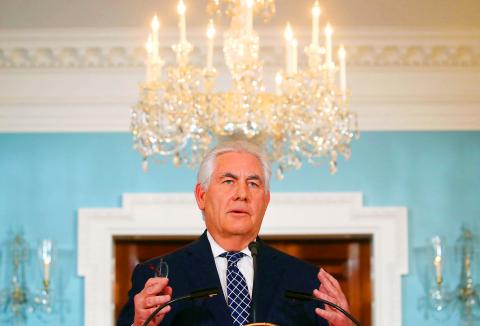
Photo: AFP
Tillerson’s announcement was the strongest signal to date that US President Donald Trump might walk away from the nuclear deal.
Trump this week ordered his National Security Council to review whether to reimpose sanctions that were eased under the accord because of Iran’s continued support of terrorism.
Tillerson said in his statement that the review would determine whether the suspension of sanctions “is vital to the national security interests of the United States.”
“Worn-out US accusations can’t mask its admission of Iran’s compliance” with the nuclear agreement, which is forcing the US administration “to change course and fulfill its own commitments,” Iranian Minister of Foreign Affairs Javad Zarif yesterday said on his Twitter account.
Trump has panned what he has called “the horrible Iran deal” reached by the US and five other world powers under his predecessor, former US president Barack Obama.
During last year’s presidential campaign, he called for dismantling or renegotiating it.
Republicans in the US Congress have also been critical, advocating new sanctions on Iran for supporting terrorism and for its ballistic missile program.
Under the international agreement, Iran is allowed to enrich and store some uranium for energy production, although it had to reduce its uranium stockpile by 96 percent, idle many of its enrichment centrifuges and pour concrete into its heavy-water nuclear reactor.
The Obama administration insisted the provisions would slow the time it would take Iran to produce nuclear weapons.
Opponents of the agreement have called for renegotiating the accord with the goal of making permanent its 15-year moratorium on uranium enrichment close to the level needed to make a bomb, but reimposing sanctions that were explicitly tied to Iran’s nuclear program — as Tillerson suggested in his announcement — would face particular opposition from the US’ European allies and give the government in Tehran grounds to walk away from the accord.
“The deal is working and there’s absolutely no reason to pull away from it,” Barbara Slavin, acting director at the Future of Iran Initiative at the Atlantic Council in Washington, said in an interview on Wednesday. “The US would be isolated from the rest of the world. Iran is abiding by it.”
She said the review was a fig leaf to cover a decision by the Trump administration to abide by the Iran accord, if grudgingly.
“Every administration, when it doesn’t know what the hell to do, reviews things,” Slavin said.
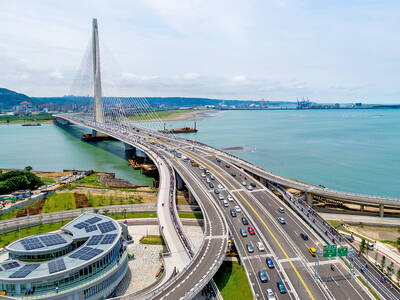
The Ministry of Transportation and Communications yesterday inaugurated the Danjiang Bridge across the Tamsui River in New Taipei City, saying that the structure would be an architectural icon and traffic artery for Taiwan. Feted as a major engineering achievement, the Danjiang Bridge is 920m long, 211m tall at the top of its pylon, and is the longest single-pylon asymmetric cable-stayed bridge in the world, the government’s Web site for the structure said. It was designed by late Iraqi-British architect Zaha Hadid. The structure, with a maximum deck of 70m, accommodates road and light rail traffic, and affords a 200m navigation channel for boats,
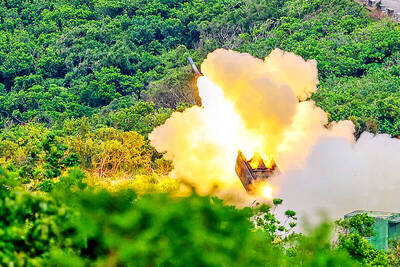
PRECISION STRIKES: The most significant reason to deploy HIMARS to outlying islands is to establish a ‘dead zone’ that the PLA would not dare enter, a source said A High Mobility Artillery Rocket System (HIMARS) would be deployed to Penghu County and Dongyin Island (東引) in Lienchiang County (Matsu) to force the Chinese military to retreat at least 100km from the coastline, a military source said yesterday. Taiwan has been procuring HIMARS and Army Tactical Missile Systems (ATACMS) from the US in batches. Once all batches have been delivered, Taiwan would possess 111 HIMARS units and 504 ATACMS, which have a range of 300km. Considering that “offense is the best defense,” the military plans to forward-deploy the systems to outlying islands such as Penghu and Dongyin so that
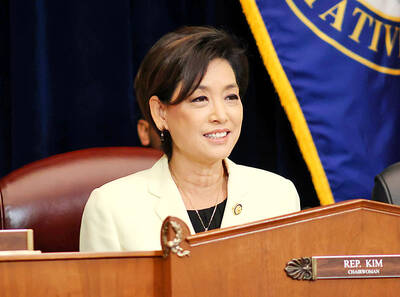
‘CLEAR MESSAGE’: The bill would set up an interagency ‘tiger team’ to review sanctions tools and other economic options to help deter any Chinese aggression toward Taiwan US Representative Young Kim has introduced a bill to deter Chinese aggression against Taiwan, calling for an interagency “tiger team” to preplan coordinated sanctions and economic measures in response to possible Chinese military or political action against Taiwan. “[Chinese President] Xi Jinping [習近平] has directed the People’s Liberation Army to be ready to invade Taiwan by 2027. China has a plan. America should have one too,” Kim said in a news release on Thursday last week. She introduced the “Deter PRC [People’s Republic of China] aggression against Taiwan act” to “ensure the US has a coordinated sanctions strategy ready should
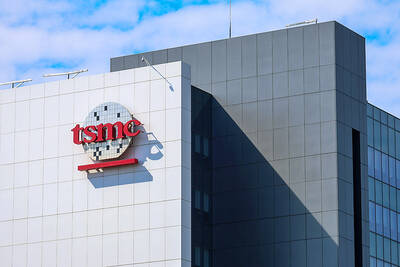
Taiwan Semiconductor Manufacturing Co (TSMC, 台積電), the world’s largest foundry service provider, yesterday said that global semiconductor revenue is projected to hit US$1.5 trillion in 2030, after the figure exceeds US$1 trillion this year, as artificial intelligence (AI) demand boosts consumption of token and compute power. “We are still at the beginning of the AI revolution, but we already see a significant impact across the whole semiconductor ecosystem,” TSMC deputy cochief operating officer Kevin Zhang (張曉強) said at the company’s annual technology symposium in Hsinchu City. “It is fair to say that in the past decade, smartphones and other mobile devices were


 RSS
RSS