


Thousands of retired police and firefighters paralyzed Taipei rush-hour traffic yesterday, occupying a crucial intersection after protesting pension reform outside numerous government buildings.
Protesters converged on the corner of Zhongshan and Zhongxiao roads next to Taipei Main Station and the Executive Yuan building, occupying the site for most of the afternoon before dispersing at about 6pm.
“Now that we have spread out, police cannot do anything, because they have to protect the Executive Yuan and Control Yuan,” said Chen Jui-chun (陳瑞群) of the National Federation of Teachers Unions, shortly after members of the Hsinchu County Retired Police Officers Association and other groups started fanning out across the intersection.
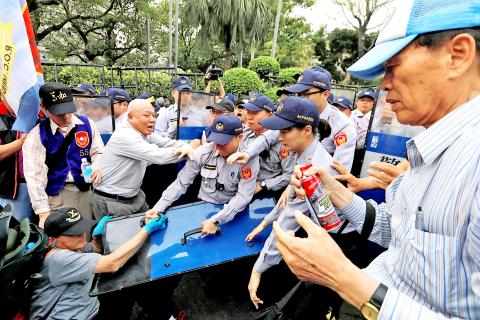
Photo: Reuters
The crowd quickly swelled after protest coordinators rallied demonstrators outside other government buildings.
“We will stay put until the Executive Yuan sends out a deputy minister, a secretary-general or Minister Without Portfolio Lin Wan-i (林萬億) to meet with us,” said Wu Sz-huai (吳斯懷), a retired lieutenant general who served as one of the demonstration’s main spokespeople.
“If you try to disperse us, you should first lock up all of the Sunflower movement protesters — why are they allowed to occupy, but not us?” said Lu Chao-tsai (盧朝財), the “commander” of Citizens for Recalling Tsai Ing-wen (蔡英文) through loudspeakers on one of the protester’s two official vehicles. “The roads belong to the people and were paid for with our tax money — what right do you have to drive us off?”
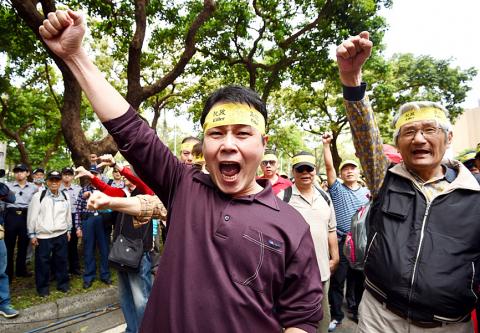
Photo: Peter Lo, Taipei Times
One of the first actions of Premier Lin Chuan’s (林全) administration was to drop official lawsuits against the Sunflower movement activists who occupied the Legislative Yuan in 2014 to protest a trade in services agreement with China.
Protesters periodically grappled with police, pushing a line of police officers into barricades outside the Executive Yuan before Keng Chi-wen (耿繼文), a former director of the National Police Agency’s Internal Affairs Office, announced a retreat after being warned by police to disperse.
“You can stay, but our vehicle is leaving,” he said, in response to protester shouts that he was “abandoning” them.
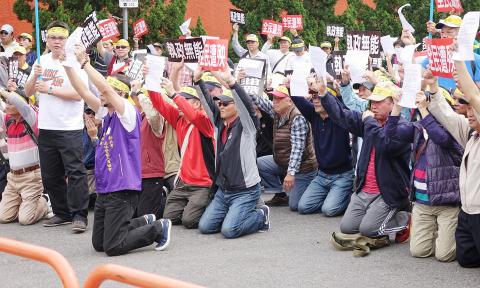
Photo: Liu Hsin-de, Taipei Times
Crowd resolve wavered before the Changhua County Military Personnel, Civil Servants and Teachers Alliance arrived, who engaged in a brief standoff with police outside the Executive Yuan before announcing a final retreat.
Shortly after protesters first occupied the intersection, members of the Hualien Civil Servant’s Association and the Hualien Retired Police Officer’s Association had also torn apart a roadblock across Qingdao E Road, bordering the Legislative Yuan, pushing their way through a police shield line to temporarily occupy the road next to a Legislative Yuan side gate.
Association members had earlier attempted to tip over barricades around the Examination Yuan using ropes.
Protesters began congregating outside the Ministry of the Interior early in the afternoon, repeatedly clashing with police before moving on to the Legislative Yuan, with separate groups also protesting outside the Ministry of Education and the Control Yuan.
They wore headbands calling Tsai a “killer,” repeatedly shouting for her to step down.
“Do not pat us on the head — that is not what we came here for,” Yunlin County Retired Police Officers Association executive director Lai Kun-yu (賴坤柚) said, calling for retired police officers to be compensated for overtime work and a shortage of government contributions to pension funds.
The Taiwan Police, Firemen and Other Occupations Alliance, which coordinated the protest, issued a list of 10 demands, calling for the government to honor its “contractual obligations” and stop seeking to impose an ex post facto law.
“If the government does not keep its word, how can it require private corporations to meet their own contractual obligations to workers?” a Changhua County Military Personnel, Civil Servants and Teachers Alliance member surnamed Yang (楊) said.
“The government has not done a good job of managing its own budget and is instead choosing to target those of us who have served many people and given decades of our lives, going back on its word after we retired,” a man surnamed Lei (雷) said. “They are violating their contractual obligations because they do not view us as part of their base — so it is no big deal to sacrifice our interests.”
More than 200 retirees had earlier gathered outside of the National Revolutionary Martyrs’ Shrine for a morning protest prior to an annual memorial ceremony, waving petitions and falling to their knees as Tsai’s entourage arrived.
The memorial service was an annual sacrifice offered by government officials to honor martyrs of the Second Guangzhou Uprising, which was suppressed immediately prior to the Xinhai Revolution.
“The average police officer lives to only 62, but the government wants to raise our retirement age to 65,” said Lin Kuo-chun (林國春), president of the New Taipei City Retired Police Officers Association and a Chinese Nationalist Party (KMT) New Taipei City councilor. “You should not wait until someone has given their life for the nation before offering incentives and fighting for their rights.”
He rejected an offer by Minister of the Interior Yeh Jiunn-rong (葉俊榮) to meet with protesters.
“We have already stated our demands many times, but the government has simply refused to give us a positive response,” he said.
Deputy Minister of the Interior Hua Ching-chun (花敬群) said that while the ministry would help protesters convey their opinions, it would still respect the conclusions reached by the National Pension Reform Commission on police officer benefits.
The protests came as the Executive Yuan prepares to send its final version of draft pension reform to the Legislative Yuan.
Additional reporting by Cheng Hung-Ta

PROVOCATIVE: Chinese Deputy Ambassador to the UN Sun Lei accused Japan of sending military vessels to deliberately provoke tensions in the Taiwan Strait China denounced remarks by Japan and the EU about the South China Sea at a UN Security Council meeting on Monday, and accused Tokyo of provocative behavior in the Taiwan Strait and planning military expansion. Ayano Kunimitsu, a Japanese vice foreign minister, told the Council meeting on maritime security that Tokyo was seriously concerned about the situation in the East China and South China seas, and reiterated Japan’s opposition to any attempt to change the “status quo” by force, and obstruction of freedom of navigation and overflight. Stavros Lambrinidis, head of the EU delegation to the UN, also highlighted South China Sea
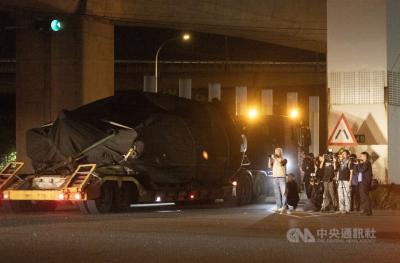
The final batch of 28 M1A2T Abrams tanks purchased from the US arrived at Taipei Port last night and were transported to the Armor Training Command in Hsinchu County’s Hukou Township (湖口), completing the military’s multi-year procurement of 108 of the tanks. Starting at 12:10am today, reporters observed more than a dozen civilian flatbed trailers departing from Taipei Port, each carrying an M1A2T tank covered with black waterproof tarps. Escorted by military vehicles, the convoy traveled via the West Coast Expressway to the Armor Training Command, with police implementing traffic control. The army operates about 1,000 tanks, including CM-11 Brave Tiger

Taiwan Semiconductor Manufacturing Co (TSMC, 台積電), the world’s largest contract chipmaker, said it expects its 2-nanometer (2nm) chip capacity to grow at a compound annual rate of 70 percent from this year to 2028. The projection comes as five fabs begin volume production of 2-nanometer chips this year — two in Hsinchu and three in Kaohsiung — TSMC senior vice president and deputy cochief operating officer Cliff Hou (侯永清) said at the company’s annual technology symposium in Silicon Valley, California, last week. Output in the first year of 2-nanometer production, which began in the fourth quarter of last year, is expected to

Taiwan’s drone exports surged past US$100 million in the first quarter, exceeding last year’s full-year total, with the Czech Republic emerging as the largest buyer, the Ministry of Economic Affairs said. Exports of complete drones reached US$115.85 million in the period, about 1.2 times the total recorded for all of last year, the ministry said in a report. Exports to the Czech Republic accounted for about US$100 million, far outpacing other markets. Poland, last year’s top destination, recorded about US$11.75 million in the first quarter. Taiwan’s drone exports have expanded rapidly in the past few years, with last year’s total


 RSS
RSS