


Retired police officers and firefighters protested outside Martyrs’ Shrine in Taipei yesterday, with some reportedly calling for President Tsai Ing-wen (蔡英文) to “lose her head” for living off the misery of the people.
“Is it right that Tsai should live a life of ease at the expense of the police and firefighters? Should [she] not be killed?” Lin Kuo-chun (林國春), who is president of the New Taipei City Retired Police Association and a New Taipei City Chinese Nationalist Party (KMT) councilor was quoted as saying, adding that in a past era she would have lost her head.
The protest targeted the governments pension reforms, saying the plans trampled the rights of retired police officers and firefighters.
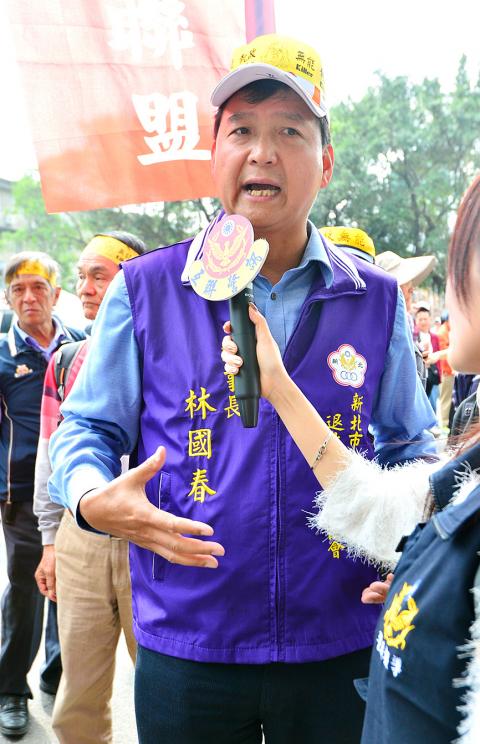
Photo: Wang Yi-sung, Taipei Times
Lin said that if the group’s rights were to suffer, the amenities and preferential treatment given the president should also be slashed.
Lin said Tsai was living “a pampered life,” as she did not have to stand in the sun during ceremonies, while chefs cook for her and chauffeurs drive her in cars worth NT$20 million (US$660,393).
“No other nation treats its police officers and firefighters so poorly,” Lin said.
Presidential Offices spokesperson Alex Huang (黃重諺) said that Lin’s statements were extremely inappropriate and unhelpful.
The goal of pension reform is for every citizen to enjoy a quality retirement that is economically safe, Huang said.
The reforms are aimed at using limited resources to fairly and sustainably care for every person, Huang said, adding that Taiwanese should have more hope that the reforms would pass.
Lin later denied that he had referred to “President Tsai” or “Tsai Ing-wen” directly when he spoke of killing, nor did he say that he would kill her.
The Democratic Progressive Party (DPP) said Lin was instigating hatred and conflict.
It called for Lin and KMT Chairwoman Hung Hsiu-chu (洪秀柱) to deliver a formal apology.
“Lin, as an elected official, nevertheless sought to stir up protesters with hate speech, unruly and undemocratic behavior, which should disqualify him from representing retired police officers and firefighters who were protesting,” DPP spokeswoman Chiu Li-li (邱莉莉) said.
Instead of helping to facilitate negotiations between the government and protesters, Lin set the worst example by using hatred to excite protesters, Chiu said.
Hung should also apologize over KMT members making such remarks, Chiu said.
KMT Culture and Communications Committee deputy director Tang Te-ming (唐德明) said every politician must take responsibility for their words and actions.
“Tsai has not apologized for hate-filled speeches by the DPP,” Tang said. “The party is lenient on itself, but harsh on others, which is not a good example for democracy.”
Additional reporting by Chen Wei-han and CNA
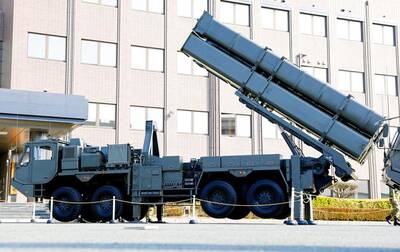
Japan has deployed long-range missiles in a southwestern region near China, the Japanese defense minister said yesterday, at a time when ties with Beijing are at their lowest in recent years. The missiles were installed in Kumamoto in the southern region of Kyushu, as Japan is attempting to shore up its military capacity as China steps up naval activity in the East China Sea. “Standoff defense capabilities enable us to counter the threat of enemy forces attempting to invade our country ... while ensuring the safety of our personnel,” Japanese Minister of Defense Shinjiro Koizumi said. “This is an extremely important initiative for
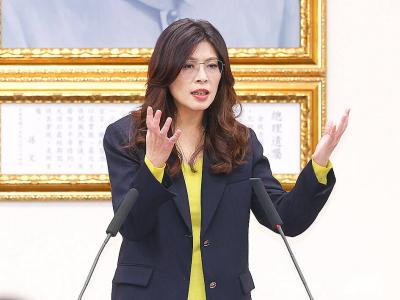
Chinese Nationalist Party (KMT) Chairwoman Cheng Li-wun (鄭麗文) today accepted an invitation from Chinese President Xi Jinping (習近平) to lead a delegation to China next month, saying she hopes to promote the peaceful development of cross-strait relations and bring stability to the Taiwan Strait. “I am grateful and happy to accept this invitation,” Cheng said in a statement from the KMT chairperson’s office. Cheng said she hopes both sides can work together to promote the peaceful development of cross-strait relations, enhance exchange and cooperation, bring stability to the Taiwan Strait and improve people’s livelihoods. At today's news conference, Cheng said any efforts to

MORE POPULAR: Taiwan Pass sales increased by 59 percent during the first quarter compared with the same period last year, the Tourism Administration said The Tourism Administration yesterday said that it has streamlined the Taiwan Pass, with two versions available for purchase beginning today. The tourism agency has made the pass available to international tourists since 2024, allowing them to access the high-speed rail, Taiwan Railway Corp services, four MRT systems and four Taiwan Tourist Shuttles. Previously, five types of Taiwan Pass were available, but some tourists have said that the offerings were too complicated. The agency said only two types of Taiwan Pass would be available, starting from a three-day pass with the high-speed rail and a three-day pass with Taiwan Railway Corp. The former costs NT$2,800

The nation’s fastest supercomputer, Nano 4 (晶創26), is scheduled to be launched in the third quarter, and would be used to train large language models in finance and national defense sectors, the National Center for High-Performance Computing (NCHC) said. The supercomputer, which would operate at about 86.05 petaflops, is being tested at a new cloud computing center in the Southern Taiwan Science Park in Tainan. The exterior of the server cabinet features chip circuitry patterns overlaid with a map of Taiwan, highlighting the nation’s central position in the semiconductor industry. The center also houses Taiwania 2, Taiwania 3, Forerunner 1 and


 RSS
RSS