


Representative to the US Stanley Kao (高碩泰) on Wednesday attended a meeting of a US-led coalition to counter the Islamic State (IS) group in Washington.
US Secretary of State Rex Tillerson presided over the meeting of the Global Coalition on the Defeat of ISIS (Islamic State of Iraq and Syria), the first since US President Donald Trump took office on Jan. 20.
The coalition, which was established in 2014 during the administration of then-US president Barack Obama, has 68 members.
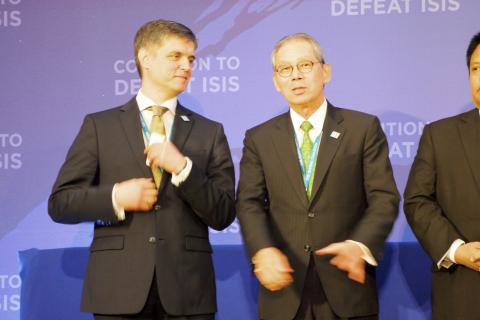
Photo: CNA
In addition to Taiwan, coalition members in the Asia-Pacific region include Afghanistan, Australia, Japan, Malaysia, New Zealand, Singapore and South Korea.
Taiwan’s participation has been in the area of humanitarian assistance, such as providing 350 temporary housing units to Iraqi refugees displaced by the militant group in 2014 and donating US$100,000 to provide shelter for refugees.
Taiwan’s representative office in the US declined to comment when asked how Taipei plans to continue its humanitarian efforts in the region.
Presidential Office spokesman Alex Huang (黃重諺) yesterday said that as a member of the international community, Taiwan has adamantly adhered to the universal values of peace, freedom, democracy and human rights.
“With that spirit in mind and based on our shared values, the nation has actively supported and participated in international cooperation on emerging issues, such as humanitarian aid, medical assistance, disease prevention and research, anti-terrorism, and combating transnational crime,” he said.
“These efforts are aimed at making Taiwan an indispensable partner of the international community,” he added.
The meeting coincided with a terror attack in London, where an assailant in a car plowed into pedestrians on Westminster Bridge, before running through the gates of the British Parliament and fatally stabbing an unarmed police officer.
He was shot dead by police officers.
The attack left four people dead, including the assailant, and at least 40 injured.
In a written statement, Tillerson condemned “these horrific acts of violence,” saying that “whether they were carried out by troubled individuals or by terrorists, the victims know no difference.”
He also extended his condolences to the victims’ families.
Trump telephoned British Prime Minister Theresa May to offer his condolences over the attack, praising the “prompt response” by UK security forces and first responders, and pledged the US’ “full support and cooperation” in responding to the attack and bringing those responsible to justice.
Additional reporting by Stacy Hsu
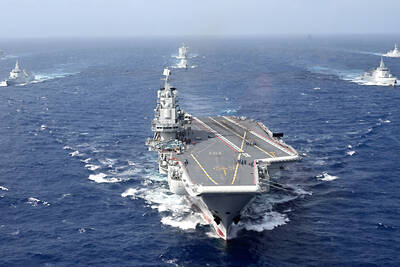
PROVOCATIVE: Chinese Deputy Ambassador to the UN Sun Lei accused Japan of sending military vessels to deliberately provoke tensions in the Taiwan Strait China denounced remarks by Japan and the EU about the South China Sea at a UN Security Council meeting on Monday, and accused Tokyo of provocative behavior in the Taiwan Strait and planning military expansion. Ayano Kunimitsu, a Japanese vice foreign minister, told the Council meeting on maritime security that Tokyo was seriously concerned about the situation in the East China and South China seas, and reiterated Japan’s opposition to any attempt to change the “status quo” by force, and obstruction of freedom of navigation and overflight. Stavros Lambrinidis, head of the EU delegation to the UN, also highlighted South China Sea
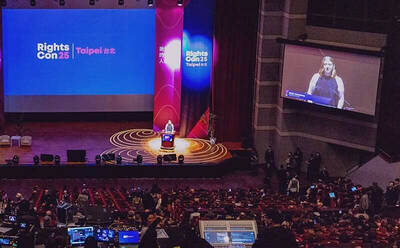
SILENCING CRITICS: In addition to blocking Taiwan, China aimed to prevent rights activists from speaking out against authoritarian states, a Cabinet department said The Ministry of Foreign Affairs (MOFA) yesterday condemned transnational repression by Beijing after RightsCon, a major digital human rights conference scheduled to be held in Zambia this week, was abruptly canceled due to Chinese pressure over Taiwanese participation. This year’s RightsCon, the world’s largest conference discussing issues “at the intersection of human rights and technology,” was scheduled to take place from tomorrow to Friday in Lusaka, and expected to draw 2,600 in-person attendees from 150 countries, along with 1,100 online participants. However, organizers were forced to cancel the event due to behind-the-scenes pressure from China, the ministry said, expressing its “strongest condemnation”
Taiwan Semiconductor Manufacturing Co (TSMC, 台積電), the world’s largest contract chipmaker, said it expects its 2-nanometer (2nm) chip capacity to grow at a compound annual rate of 70 percent from this year to 2028. The projection comes as five fabs begin volume production of 2-nanometer chips this year — two in Hsinchu and three in Kaohsiung — TSMC senior vice president and deputy cochief operating officer Cliff Hou (侯永清) said at the company’s annual technology symposium in Silicon Valley, California, last week. Output in the first year of 2-nanometer production, which began in the fourth quarter of last year, is expected to
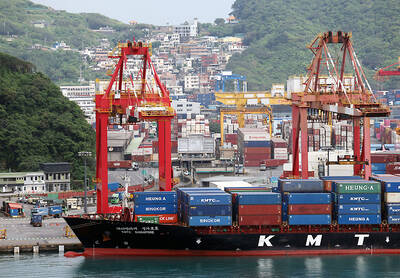
Taiwan’s economy grew far faster than expected in the first quarter, as booming demand for artificial intelligence (AI) applications drove a surge in exports, spilling over into investment and consumption, the Directorate-General of Budget, Accounting and Statistics (DGBAS) said yesterday. GDP growth was 13.69 percent year-on-year during the January-to-March period, beating the DGBAS’ February forecast by 2.23 percentage points and marking the most robust growth in nearly four decades, DGBAS senior official Chiang Hsin-yi (江心怡) told a news conference in Taipei. The result was powered by exports, which remain the backbone of Taiwan’s economy, Chiang said. Outbound shipments jumped 51.12 percent year-on-year to


 RSS
RSS