


The Taipei City Government yesterday held a launch ceremony for a photovoltaic power plant named Taipei Energy Hill, which is capable of generating 2 million kilowatt-hours of electricity per year.
The power plant in the Fudekeng Environmental Restoration Park in the city’s Muzha (木柵) area, is built on the site of of a former landfill and consists of 8,000 solar panels covering about 3 hectares.
The electricity generated by the plant would help the city reduce yearly carbon dioxide emissions by 1,000 tonnes, which is three times the amount that Daan Forest Park can absorb in a year, the Taipei Department of Environmental Protection said.

Photo: Huang Yao-cheng, Taipei Times
The department in July last year signed a contract with Taipei-based Tatung Co (大同), a leader in the nation’s photovoltaic industry, to build the power plant.
Touting the facility as a model for “green” electricity generation, Taipei Mayor Ko Wen-je (柯文哲) said at the ceremony that the power plant has generated 153,000 kilowatt-hours of electricity since it went online last month, which translates into an about 80-tonne reduction in carbon dioxide emissions.
The city provided the land on which the power plant was built and Tatung provided the photovoltaic panels, Ko said.
The electricity generated by the plant would be sold to state-run Taiwan Power Co (Taipower, 台電), he said.
According to the contract, Tatung is to pay the city government 10 percent of the revenue it makes from selling electricity, which costs about NT$5 per kilowatt-hour, which is like “rent” paid by the firm, the mayor said.
To boost solar energy generation, the city government has contracted out two projects to Tatung to install solar panels on the roofs of central and city government agencies, Ko said.
In other news, Ko yesterday fielded media questions about illegally built mezzanines in Neihu District (內湖).
The Chinese-language Liberty Times (the Taipei Times’ sister newspaper) yesterday reported that the city government has made an exception for the district to legalize the mezzanines by allowing property owners to pay a fee for the additional floor space.
Ko took issue with the word “legalize,” saying the city government would ensure that owners pay fees that apply to extra floor space created by mezzanines, adding that structures that do not conform to regulations would be torn down.
If property owners do not contact the city government by July 1, the structures would be torn down, he said.
Taipei Construction Management Office spokesman Horng Der-haur (洪德豪) said people started building mezzanines in Neihu in the early 2000s after the former industrial zone was designated as a science park, which allowed offices and stores to be established.
As a result, people who own factories with raised ceilings built mezzanines into their houses and rented them out, he said.
There are 147 units in 52 buildings in Neihu with illegal mezzanines, he said.
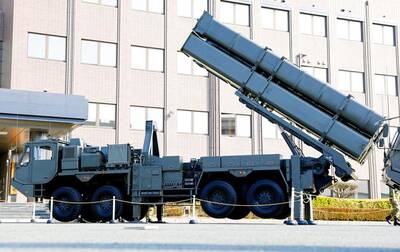
Japan has deployed long-range missiles in a southwestern region near China, the Japanese defense minister said yesterday, at a time when ties with Beijing are at their lowest in recent years. The missiles were installed in Kumamoto in the southern region of Kyushu, as Japan is attempting to shore up its military capacity as China steps up naval activity in the East China Sea. “Standoff defense capabilities enable us to counter the threat of enemy forces attempting to invade our country ... while ensuring the safety of our personnel,” Japanese Minister of Defense Shinjiro Koizumi said. “This is an extremely important initiative for
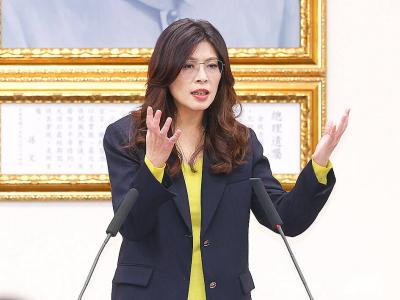
Chinese Nationalist Party (KMT) Chairwoman Cheng Li-wun (鄭麗文) today accepted an invitation from Chinese President Xi Jinping (習近平) to lead a delegation to China next month, saying she hopes to promote the peaceful development of cross-strait relations and bring stability to the Taiwan Strait. “I am grateful and happy to accept this invitation,” Cheng said in a statement from the KMT chairperson’s office. Cheng said she hopes both sides can work together to promote the peaceful development of cross-strait relations, enhance exchange and cooperation, bring stability to the Taiwan Strait and improve people’s livelihoods. At today's news conference, Cheng said any efforts to
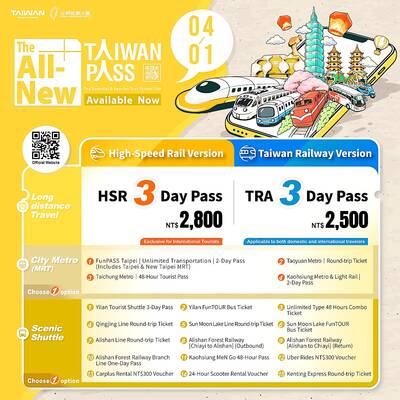
MORE POPULAR: Taiwan Pass sales increased by 59 percent during the first quarter compared with the same period last year, the Tourism Administration said The Tourism Administration yesterday said that it has streamlined the Taiwan Pass, with two versions available for purchase beginning today. The tourism agency has made the pass available to international tourists since 2024, allowing them to access the high-speed rail, Taiwan Railway Corp services, four MRT systems and four Taiwan Tourist Shuttles. Previously, five types of Taiwan Pass were available, but some tourists have said that the offerings were too complicated. The agency said only two types of Taiwan Pass would be available, starting from a three-day pass with the high-speed rail and a three-day pass with Taiwan Railway Corp. The former costs NT$2,800

The nation’s fastest supercomputer, Nano 4 (晶創26), is scheduled to be launched in the third quarter, and would be used to train large language models in finance and national defense sectors, the National Center for High-Performance Computing (NCHC) said. The supercomputer, which would operate at about 86.05 petaflops, is being tested at a new cloud computing center in the Southern Taiwan Science Park in Tainan. The exterior of the server cabinet features chip circuitry patterns overlaid with a map of Taiwan, highlighting the nation’s central position in the semiconductor industry. The center also houses Taiwania 2, Taiwania 3, Forerunner 1 and


 RSS
RSS