


A powerful nighttime earthquake in the southern Philippines killed at least six people and injured more than 120, with officials yesterday combing through cracked buildings and nearby towns to check on the damage and other possible casualties.
The magnitude 6.7 earthquake roused residents from their sleep late on Friday in Surigao del Norte province, forcing hundreds of people to flee their homes.
It was centered about 16km northwest of the provincial capital, Surigao City, at a relatively shallow depth of 10km, Philippine Institute of Volcanology and Seismology Director Renato Solidum said.
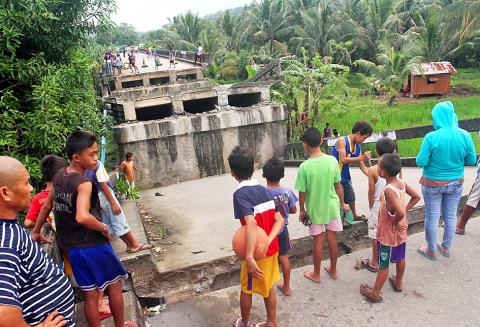
Photo: Reuters
Nearly 100 aftershocks have been felt, officials said.
Evacuation centers accommodated wary residents overnight, but many returned home yesterday, Philippine Secretary of Social Welfare and Development Judy Taguiwalo said, adding that officials were continuing to assess the damage in Surigao City and outlying towns.
Provincial information officer Mary Jul Escalante was being interviewed by TV network ABS-CBN when another aftershock struck.
“Oh sir, there’s an aftershock,” she said. “I’m shaking, we have a phobia now.”
At least six people were killed, mostly after being struck by falling debris and concrete walls, provincial disaster response official Gilbert Gonzales said.
At least 126 people were injured in Surigao City, where the earthquake knocked out power and forced the closure of the domestic airport due to deep cracks in its runway, officials said.
Several buildings, including a state college, a hotel and a shopping mall, were damaged in the city about 700km southeast of Manila.
Surigao was placed under a state of calamity to allow faster release of emergency funds, provincial police Senior Superintendent Anthony Maghari said by telephone.
TV footage showed Philippine Army troops and other rescuers pulling out the body of a man from the concrete rubble of a damaged house while relatives wept.
In Surigao City’s downtown area, the facades of a number of buildings were heavily cracked and their glass windows shattered, with canopies and debris falling on parked cars on the street below.
Roads had visible cracks in the coastal city and a bridge collapsed in an outlying town, officials said.
“The shaking was so strong I could hardly stand,” Philippine Coast Guard official Rayner Neil Elopre said by telephone.
Village leaders asked residents to move to a school building on higher ground, Elopre said, pausing briefly during a mild aftershock while talking on the telephone.
Police officer Jimmy Sarael said he, his wife and two children embraced each other until the shaking eased.
They later moved to the moonlit grounds outside the provincial capitol complex to join more than 1,000 jittery residents, he said.
The last major earthquake that struck Surigao, an impoverished region also dealing with a communist insurgency, was in 1879, Solidum said.
A magnitude 7.7 earthquake killed nearly 2,000 people on northern Luzon Island in 1990.
Amid the calamity, the military appealed to New People’s Army guerrillas not to disrupt rescue and rehabilitation work.
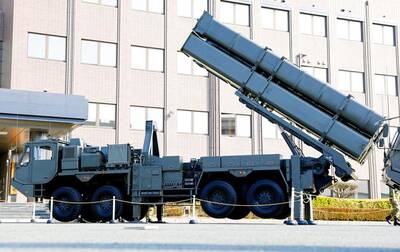
Japan has deployed long-range missiles in a southwestern region near China, the Japanese defense minister said yesterday, at a time when ties with Beijing are at their lowest in recent years. The missiles were installed in Kumamoto in the southern region of Kyushu, as Japan is attempting to shore up its military capacity as China steps up naval activity in the East China Sea. “Standoff defense capabilities enable us to counter the threat of enemy forces attempting to invade our country ... while ensuring the safety of our personnel,” Japanese Minister of Defense Shinjiro Koizumi said. “This is an extremely important initiative for

Chinese Nationalist Party (KMT) Chairwoman Cheng Li-wun (鄭麗文) today accepted an invitation from Chinese President Xi Jinping (習近平) to lead a delegation to China next month, saying she hopes to promote the peaceful development of cross-strait relations and bring stability to the Taiwan Strait. “I am grateful and happy to accept this invitation,” Cheng said in a statement from the KMT chairperson’s office. Cheng said she hopes both sides can work together to promote the peaceful development of cross-strait relations, enhance exchange and cooperation, bring stability to the Taiwan Strait and improve people’s livelihoods. At today's news conference, Cheng said any efforts to

MORE POPULAR: Taiwan Pass sales increased by 59 percent during the first quarter compared with the same period last year, the Tourism Administration said The Tourism Administration yesterday said that it has streamlined the Taiwan Pass, with two versions available for purchase beginning today. The tourism agency has made the pass available to international tourists since 2024, allowing them to access the high-speed rail, Taiwan Railway Corp services, four MRT systems and four Taiwan Tourist Shuttles. Previously, five types of Taiwan Pass were available, but some tourists have said that the offerings were too complicated. The agency said only two types of Taiwan Pass would be available, starting from a three-day pass with the high-speed rail and a three-day pass with Taiwan Railway Corp. The former costs NT$2,800

The nation’s fastest supercomputer, Nano 4 (晶創26), is scheduled to be launched in the third quarter, and would be used to train large language models in finance and national defense sectors, the National Center for High-Performance Computing (NCHC) said. The supercomputer, which would operate at about 86.05 petaflops, is being tested at a new cloud computing center in the Southern Taiwan Science Park in Tainan. The exterior of the server cabinet features chip circuitry patterns overlaid with a map of Taiwan, highlighting the nation’s central position in the semiconductor industry. The center also houses Taiwania 2, Taiwania 3, Forerunner 1 and


 RSS
RSS