


The People’s Liberation Army Navy (PLAN) naming its recently completed destroyer Xining (西寧), using the same Chinese characters as the Taiwanese frigate Si Ning, might lead to confusion if the ships encounter each other on maneuvers, Taiwanese military observers said.
According to Chinese media affiliated with the PLA, the Xining is an indigenously developed Type 052D advanced guided-missile destroyer, with a displacement of 7,500 tonnes and low radar visibility.
The Republic of China (ROC) Navy “does not rule out” the possibility of the Si Ning encountering the Xining, a Ministry of National Defense official in Taipei said on condition of anonymity.
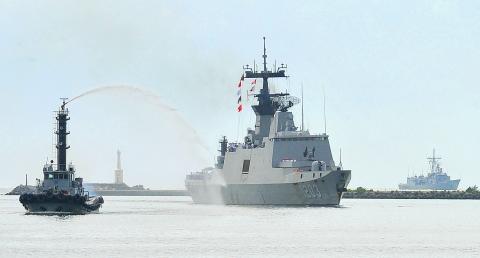
Photo: Huang Chih-yuan, Taipei Times
Although the Xining is assigned to the PLAN’s North Sea Fleet, it is a principal combat ship and is therefore likely to conduct transoceanic and expeditionary warfare training, including those conducted near Taiwanese waters, the official said.
The Si Ning is a Kang Ding-class frigate, with the pennant number DDG-124, and is based in Kaohsiung’s Zuoying District (左營), the official said.
The Xining is the second Chinese warship to bear that name, the official said, adding that its predecessor with pennant number DDG-108 was a first-generation guided-missile destroyer, commissioned in 1980 and decommissioned in 2013.
A source familiar with naval affairs said that Taiwanese and Chinese warships rarely encountered each other in the past because the two navies usually restricted their ship movements to fixed lanes.
However, the PLAN has in recent years been moving its ships off the established lanes, leading to increased chances of maritime encounters, the source said.
The Taiwanese navy is to follow international customs regulating those occurrences to avoid friction, the source said.
A situation involving ships with the same name appearing in the same area is likely to cause difficulties, another unnamed defense ministry official said on Sunday.
Because the Taiwanese and Chinese navies both use place names for their ships, four ships have the same names: Taiwan’s Si Ning and Kun Ming and China’s Xining and Kunming, the official said.
Taiwan’s six Kang Ding-class frigates were named after the ROC’s former Chinese provinces, and Beijing also intends to name its destroyers after its major provinces and cities, with up to 18 ships planned, the official said.
According to the Taiwanese navy’s naming conventions, ships belonging to Class I principle warships are named after place names or military figures of renown, with Class II patrol ships named after mountains and Class III after rivers, the official said.
However, in 2005, the Legislative Yuan’s National Defense Committee requested that the defense ministry name new warships “using Taiwanese place names or names that resonate with Taiwanese,” and the military has complied, the official said.
The Taiwanese navy named its post-2005 Keelung-class destroyers Keelung, Su Ao, Tso Ying and Ma Kong, the official said.
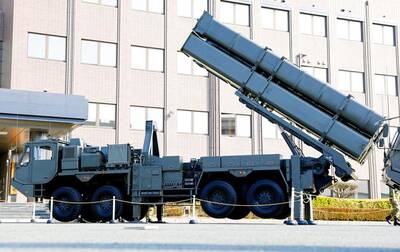
Japan has deployed long-range missiles in a southwestern region near China, the Japanese defense minister said yesterday, at a time when ties with Beijing are at their lowest in recent years. The missiles were installed in Kumamoto in the southern region of Kyushu, as Japan is attempting to shore up its military capacity as China steps up naval activity in the East China Sea. “Standoff defense capabilities enable us to counter the threat of enemy forces attempting to invade our country ... while ensuring the safety of our personnel,” Japanese Minister of Defense Shinjiro Koizumi said. “This is an extremely important initiative for
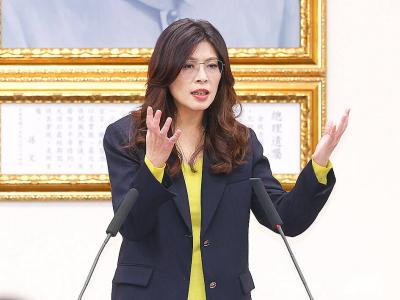
Chinese Nationalist Party (KMT) Chairwoman Cheng Li-wun (鄭麗文) today accepted an invitation from Chinese President Xi Jinping (習近平) to lead a delegation to China next month, saying she hopes to promote the peaceful development of cross-strait relations and bring stability to the Taiwan Strait. “I am grateful and happy to accept this invitation,” Cheng said in a statement from the KMT chairperson’s office. Cheng said she hopes both sides can work together to promote the peaceful development of cross-strait relations, enhance exchange and cooperation, bring stability to the Taiwan Strait and improve people’s livelihoods. At today's news conference, Cheng said any efforts to
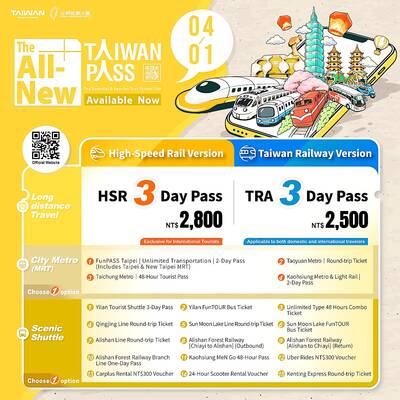
MORE POPULAR: Taiwan Pass sales increased by 59 percent during the first quarter compared with the same period last year, the Tourism Administration said The Tourism Administration yesterday said that it has streamlined the Taiwan Pass, with two versions available for purchase beginning today. The tourism agency has made the pass available to international tourists since 2024, allowing them to access the high-speed rail, Taiwan Railway Corp services, four MRT systems and four Taiwan Tourist Shuttles. Previously, five types of Taiwan Pass were available, but some tourists have said that the offerings were too complicated. The agency said only two types of Taiwan Pass would be available, starting from a three-day pass with the high-speed rail and a three-day pass with Taiwan Railway Corp. The former costs NT$2,800

The nation’s fastest supercomputer, Nano 4 (晶創26), is scheduled to be launched in the third quarter, and would be used to train large language models in finance and national defense sectors, the National Center for High-Performance Computing (NCHC) said. The supercomputer, which would operate at about 86.05 petaflops, is being tested at a new cloud computing center in the Southern Taiwan Science Park in Tainan. The exterior of the server cabinet features chip circuitry patterns overlaid with a map of Taiwan, highlighting the nation’s central position in the semiconductor industry. The center also houses Taiwania 2, Taiwania 3, Forerunner 1 and


 RSS
RSS