


Four social media activists with outspoken, secular and anti-military views have gone missing in Pakistan in recent days, sparking fears of a crackdown on left-wing dissenters.
Pakistan’s intelligence agencies have a history of illegal detentions and of not notifying relatives about where they are or why they are being held. However, such “forced disappearances” are usually directed against those suspected of involvement in terrorism or violent separatism.
One of the four men, Asim Saeed, was abducted from his home in Lahore on Friday after he had returned from working in Singapore. Ahmad Waqas Goraya, another online activist who is usually based in the Netherlands, was detained on the same day, his friends said.
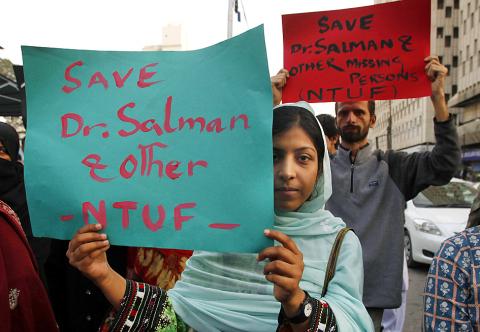
Photo: AP
According to a statement given by Saeed’s father to the police, four men arrived at the house in a pickup truck and “forcefully took him away.”
“I made all efforts to locate my son, but I have been unable to trace him,” his statement said.
At the time of Saeed’s abduction, the information technology worker was carrying his laptop and two mobile phones.
Both Saeed and Goraya help run the Mochi Facebook page critical of Pakistan’s powerful military. The page recently criticized the army’s heavy-handed crackdown on political groups in Karachi, and accused senior officers of corruption and the military of interfering in national politics.
Salman Haider, a lecturer at Fatima Jinnah Women University, failed to come home on Friday. His wife received a mysterious message from his phone saying he was abandoning his car on the Islamabad-Rawalpindi motorway. The car was later recovered by police.
On Saturday, Pakistani Minister of the Interior Chaudhry Nisar Ali Khan said he had urged police to find Haider, a playwright, poet and editor of Tanqeed. The online magazine has criticized army counterinsurgency operations in the southern state of Balochistan.
Relatives of the fourth man, Ahmed Raza Naseer, said he was taken from his family’s shop in the Punjab District of Sheikhupra on Saturday.
Human Rights Watch asked authorities to investigate the apparent abductions as a matter of urgency.
“The Pakistani government has an immediate obligation to locate the four missing human rights activists and act to ensure their safety,” said Brad Adams, the group’s Asia director. “The nature of these apparent abductions puts the ... government on notice that it can either be part of the solution or it will be held responsible for its role in the problem.”
Shahzad Ahmad, director of Bytes for All, a human rights group focused on online security, said the disappearances had spooked social media activists, and several had deactivated their Facebook and Twitter accounts.
“We are concerned over the recent roundup of social media activists, which we see as a threat to freedom of expression, association and assembly in online spaces,” he said.

NATIONAL SECURITY THREAT: An official said that Guan Guan’s comments had gone beyond the threshold of free speech, as she advocated for the destruction of the ROC China-born media influencer Guan Guan’s (關關) residency permit has been revoked for repeatedly posting pro-China content that threatens national security, the National Immigration Agency said yesterday. Guan Guan has said many controversial things in her videos posted to Douyin (抖音), including “the red flag will soon be painted all over Taiwan” and “Taiwan is an inseparable part of China,” while expressing hope for expedited “reunification.” The agency received multiple reports alleging that Guan Guan had advocated for armed reunification last year. After investigating, the agency last month issued a notice requiring her to appear and account for her actions. Guan Guan appeared as required,
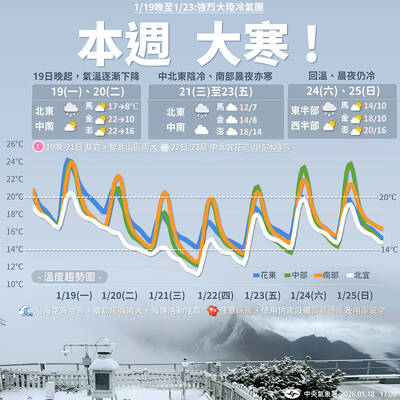
A strong cold air mass is expected to arrive tonight, bringing a change in weather and a drop in temperature, the Central Weather Administration (CWA) said. The coldest time would be early on Thursday morning, with temperatures in some areas dipping as low as 8°C, it said. Daytime highs yesterday were 22°C to 24°C in northern and eastern Taiwan, and about 25°C to 28°C in the central and southern regions, it said. However, nighttime lows would dip to about 15°C to 16°C in central and northern Taiwan as well as the northeast, and 17°C to 19°C elsewhere, it said. Tropical Storm Nokaen, currently

‘NATO-PLUS’: ‘Our strategic partners in the Indo-Pacific are facing increasing aggression by the Chinese Communist Party,’ US Representative Rob Wittman said The US House of Representatives on Monday released its version of the Consolidated Appropriations Act, which includes US$1.15 billion to support security cooperation with Taiwan. The omnibus act, covering US$1.2 trillion of spending, allocates US$1 billion for the Taiwan Security Cooperation Initiative, as well as US$150 million for the replacement of defense articles and reimbursement of defense services provided to Taiwan. The fund allocations were based on the US National Defense Authorization Act for fiscal 2026 that was passed by the US Congress last month and authorized up to US$1 billion to the US Defense Security Cooperation Agency in support of the
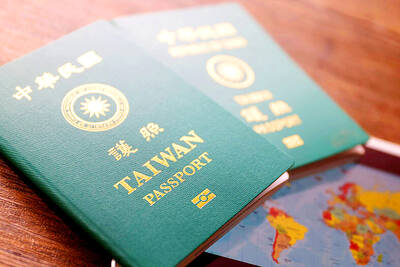
PAPERS, PLEASE: The gang exploited the high value of the passports, selling them at inflated prices to Chinese buyers, who would treat them as ‘invisibility cloaks’ The Yilan District Court has handed four members of a syndicate prison terms ranging from one year and two months to two years and two months for their involvement in a scheme to purchase Taiwanese passports and resell them abroad at a massive markup. A Chinese human smuggling syndicate purchased Taiwanese passports through local criminal networks, exploiting the passports’ visa-free travel privileges to turn a profit of more than 20 times the original price, the court said. Such criminal organizations enable people to impersonate Taiwanese when entering and exiting Taiwan and other countries, undermining social order and the credibility of the nation’s


 RSS
RSS