


The government is planning to ban smoking in bars, nightclubs and cigar houses, and place restrictions on e-cigarettes similar to those on tobacco products, Health Promotion Administration (HPA) officials said.
The law bans smoking at most public places, but permits it at cigar houses as well as bars and nightclubs that are open after 9pm for people above the age of 18.
Smoking is also allowed in certain indoor areas of hotels, restaurants and shopping malls that are equipped with separate smoking partitions with independent air-conditioning systems.
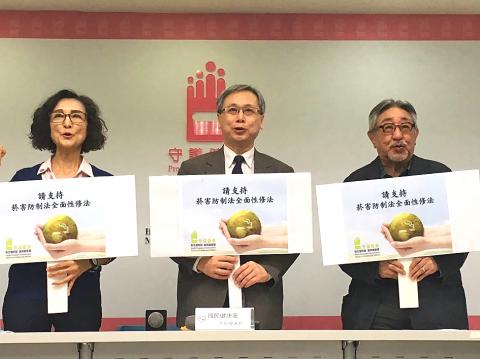
Photo: Lin Yen-tung, Taipei Times
However, a draft amendment to the Tobacco Hazards Prevention Act (菸害防制法), which was announced by the ministry on Wednesday, seeks to ban smoking in all those places, HPA official Lo Su-ying (羅素英) said.
Lo said the change follows international trends and is based on findings that indoor partitions cannot effectively prevent cigarette smoke from spreading through the air.
The amendment would also ban e-cigarettes in the same way as tobacco, and make it illegal to provide them to people under the age of 18, with violators subject to a fine of up to NT$10,000 (US$313), Lo said.
E-cigarettes have emerged as a new threat to people’s health and could expose minors to smoking at an early age, Lo said, adding that the amendment would also ban e-cigarette advertisements and sponsorships.
According to HPA statistics, at least 20,000 Taiwanese die from cigarette-caused illnesses each year.
More than 40 percent of Taiwanese men aged between 31 and 50 are smokers, a much higher percentage compared with 24.9 percent in Singapore, 22.5 percent in Norway, 19.9 percent in Hong Kong and 19 percent in New Zealand, statistics showed.
The John Tung Foundation, an organization that focuses on public health issues and tobacco control, said it is glad to see the draft amendment, but urged the government to raise fines.
Yau Seu-wain (姚思遠), a law professor and chief executive officer of the foundation, said tobacco manufacturers and importers are only fined between NT$5 million and NT$25 million for violations, even though their total revenues are “about NT$160 billion per year.”
Yau called for suspending the operations of tobacco manufacturers and importers for up to three years and doubling their fines to between NT$10 million and NT$50 million if they are caught illegally advertising or promoting tobacco products three times.
The HPA said it would collect opinions for a period of 60 days, before sending the draft amendment to the Executive Yuan and Legislative Yuan for review.
The proposed amendment follows a slew of new regulations in Taiwan to tighten smoking restrictions.
Beginning on Dec. 26 last year, smoking has been banned on sidewalks near 267 schools in Taipei and has been banned at all 932 bus stops in Taipei as of Sunday last week.
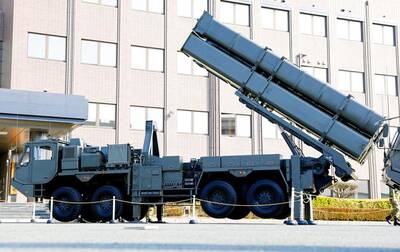
Japan has deployed long-range missiles in a southwestern region near China, the Japanese defense minister said yesterday, at a time when ties with Beijing are at their lowest in recent years. The missiles were installed in Kumamoto in the southern region of Kyushu, as Japan is attempting to shore up its military capacity as China steps up naval activity in the East China Sea. “Standoff defense capabilities enable us to counter the threat of enemy forces attempting to invade our country ... while ensuring the safety of our personnel,” Japanese Minister of Defense Shinjiro Koizumi said. “This is an extremely important initiative for

Chinese Nationalist Party (KMT) Chairwoman Cheng Li-wun (鄭麗文) today accepted an invitation from Chinese President Xi Jinping (習近平) to lead a delegation to China next month, saying she hopes to promote the peaceful development of cross-strait relations and bring stability to the Taiwan Strait. “I am grateful and happy to accept this invitation,” Cheng said in a statement from the KMT chairperson’s office. Cheng said she hopes both sides can work together to promote the peaceful development of cross-strait relations, enhance exchange and cooperation, bring stability to the Taiwan Strait and improve people’s livelihoods. At today's news conference, Cheng said any efforts to
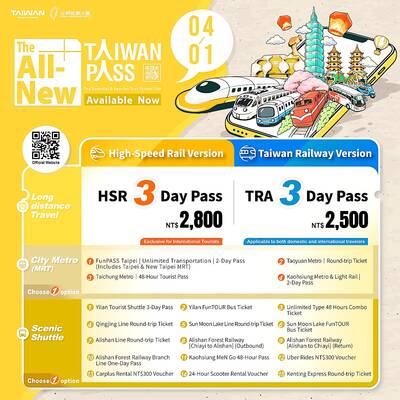
MORE POPULAR: Taiwan Pass sales increased by 59 percent during the first quarter compared with the same period last year, the Tourism Administration said The Tourism Administration yesterday said that it has streamlined the Taiwan Pass, with two versions available for purchase beginning today. The tourism agency has made the pass available to international tourists since 2024, allowing them to access the high-speed rail, Taiwan Railway Corp services, four MRT systems and four Taiwan Tourist Shuttles. Previously, five types of Taiwan Pass were available, but some tourists have said that the offerings were too complicated. The agency said only two types of Taiwan Pass would be available, starting from a three-day pass with the high-speed rail and a three-day pass with Taiwan Railway Corp. The former costs NT$2,800

The nation’s fastest supercomputer, Nano 4 (晶創26), is scheduled to be launched in the third quarter, and would be used to train large language models in finance and national defense sectors, the National Center for High-Performance Computing (NCHC) said. The supercomputer, which would operate at about 86.05 petaflops, is being tested at a new cloud computing center in the Southern Taiwan Science Park in Tainan. The exterior of the server cabinet features chip circuitry patterns overlaid with a map of Taiwan, highlighting the nation’s central position in the semiconductor industry. The center also houses Taiwania 2, Taiwania 3, Forerunner 1 and


 RSS
RSS