


The Chinese Taipei Baseball Association (CTBA) yesterday apologized for evicting a group of fans who were waving a banner reading “Taiwan is not Chinese Taipei” ahead of a match between Taiwan and Japan at an under-18 international baseball tournament in Taichung on Wednesday.
A group of Providence University students, who were calling for the replacement of the term “Chinese Taipei,” were evicted from the game at the 11th Baseball Federation of Asia Under-18 Championship for holding what the association said was a political slogan.
Two association members tried to snatch the banner from the students and the students were escorted from the stadium soon afterward.
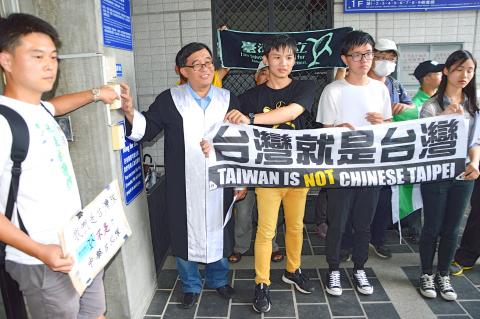
Photo: Chang Jui-chen, Taipei Times
After a video capturing the scuffle went viral on the Internet, Chinese Taipei Baseball Association secretary-general Lin Chung-cheng (林宗成) apologized for the actions of the association’s members following criticism from the city government, politicians and netizens.
Lin said according to International Olympic Committee (IOC) rules, political banners are banned from international sports competitions, but that the association would handle such a situation with more care in the future.
The association is to designate a “protest area” near the stadium entrance, but protests are not allowed inside the stadium, Lin said.
He called on the government to establish a standard reaction procedure, as the association has little experience in handling such incidents.
The Taichung City Government said the association enforced the rule too vociferously and that freedom of speech must be protected as long as it does not disrupt the game.
“The association has to compensate and apologize for the fans’ losses,” Taichung Information Bureau Director-General Cho Kuan-ting (卓冠廷) said, adding that the city government would deploy additional police officers at the stadium to protect the rights of fans.
“The city government will respect fans’ rights to hold national flags or slogans as long as they do not interfere with other people,” Chou said.
Democratic Progressive Party (DPP) Legislator Huang Kuo-shu (黃國書) said the banner in question was not political, but merely an expression of an opinion.
“Whatever does not serve the interests of particular politicians or political parties should not be understood as political. Taiwan is a free country and it is unreasonable to enforce the IOC rules restrictively,” Huang said.
DPP Legislator Chang Liao Wan-chien (張廖萬堅), who is a director of the association, said the term “Chinese Taipei” is a compromise that Taiwan has to accept to enter international sports competitions and dissatisfaction with the term is understandable.
“The slogan was nothing unusual, but the association’s overreaction saw it make the headlines,” Chang Liao said.
Sports Administration Director Lin Jer-hung (林哲宏) said the agency would set up a standard procedure to handle similar situations and prevent conflict.
Meanwhile, the students yesterday took their case to court, accusing two members of the association of unnecessary use of force and damage to property.
They said freedom of speech must be protected and reasserted their opinion that the nation should use “Taiwan” when participating in international sports competitions.
Lawyer Cheng Yi-ying (鄭懿瀛), who is helping the students, said the association’s ban on political banners is against freedom of speech and that the association would be censoring fans if it plans to define what slogans or objects are political.

Japan has deployed long-range missiles in a southwestern region near China, the Japanese defense minister said yesterday, at a time when ties with Beijing are at their lowest in recent years. The missiles were installed in Kumamoto in the southern region of Kyushu, as Japan is attempting to shore up its military capacity as China steps up naval activity in the East China Sea. “Standoff defense capabilities enable us to counter the threat of enemy forces attempting to invade our country ... while ensuring the safety of our personnel,” Japanese Minister of Defense Shinjiro Koizumi said. “This is an extremely important initiative for
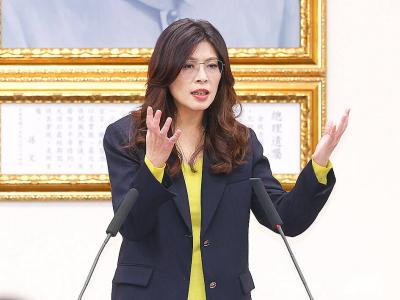
Chinese Nationalist Party (KMT) Chairwoman Cheng Li-wun (鄭麗文) today accepted an invitation from Chinese President Xi Jinping (習近平) to lead a delegation to China next month, saying she hopes to promote the peaceful development of cross-strait relations and bring stability to the Taiwan Strait. “I am grateful and happy to accept this invitation,” Cheng said in a statement from the KMT chairperson’s office. Cheng said she hopes both sides can work together to promote the peaceful development of cross-strait relations, enhance exchange and cooperation, bring stability to the Taiwan Strait and improve people’s livelihoods. At today's news conference, Cheng said any efforts to

MORE POPULAR: Taiwan Pass sales increased by 59 percent during the first quarter compared with the same period last year, the Tourism Administration said The Tourism Administration yesterday said that it has streamlined the Taiwan Pass, with two versions available for purchase beginning today. The tourism agency has made the pass available to international tourists since 2024, allowing them to access the high-speed rail, Taiwan Railway Corp services, four MRT systems and four Taiwan Tourist Shuttles. Previously, five types of Taiwan Pass were available, but some tourists have said that the offerings were too complicated. The agency said only two types of Taiwan Pass would be available, starting from a three-day pass with the high-speed rail and a three-day pass with Taiwan Railway Corp. The former costs NT$2,800

The nation’s fastest supercomputer, Nano 4 (晶創26), is scheduled to be launched in the third quarter, and would be used to train large language models in finance and national defense sectors, the National Center for High-Performance Computing (NCHC) said. The supercomputer, which would operate at about 86.05 petaflops, is being tested at a new cloud computing center in the Southern Taiwan Science Park in Tainan. The exterior of the server cabinet features chip circuitry patterns overlaid with a map of Taiwan, highlighting the nation’s central position in the semiconductor industry. The center also houses Taiwania 2, Taiwania 3, Forerunner 1 and


 RSS
RSS