


The Ministry of National Defense (MND) yesterday released the results of its investigation into an accidental missile launch last month, saying a series of missteps and procedural violations caused the mishap.
A Hsiung Feng III supersonic anti-ship missile was accidentally launched from a Kaohsiung-based Chinchiang-class corvette ahead of a training exercise on July 1. The missile ripped through a fishing boat, killing the boat’s captain, Huang Wen-chung (黃文忠), and injuring three crew members.
The missile was launched because Petty Officer Second Class Kao Chia-chun (高嘉駿) accidentally connected unnecessary fire plugs — a connector assembly used to send launch orders, to a missile launcher — Navy Command Headquarters Chief of Staff Vice Admiral Mei Chia-shu (梅家樹) said.
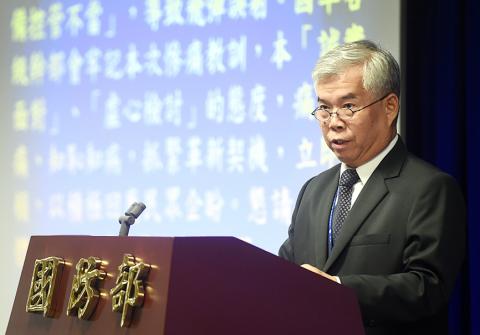
Photo: Chien Jung-fong, Taipei Times
Kao was supposed to connect only two fire plugs, because safety devices were installed on only two of the ship’s four missiles, but he connected four, Mei said.
Kao’s supervisor, Chief Petty Officer Chen Ming-hsiu (陳銘修), should have requested only two fire plugs instead of four, while the ship’s weapon systems officers should only have given him two, Mei said.
Chen misunderstood orders for the drill, believing that all four missiles were to be prepared for the training exercise, but the exercise was only to simulate the launch of one missile, Mei said, adding that during a pre-drill rehearsal, Chen left the operations room after ordering Kao to establish two sets of firing solutions.
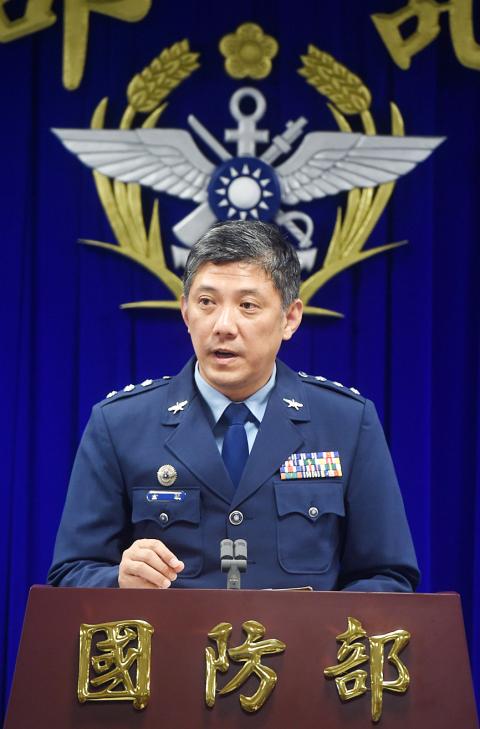
Photo: Chien Jung-fong, Taipei Times
According to protocol, Chen should have supervised Kao throughout the entire process, but Kao was left alone in the operations room as he went through the entire pre-launch process while rehearsing for the exercise, when he accidentally hit the launch button, Mei said.
“There were too many oversights and too much negligence. We are deeply distressed [by the incident], but we have made efforts to improve [launch procedures],” Mei said.
Asked how Chen could have misunderstood orders for the exercise, Mei said instructions were ambiguous, adding that the navy would make improvements.
“The missile system will also be redesigned to prevent accidental launches,” Mei said.
Ministry Inspector General Wu Pao-Kun (吳寶琨) said that the July 1 training exercise should not have been scheduled, because the ship’s commander had only been in command since April 11, while operational rules stipulate that such high-level drills are not allowed until a commander has been in charge for more than three months.
The ship was scheduled to begin a patrol mission immediately after the drill, and its commander, Major Lin Po-tse (林伯澤), had attended a pre-patrol meeting earlier that day, Wu added.
The tight schedule might have been a contributing factor to the accident, Wu said, adding that the ministry would prevent such scheduling issues.
“In addition to the navy’s previously announced disciplinary action, the ship’s executive officer and officers who approved the drill are to be punished for procedural violations and failing to provide proper supervision,” Wu said.
The Kaohsiung District Prosecutors’ Office yesterday charged Kao, Chen and Lieutenant Hsu Po-wei (許博為), the ship’s weapon systems officer, with causing the incident.
Kao was charged with negligence resulting in the death of the fishing boat’s captain, which could result in a five-year jail term if he is found guilty.
Chen and Hsu were charged with neglecting their duties and causing an accident, which carry a total prison term of three to 10 years.
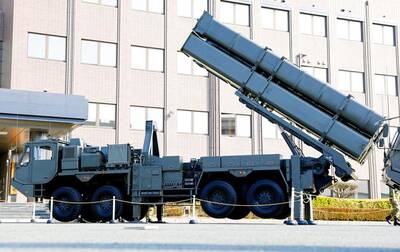
Japan has deployed long-range missiles in a southwestern region near China, the Japanese defense minister said yesterday, at a time when ties with Beijing are at their lowest in recent years. The missiles were installed in Kumamoto in the southern region of Kyushu, as Japan is attempting to shore up its military capacity as China steps up naval activity in the East China Sea. “Standoff defense capabilities enable us to counter the threat of enemy forces attempting to invade our country ... while ensuring the safety of our personnel,” Japanese Minister of Defense Shinjiro Koizumi said. “This is an extremely important initiative for
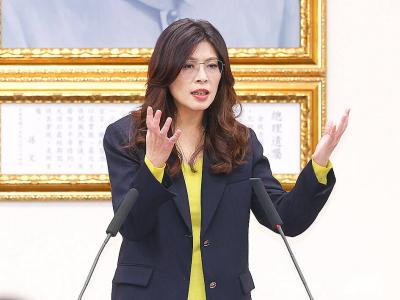
Chinese Nationalist Party (KMT) Chairwoman Cheng Li-wun (鄭麗文) today accepted an invitation from Chinese President Xi Jinping (習近平) to lead a delegation to China next month, saying she hopes to promote the peaceful development of cross-strait relations and bring stability to the Taiwan Strait. “I am grateful and happy to accept this invitation,” Cheng said in a statement from the KMT chairperson’s office. Cheng said she hopes both sides can work together to promote the peaceful development of cross-strait relations, enhance exchange and cooperation, bring stability to the Taiwan Strait and improve people’s livelihoods. At today's news conference, Cheng said any efforts to
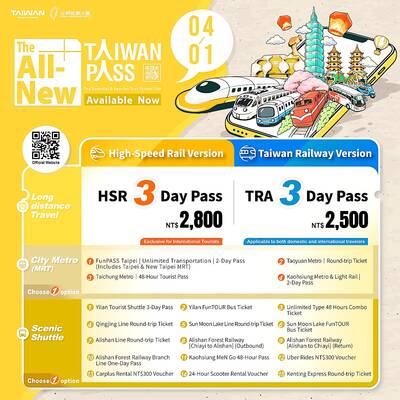
MORE POPULAR: Taiwan Pass sales increased by 59 percent during the first quarter compared with the same period last year, the Tourism Administration said The Tourism Administration yesterday said that it has streamlined the Taiwan Pass, with two versions available for purchase beginning today. The tourism agency has made the pass available to international tourists since 2024, allowing them to access the high-speed rail, Taiwan Railway Corp services, four MRT systems and four Taiwan Tourist Shuttles. Previously, five types of Taiwan Pass were available, but some tourists have said that the offerings were too complicated. The agency said only two types of Taiwan Pass would be available, starting from a three-day pass with the high-speed rail and a three-day pass with Taiwan Railway Corp. The former costs NT$2,800
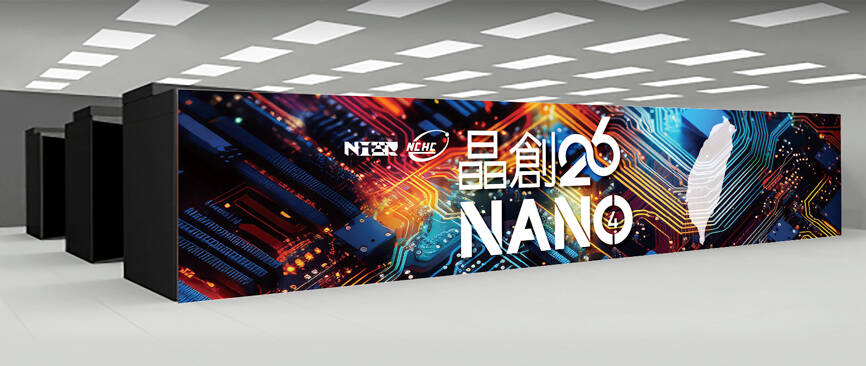
The nation’s fastest supercomputer, Nano 4 (晶創26), is scheduled to be launched in the third quarter, and would be used to train large language models in finance and national defense sectors, the National Center for High-Performance Computing (NCHC) said. The supercomputer, which would operate at about 86.05 petaflops, is being tested at a new cloud computing center in the Southern Taiwan Science Park in Tainan. The exterior of the server cabinet features chip circuitry patterns overlaid with a map of Taiwan, highlighting the nation’s central position in the semiconductor industry. The center also houses Taiwania 2, Taiwania 3, Forerunner 1 and


 RSS
RSS