


Taiwan’s hope for a medal in raquet sports at the Olympics in Rio de Janeiro now rests on the shoulders of Chou Tien-chen (周天成), who won his match yesterday and advanced to the badminton quarter-finals, where he faces Lee Chong Wei (李宗偉) of Malaysia today at 7:30pm Taiwan Time.
Taiwan’s Tai Tzu-ying (戴資穎) fell to ninth-seeded P.V. Sindhu of India 21-13, 21-15 in the women’s singles.
For today, it will be a head-to-head duel between the two nations’ No. 1s, with Chou, 26, having an edge in the youth stakes, while Lee, 33, has more experience and victories, winning silver in the singles at the Beijing and London Olympics.
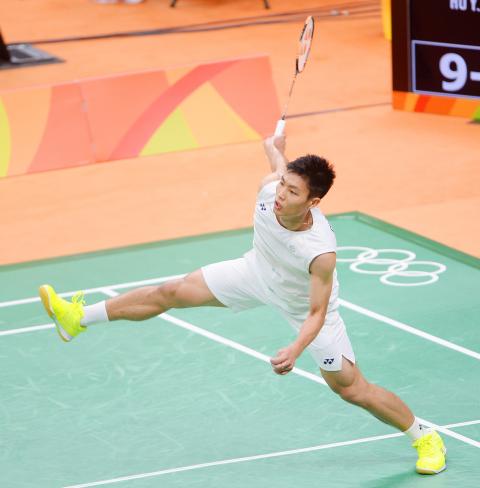
Photo: Lin Cheng-kung, Taipei Times
Chou, seeded sixth, said that he was happy to get into the quarter-finals, as it was his minimum goal, matching the best performance by a Taiwanese in the men’s singles in Olympic competition after Hsieh Yu-hsin (謝裕興) made the last eight in Beijing.
“The most important thing is to get a good rest so I can get into my best condition to face Lee, Malaysia’s No. 1,” Chou said.
Chou has never defeated Lee in four previous attempts, but he said every player has a chance.
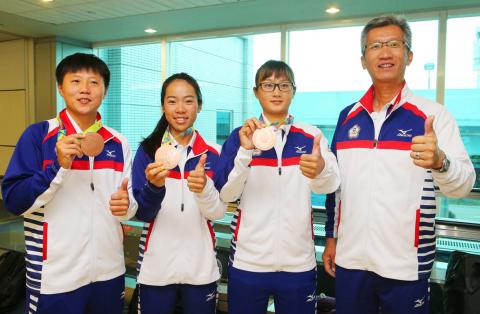
Photo: CNA
“Just look at how many seeded players have fallen,” Chou said.
He described Lee as a player who mixes up his shots well and disguises them effectively, making them hard for opponents to read.
Chou defeated Hu Yun (胡贇) of Hong Kong 21-10, 21-13 in their round-of-16 encounter yesterday, in a match he said was easier than expected.
Chou had a 2-3 career record against Hu going into the match, but he had won their past two contests and never seemed threatened by any part of his 34-year-old opponent’s game.
“The match against Hu may have been easier than I expected, but this is the Olympics, and every opponent is strong,” Chou said.
Tai, who was seeded eighth in the women’s singles, had buzzed through her two preliminary-round matches.
However, in facing ninth-seed Sindhu, Tai might have suffered from not being tested more as she was beleaguered by repeated mistakes and an inability to cope with the Indian’s aggressive play.
Her disappointment showed as tears fell as she spoke with reporters afterward.
“I’m sorry for letting you down,” said Tai, who tried hard to maintain her composure, but said it was difficult to do so “when thinking about everyone’s expectations and support.”
Tai had reached the round of 16 in the London Olympics in 2012 and had expected more in Rio.
“I’m very sad that I didn’t do better than last time,” she said. “It’s unfortunate because it’s not what I expected. I feel I didn’t play the way I’m capable of playing today.”
Tai had beaten her Indian opponent four of the previous six times they had played, but seemed troubled by Sindhu’s 1.79m height, often hitting the shuttlecock long and making unforced errors trying to do too much.

Japan has deployed long-range missiles in a southwestern region near China, the Japanese defense minister said yesterday, at a time when ties with Beijing are at their lowest in recent years. The missiles were installed in Kumamoto in the southern region of Kyushu, as Japan is attempting to shore up its military capacity as China steps up naval activity in the East China Sea. “Standoff defense capabilities enable us to counter the threat of enemy forces attempting to invade our country ... while ensuring the safety of our personnel,” Japanese Minister of Defense Shinjiro Koizumi said. “This is an extremely important initiative for

Chinese Nationalist Party (KMT) Chairwoman Cheng Li-wun (鄭麗文) today accepted an invitation from Chinese President Xi Jinping (習近平) to lead a delegation to China next month, saying she hopes to promote the peaceful development of cross-strait relations and bring stability to the Taiwan Strait. “I am grateful and happy to accept this invitation,” Cheng said in a statement from the KMT chairperson’s office. Cheng said she hopes both sides can work together to promote the peaceful development of cross-strait relations, enhance exchange and cooperation, bring stability to the Taiwan Strait and improve people’s livelihoods. At today's news conference, Cheng said any efforts to

MORE POPULAR: Taiwan Pass sales increased by 59 percent during the first quarter compared with the same period last year, the Tourism Administration said The Tourism Administration yesterday said that it has streamlined the Taiwan Pass, with two versions available for purchase beginning today. The tourism agency has made the pass available to international tourists since 2024, allowing them to access the high-speed rail, Taiwan Railway Corp services, four MRT systems and four Taiwan Tourist Shuttles. Previously, five types of Taiwan Pass were available, but some tourists have said that the offerings were too complicated. The agency said only two types of Taiwan Pass would be available, starting from a three-day pass with the high-speed rail and a three-day pass with Taiwan Railway Corp. The former costs NT$2,800

The nation’s fastest supercomputer, Nano 4 (晶創26), is scheduled to be launched in the third quarter, and would be used to train large language models in finance and national defense sectors, the National Center for High-Performance Computing (NCHC) said. The supercomputer, which would operate at about 86.05 petaflops, is being tested at a new cloud computing center in the Southern Taiwan Science Park in Tainan. The exterior of the server cabinet features chip circuitry patterns overlaid with a map of Taiwan, highlighting the nation’s central position in the semiconductor industry. The center also houses Taiwania 2, Taiwania 3, Forerunner 1 and


 RSS
RSS