


Uni-President Enterprises Corp (UPE, 統一企業) yesterday confirmed that founder and honorary chairman Kao Ching-yuan (高清愿) died last week at the age of 88.
A private funeral was held in Tainan’s Yongkang District (永康) yesterday, attended only by Kao’s family and friends, as well as Uni-President employees.
Born in Tainan on May 24, 1929, Kao was from a poor family and was not formally educated beyond elementary school. He founded UPE in 1967 and served as its chairman until 2013.
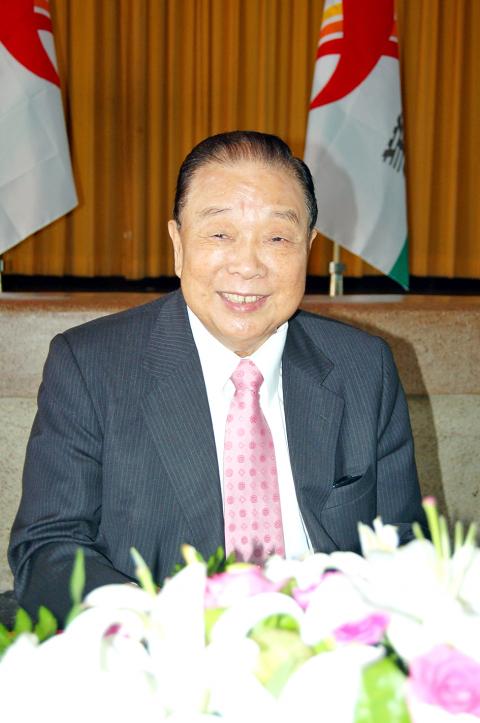
Photo: Yang Ya-min, Taipei Times
The company grew to become a conglomerate encompassing food manufacturing, retail, leisure and express-delivery services. It also operates the Starbucks coffee chain in Taiwan via a joint venture with the Seattle-based group.
The conglomerate is also known for operating 7-Eleven, the nation’s largest convenience store chain, through its affiliate President Chain Store Corp (PCSC, 統一超商).
Kao launched the convenience store chain in the 1980s, aiming to expand retail channels available for UPE products.
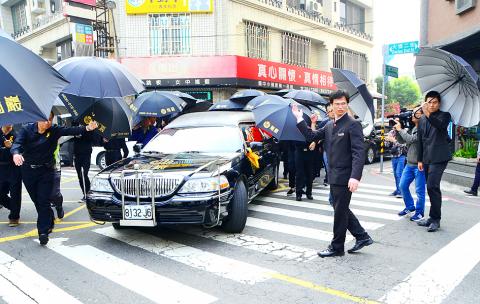
Photo: Wu Chun-feng, Taipei Times
UPE’s footprint expanded in the 1990s, with manufacturing bases set up in China, Indonesia, Thailand and other countries.
Kao, who had only one child, handed over the business to his son-in-law, Alex Lo (羅智先), in November 2013. Since then, the company has continued to grow under Lo’s leadership, weathering a series of food-safety crises in Taiwan while expanding its presence in China.
Lo’s management style and strategy of focusing on improving margins over sales growth has been well received by the market, with foreign institutional investors raising their holdings in UPE from about 44 percent to 52 percent in the past decade.
However, a potential succession challenge is on the horizon, as Lo had established a rule stipulating that key executives must retire at the age of 60 to make way for new talent.
Lo’s 60th birthday is this year.
Lo is expected to conform to the rule he has set, but major stakeholders in the company are likely to try to convince him to stay to avoid disruptions in leadership, industry observers said.
In addition, the company’s triennial board elections are to take place this year.
UPE’s net income rose 26.8 percent annually to NT$14.11 billion (US$435.79 million) last year, with earnings per share (EPS) of NT$2.48. Consolidated sales dipped 0.5 percent year-on-year to NT$416.15 billion.
PCSC’s net income decreased 9.8 percent to NT$8.24 billion last year, with EPS of NT$7.92, while consolidated sales grew 2.52 percent to NT$205.5 billion.
Despite a tepid consumption environment, UPE is expected to see continued solid growth and market share gains in all segments, driven by new product launches and contributions from its Chinese subsidiary, Uni-President China Holdings Ltd (UPC, 統一中國控股), Yuanta Securities Investment Consulting Co (元大投顧) said in a note this week.
Uni-President China last year saw net income rise 192 percent annually to 835 million yuan (US$129.18 million) as it continued its high-end product focus, coupled with a strong pipeline of new products, Yuanta said.

Japan has deployed long-range missiles in a southwestern region near China, the Japanese defense minister said yesterday, at a time when ties with Beijing are at their lowest in recent years. The missiles were installed in Kumamoto in the southern region of Kyushu, as Japan is attempting to shore up its military capacity as China steps up naval activity in the East China Sea. “Standoff defense capabilities enable us to counter the threat of enemy forces attempting to invade our country ... while ensuring the safety of our personnel,” Japanese Minister of Defense Shinjiro Koizumi said. “This is an extremely important initiative for
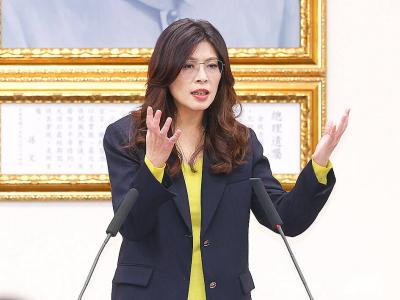
Chinese Nationalist Party (KMT) Chairwoman Cheng Li-wun (鄭麗文) today accepted an invitation from Chinese President Xi Jinping (習近平) to lead a delegation to China next month, saying she hopes to promote the peaceful development of cross-strait relations and bring stability to the Taiwan Strait. “I am grateful and happy to accept this invitation,” Cheng said in a statement from the KMT chairperson’s office. Cheng said she hopes both sides can work together to promote the peaceful development of cross-strait relations, enhance exchange and cooperation, bring stability to the Taiwan Strait and improve people’s livelihoods. At today's news conference, Cheng said any efforts to

MORE POPULAR: Taiwan Pass sales increased by 59 percent during the first quarter compared with the same period last year, the Tourism Administration said The Tourism Administration yesterday said that it has streamlined the Taiwan Pass, with two versions available for purchase beginning today. The tourism agency has made the pass available to international tourists since 2024, allowing them to access the high-speed rail, Taiwan Railway Corp services, four MRT systems and four Taiwan Tourist Shuttles. Previously, five types of Taiwan Pass were available, but some tourists have said that the offerings were too complicated. The agency said only two types of Taiwan Pass would be available, starting from a three-day pass with the high-speed rail and a three-day pass with Taiwan Railway Corp. The former costs NT$2,800

The nation’s fastest supercomputer, Nano 4 (晶創26), is scheduled to be launched in the third quarter, and would be used to train large language models in finance and national defense sectors, the National Center for High-Performance Computing (NCHC) said. The supercomputer, which would operate at about 86.05 petaflops, is being tested at a new cloud computing center in the Southern Taiwan Science Park in Tainan. The exterior of the server cabinet features chip circuitry patterns overlaid with a map of Taiwan, highlighting the nation’s central position in the semiconductor industry. The center also houses Taiwania 2, Taiwania 3, Forerunner 1 and


 RSS
RSS