


The four Chinese Nationalist Party (KMT) chairperson candidates had their first televised policy presentation yesterday.
The candidates presented their views and reform plans for a better party in the first round of policy presentations held by the party, before which chairperson candidate Hung Hsiu-chu (洪秀柱) and KMT Acting Chairperson and chairperson hopeful Huang Min-hui (黃敏惠) went to the Sun Yat-sen (孫逸仙) Memorial Hall to pay tribute to Sun on the anniversary of his death.
Hung, taking questions outside of the hall from the media about Sun’s legacy, said that Sun’s establishment of the Republic of China (ROC) should be “passed on rather than negated.”
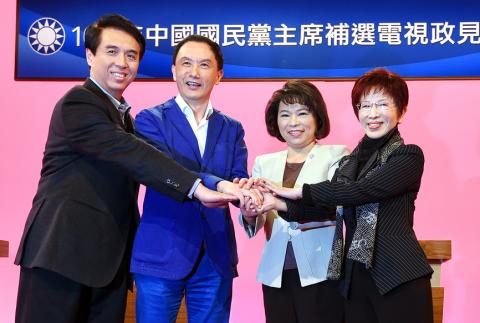
Photo: Liao Chen-huei, Taipei Times
While it has to be admitted that the KMT used to be a party-state during the authoritarian era, “the KMT and former president Chiang Ching-kuo (蔣經國) should be admired for his wise decision to lead Taiwan out of authoritarianism and toward democracy, which was the transitional justice achieved by Chiang,” Hung said.
In her policy presentation in the afternoon, Hung rejected claims that she advocates “immediate unification” with China.
“My view was said to be incompatible with the mainstream opinion during my presidential campaign, but to put it frankly, was my argument wrong?” Hung said. “It is unfortunate that some of our supporters and even comrades have lost hope in our cross-strait theory after the electoral rout; the responsibility of the chairperson would be to maintain the dignity of the existence of the ROC and its Constitution.”
Huang said that she supports the “one China, different interpretations” mantra signified by the so-called “1992 consensus,” adding that while the ROC governs Taiwan, Penghu, Kinmen and Matsu, “according to the Constitution it also has sovereignty over [China].”
Huang said in a debate held by the KMT’s younger generation last month that the ROC “is” Taiwan, Penghu, Kinmen and Matsu.
KMT chairperson candidate Apollo Chen (陳學聖) said that the KMT’s cross-strait policy should be one that follows the “1992 consensus,” but also upholds the value of Taiwan’s subjectivity.
“[Cross-strait] similarities and differences should be maintained,” he said.
KMT chairperson candidate Lee Hsin (李新) slammed Hung and Huang for “changing their positions all the time” and said that the KMT government’s cross-strait policy has degenerated into one characterized by a “surrender-like pro-China stance.”
Lee accused the party of failing to tell the public and party members what it has done wrong.
“Why has President Ma Ying-jeou (馬英九) not yet been examined [on his deeds by the party]?” Lee said.
The handling of party assets was also a common point of concern for the chairperson hopefuls.
Lee dismissed claims that the KMT’s party assets are all ill-gotten.
He said that the KMT government’s expenses had depended on US financial aid, profit from the export of agricultural products and the party fees that millions of military personnel and civil servants paid every month.
Saying that the party-state had also used the money from party members to support the building of local infrastructure and boosted Taiwan’s development, Lee added that the money was clean.
“Party assets that are legal belong to party members; those that are illegal belong to Taiwan’s 23 million people,” he said.
Chen called for making public the list of party assets and returning the illegal ones.
Huang also called for transparency on the issue, but added transitional justice should not be achieved with “means that contradict justice.”
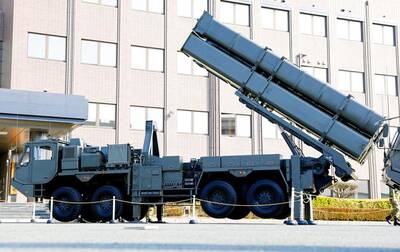
Japan has deployed long-range missiles in a southwestern region near China, the Japanese defense minister said yesterday, at a time when ties with Beijing are at their lowest in recent years. The missiles were installed in Kumamoto in the southern region of Kyushu, as Japan is attempting to shore up its military capacity as China steps up naval activity in the East China Sea. “Standoff defense capabilities enable us to counter the threat of enemy forces attempting to invade our country ... while ensuring the safety of our personnel,” Japanese Minister of Defense Shinjiro Koizumi said. “This is an extremely important initiative for
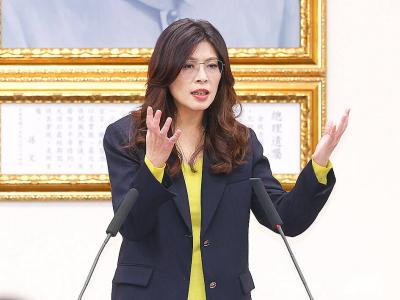
Chinese Nationalist Party (KMT) Chairwoman Cheng Li-wun (鄭麗文) today accepted an invitation from Chinese President Xi Jinping (習近平) to lead a delegation to China next month, saying she hopes to promote the peaceful development of cross-strait relations and bring stability to the Taiwan Strait. “I am grateful and happy to accept this invitation,” Cheng said in a statement from the KMT chairperson’s office. Cheng said she hopes both sides can work together to promote the peaceful development of cross-strait relations, enhance exchange and cooperation, bring stability to the Taiwan Strait and improve people’s livelihoods. At today's news conference, Cheng said any efforts to
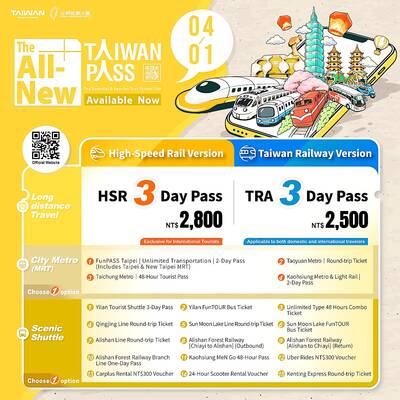
MORE POPULAR: Taiwan Pass sales increased by 59 percent during the first quarter compared with the same period last year, the Tourism Administration said The Tourism Administration yesterday said that it has streamlined the Taiwan Pass, with two versions available for purchase beginning today. The tourism agency has made the pass available to international tourists since 2024, allowing them to access the high-speed rail, Taiwan Railway Corp services, four MRT systems and four Taiwan Tourist Shuttles. Previously, five types of Taiwan Pass were available, but some tourists have said that the offerings were too complicated. The agency said only two types of Taiwan Pass would be available, starting from a three-day pass with the high-speed rail and a three-day pass with Taiwan Railway Corp. The former costs NT$2,800
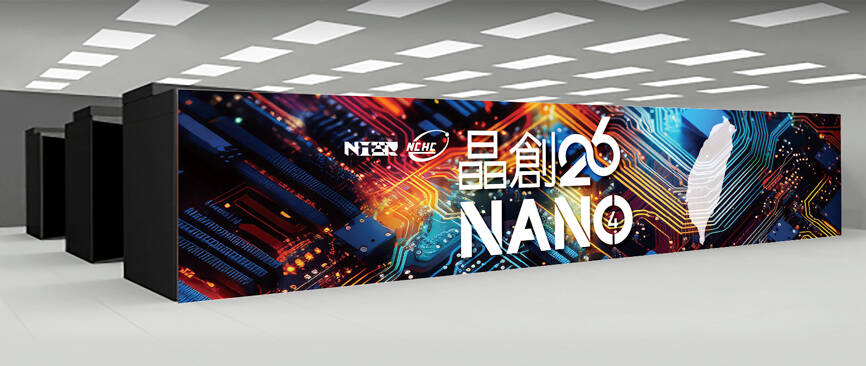
The nation’s fastest supercomputer, Nano 4 (晶創26), is scheduled to be launched in the third quarter, and would be used to train large language models in finance and national defense sectors, the National Center for High-Performance Computing (NCHC) said. The supercomputer, which would operate at about 86.05 petaflops, is being tested at a new cloud computing center in the Southern Taiwan Science Park in Tainan. The exterior of the server cabinet features chip circuitry patterns overlaid with a map of Taiwan, highlighting the nation’s central position in the semiconductor industry. The center also houses Taiwania 2, Taiwania 3, Forerunner 1 and


 RSS
RSS