


The Chinese Nationalist Party (KMT) caucus issued a public statement yesterday saying that it would participate in the review of the bill on party assets in the legislature “with a selfless, open and people-first attitude” and called on the party headquarters to return the assets to public interest groups or the government after deducting current and retired party workers’ pensions.
The statement said that the amassing of party assets “has its historical background,” as “the Republic of China [ROC] was established with the leadership of the KMT and the party army was the national army.”
“The ROC had gone through a long period of being a party-state,” it said.
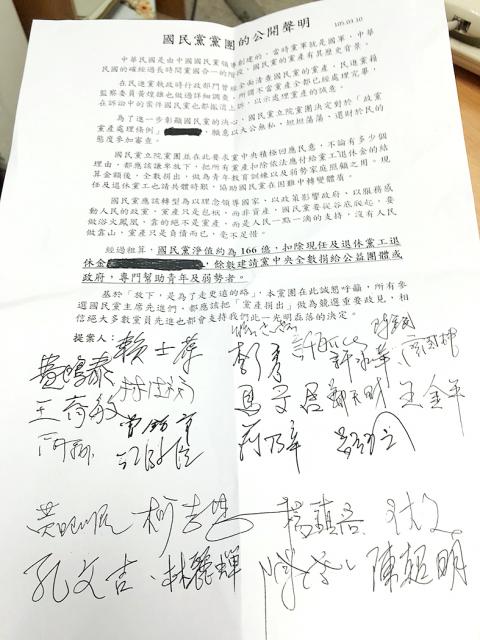
Photo: Chen Yu-hsuan, Taipei Times
During the Democratic Progressive Party’s (DPP) administration from 2000 to 2008, the KMT’s assets were thoroughly investigated by the executive department, while then-Control Yuan member Huang Huang-hsiung (黃煌雄) of the DPP had also conducted a detailed investigation, the statement said.
“The handling of the so-called ill-gotten party assets therefore had already been done; the KMT has also withdrawn all the appeals in the lawsuits pertaining to the assets to show its sincerity in handling party assets,” the statement said.
“To further show the KMT’s determination, the party caucus has decided to participate in the review of the bill governing party assets proposed in the legislature with a selfless, open and people-first attitude,” the statement said.
“The KMT caucus asks the party headquarters to proactively respond to the public. [We] should face the public, be humble and let [the assets] go without making excuses. [We] should, after keeping enough to pay for party workers’ pensions, donate all the assets for the use of educational training and helping vulnerable families,” KMT caucus whip Lai Shyh-bao (賴士葆) said.
KMT Administration and Management Committee director Lin Yu-hsien (林祐賢), who was invited to the caucus meeting, said that as of Dec. 31 last year, the net worth of the assets was about NT$16.6 billion (US$501.8 million), most of which are illiquid assets.
Lai said that the committee revealed all the data about party assets during the meeting and the party caucus would also make the data open to the public.
The statement also said that the KMT should transform itself into a party that could “lead the country with ideas, influence the government with policies and move the people with service.”
“The assets are burdens on the party and are debts rather than assets; the party has to rely on public support rather than its assets to pick itself up from the ground,” the statement said.
Lin denied the rumor that the KMT possesses more than NT$100 billion worth of party assets, saying that the highest figure ever was about NT$91.8 billion, of which at least NT$42.7 billion had been lost in the Asian financial crisis after former president Lee Teng-hui (李登輝) of the KMT ordered to have the assets used to bail out corporations.
KMT Secretary-General Lee Shu-chuan (李四川) said that the KMT is “definitely not as rich as some people deliberately trumpeted,” adding that the party has a “financial deficit of NT$800 million per year” and a bank loan of NT$18.6 billion from the Central Investment Co.
Questioning the NT$16.6 billion figure, Democratic Progressive Party Legislator Lee Chun-yi (李俊俋) said it looks to him that the KMT “is shifting the responsibility to Lee Teng-hui.”
The point is not how much of the party assets were owned under whose term of chairmanship, but how the KMT amassed its assets, he added.
New Power Party caucus whip Hsu Yung-ming (徐永明) said that transitional justice is not only about chasing the ill-gotten party assets, but also about uncovering the truth.
“Taiwanese would not find it acceptable if the KMT simply just ‘returns’ the money,” Hsu said.
Additional reporting by Aaron Tu and Chen Yu-hsuan
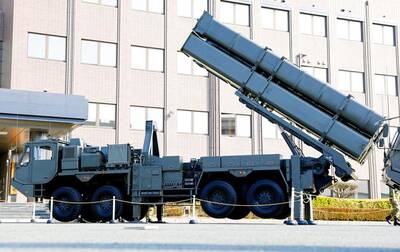
Japan has deployed long-range missiles in a southwestern region near China, the Japanese defense minister said yesterday, at a time when ties with Beijing are at their lowest in recent years. The missiles were installed in Kumamoto in the southern region of Kyushu, as Japan is attempting to shore up its military capacity as China steps up naval activity in the East China Sea. “Standoff defense capabilities enable us to counter the threat of enemy forces attempting to invade our country ... while ensuring the safety of our personnel,” Japanese Minister of Defense Shinjiro Koizumi said. “This is an extremely important initiative for
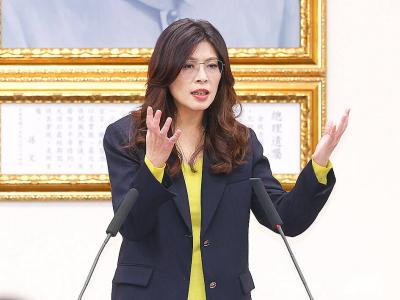
Chinese Nationalist Party (KMT) Chairwoman Cheng Li-wun (鄭麗文) today accepted an invitation from Chinese President Xi Jinping (習近平) to lead a delegation to China next month, saying she hopes to promote the peaceful development of cross-strait relations and bring stability to the Taiwan Strait. “I am grateful and happy to accept this invitation,” Cheng said in a statement from the KMT chairperson’s office. Cheng said she hopes both sides can work together to promote the peaceful development of cross-strait relations, enhance exchange and cooperation, bring stability to the Taiwan Strait and improve people’s livelihoods. At today's news conference, Cheng said any efforts to
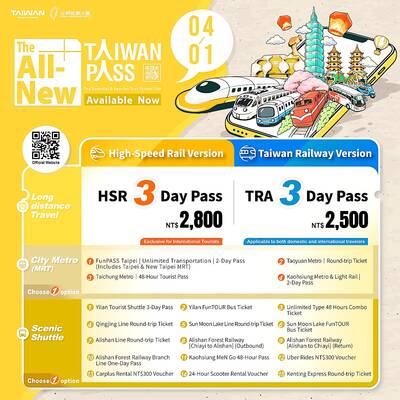
MORE POPULAR: Taiwan Pass sales increased by 59 percent during the first quarter compared with the same period last year, the Tourism Administration said The Tourism Administration yesterday said that it has streamlined the Taiwan Pass, with two versions available for purchase beginning today. The tourism agency has made the pass available to international tourists since 2024, allowing them to access the high-speed rail, Taiwan Railway Corp services, four MRT systems and four Taiwan Tourist Shuttles. Previously, five types of Taiwan Pass were available, but some tourists have said that the offerings were too complicated. The agency said only two types of Taiwan Pass would be available, starting from a three-day pass with the high-speed rail and a three-day pass with Taiwan Railway Corp. The former costs NT$2,800

The nation’s fastest supercomputer, Nano 4 (晶創26), is scheduled to be launched in the third quarter, and would be used to train large language models in finance and national defense sectors, the National Center for High-Performance Computing (NCHC) said. The supercomputer, which would operate at about 86.05 petaflops, is being tested at a new cloud computing center in the Southern Taiwan Science Park in Tainan. The exterior of the server cabinet features chip circuitry patterns overlaid with a map of Taiwan, highlighting the nation’s central position in the semiconductor industry. The center also houses Taiwania 2, Taiwania 3, Forerunner 1 and


 RSS
RSS