


A broad majority of voters across party lines believe that transitional justice remains incomplete, according to a poll released yesterday by the Chinese-language weekly Business Today, even as potential legal challenges continue to complicate the drafting of legislation on the issue.
The survey found that 76.3 percent of respondents believe that the nation has yet to achieve transitional justice, which was defined as investigating past human rights violations and the seizure of national property by privileged groups.
Large majorities also supported investigation into two Chinese Nationalist Party (KMT) “peripheral organizations,” the China Youth Corps and National Women’s League of the Republic of China.
Asked if the two groups should face examination as part of the transitional justice process, 66.6 percent of respondents said the youth corps should be examined and 72.9 said yes for the league.
Both organizations were founded shortly after the KMT government fled to Taiwan following its loss in the Chinese Civil War, with Chiang Kai-shek’s (蔣介石) wife, Soong Mayling (宋美齡), heading the league during its early years, and his son and later president, Chiang Ching-kuo (蔣經國), heading the youth group.
Of those in favor of inquiries into the two groups, more than 60 percent preferred requiring both organizations to appoint only nonpartisan people to their supervisory and governing boards to direct disbandment.
More than 66 percent of respondents identifying themselves as KMT supporters agreed that the nation had yet to achieve transitional justice, more than 58 percent said the youth corps should be subject to examination and 54 percent said the same about the league.
“Asking the people is the clearest way to decide whether or not transitional justice has been completed,” Business Today president Andy Liang (梁永煌) said, adding that transitional justice was the “last mile” in the journey toward becoming a true democratic nation.
While property controlled by the two organizations had been provided largely by the central government, their boards were still dominated by KMT members, he said, adding that the league prevented outsiders from participating or standing for board elections by requiring recommendations from two current members to be considered for admission.
New Power Party executive chairman Huang Kuo-chang (黃國昌) said that while the corps and the league had a history of using national resources to perform “peripheral work” for the KMT, properly designing legislation directed at the groups was crucial because of the possibility of legal challenges.
“The prickly issue now is that in the process of their development — by using improper means to obtain national property and resources — many such organizations incorporated legal personages to provide them with a protective umbrella,” he said.
Most such organizations are considered legally independent of the KMT, operating in accordance with incorporation articles, which makes targeting them more challenging than recovering “illicit assets” under direct KMT control, he said.
“When we face these problems, it is difficult to avoid the issue of retroactively targeting what has already taken place, because there will not be any correction or restoration to past injustices if you do not,” Huang added.
“Passing legislation should be relatively smooth, but what I am really concerned about are the subsequent lawsuits and allegations of violating the Constitution, because that will be the real challenge,” he said.
The survey was conducted by Taiwan Indicators Survey Research with 1,121 respondents selected through stratified random sampling. It had a margin of error of plus or minus-2.9 percentage points at a 95 percent level of confidence.

The National Chungshan Institute of Science and Technology yesterday showcased its locally developed variants of the Vision 60 robotic patrol dog, which it plans to deploy on the nation’s outlying territories in the South China Sea. The variants were produced under the Joint Lab project — created by the institute and domestic companies — and assembled with domestically produced motors, lenses and artificial intelligence (AI) systems alongside licensed tech from the US, Missile and Rocket Systems Research Division deputy director Jen Kuo-kang (任國光) told the media event at a military base in Taipei’s Dazhi (大直) area. Taiwan has built up its strengths

RIGHT DIRECTION: Taiwan’s efforts to prevent forced labor include a proposal to ‘fully prohibit’ employers from withholding workers’ documents, an official said Taiwan is to establish a mechanism to restrict imports of goods linked to forced labor, the Executive Yuan said yesterday, after the US proposed imposing additional tariffs on Taiwanese goods over labor concerns. “The Ministry of Labor and the Ministry of Economic Affairs are to establish an interministerial review procedure,” Executive Yuan spokesperson Michelle Lee (李慧芝) said at a news briefing in Taipei. “The government is to use the Foreign Trade Act [貿易法] as the legal basis to restrict imports of goods produced with forced labor” and bring its supply chain governance more in line with international standards on human rights, resilience

NOT IMMEDIATE: Taiwan has a chance to appeal the proposed 10 percent tariff before it starts, while other countries face a 12.5 percent tariff from the trade office Taiwan is among 60 economies determined by the US to have failed to impose or enforce a ban on the importation of goods produced with forced labor, according to a notice released on Tuesday by the Office of the US Trade Representative (USTR), which proposed imposing an additional 10 percent or more tariff on them. The USTR in a statement said that following an investigation, it had determined under Section 301 of the Trade Act of 1974 that the failure of the 60 economies to impose and effectively enforce a prohibition on the importation of goods produced with forced labor is
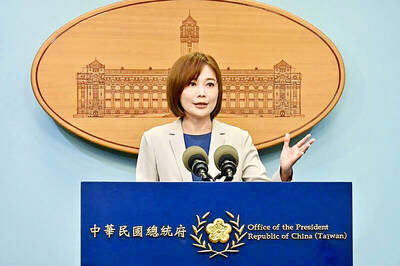
TIT-FOR-TAT: The US allegedly revoked the visa of a Chinese national working at Xinhua News Agency in the US in response to Beijing’s expulsion of Vivian Wang The Presidential Office yesterday condemned China for expelling a New York Times correspondent from Beijing following the newspaper’s interview with President William Lai (賴清德), saying the move highlighted Beijing’s suppression of press freedom and its threat to international news media. Taiwan has noted a series of recent incidents in which Beijing used similar tactics to “threaten and pressure international media outlets and journalists,” Presidential Office spokeswoman Karen Kuo (郭雅慧) said in a statement. “This concerns not only press freedom and freedom of expression, but also the safety of journalists, and Taiwan and relevant partners are paying close attention to the situation,” she


 RSS
RSS