


Less than two weeks before the 69th anniversary of the 228 Incident, the Taipei High Administrative Court yesterday ruled in favor of Keisho Aoyama, the son of a Japanese victim of the massacre, in his compensation request.
The court ruled that he is eligible for NT$6 million (US$190,077) in compensation for his father’s death.
If the 228 Memorial Foundation and the Ministry of the Interior decide not to appeal, the ruling would make Aoyama the first foreigner to be compensated for the 228 Incident, the Taiwan Association for Human Rights (TAHR) said.
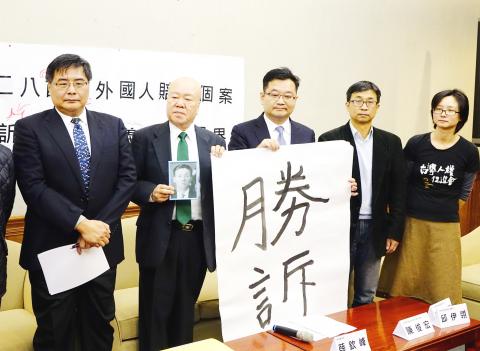
Photo: Wang Yi-sung, Taipei Times
Aoyama, from Okinawa, Japan, filed for compensation with the 228 Memorial Foundation in 2011 (officially processed in 2013) for his father, Esaki Aoyama, who was, according to various records, captured by the Chinese Nationalist Party (KMT) regime’s army in 1947 when his ship from Okinawa reached the shore of Keelung and was later reportedly murdered on Heping Island (和平島), which was at that time called Sheliao Island (社寮島).
Esaki Aoyama boarded the ship bound for Keelung for a reunion with his wife and son, who were still living in Keelung, after he returned from Vietnam as a draftee soldier.
Keisho Aoyama’s request was rejected by the foundation in 2014, despite his father being recognized as a 228 Incident victim. With the help of the TAHR and Taiwanese lawyers, he filed an administrative lawsuit with the Taipei High Administrative Court in September last year.
The court said in its press release that the Feb. 28 Incident Disposition and Compensation Act (二 二 八事件處理及賠償條例), promulgated in 1995, does not state that compensation should be restricted to Taiwanese.
Taiwan also ratified in 2009 two international human rights covenants, it said, adding that any violation of human rights should be effectively compensated with no discriminatory treatment.
Hsueh Chin-feng (薛欽峰), the lawyer representing Keisho Aoyama, lauded the decision as a “historic ruling,” saying its significance lies in having set a precedent that regardless of nationality, everyone should be equally protected by the law.
“The court stated that the 228 compensation act, a special law, has priority over the State Compensation Law (國家賠償法), a general law,” Hsueh, said referring to the ministry’s invoking of the Article 15 of the state compensation law that says the provisions of the law “shall be applicable to a foreign claimant only to the extent that the people of the Republic of China, according to a treaty, law, or custom of that person’s country, enjoy the same rights in that country.”
The ministry, the competent authority of the supposedly independent 228 Memorial Foundation, had hindered the approval of Keisho Aoyama’s compensation request by suggesting that since Japan has not compensated Taiwanese comfort women and former Taiwanese service personnel, “the principle of reciprocity” maintained in the state compensation law does not apply, TAHR said.
Keisho Aoyama, who appeared at a news conference in Taipei yesterday, said the ruling was “a groundbreaking one upholding justice and human rights,” thanking those who had offered him assistance along the way.
“While the problems of Taiwanese comfort women and Japanese soldiers still exist, the ruling is a great deed in its attempt to overcome this vicious cycle,” he said.
He called on the government and the foundation not to appeal the ruling.
TAHR executive board member Fort Liao (廖福特) echoed the call, asking the ministry “not to manufacture more excuses, especially during a period of transition of power.”
“This is belated justice. Financial compensation is not the point; what matters most is the state’s recognition of Esaki Aoyama as a victim of the state’s human rights violations,” Liao said.
“The ruling shows that the state cannot avoid its responsibility because the victim of the state’s human rights violation is a foreigner,” he said.
228 Memorial Foundation chief executive Liao Chie-ping (廖繼斌) said the foundation’s board would meet on Wednesday next week to discuss the ruling and that he hoped the conclusion would be announced before Feb. 28.
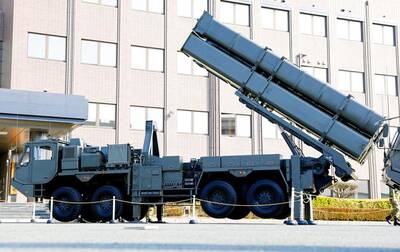
Japan has deployed long-range missiles in a southwestern region near China, the Japanese defense minister said yesterday, at a time when ties with Beijing are at their lowest in recent years. The missiles were installed in Kumamoto in the southern region of Kyushu, as Japan is attempting to shore up its military capacity as China steps up naval activity in the East China Sea. “Standoff defense capabilities enable us to counter the threat of enemy forces attempting to invade our country ... while ensuring the safety of our personnel,” Japanese Minister of Defense Shinjiro Koizumi said. “This is an extremely important initiative for
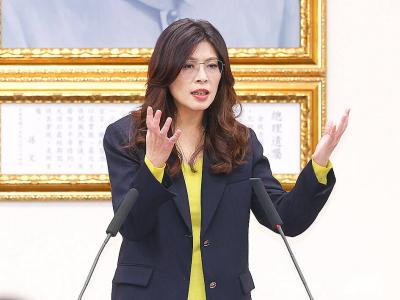
Chinese Nationalist Party (KMT) Chairwoman Cheng Li-wun (鄭麗文) today accepted an invitation from Chinese President Xi Jinping (習近平) to lead a delegation to China next month, saying she hopes to promote the peaceful development of cross-strait relations and bring stability to the Taiwan Strait. “I am grateful and happy to accept this invitation,” Cheng said in a statement from the KMT chairperson’s office. Cheng said she hopes both sides can work together to promote the peaceful development of cross-strait relations, enhance exchange and cooperation, bring stability to the Taiwan Strait and improve people’s livelihoods. At today's news conference, Cheng said any efforts to
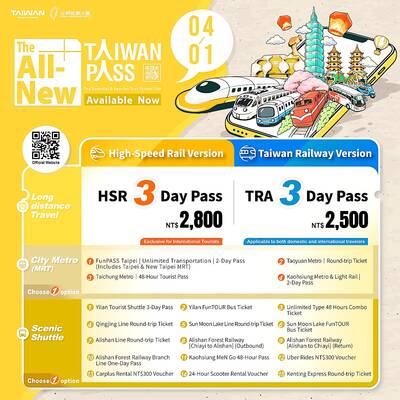
MORE POPULAR: Taiwan Pass sales increased by 59 percent during the first quarter compared with the same period last year, the Tourism Administration said The Tourism Administration yesterday said that it has streamlined the Taiwan Pass, with two versions available for purchase beginning today. The tourism agency has made the pass available to international tourists since 2024, allowing them to access the high-speed rail, Taiwan Railway Corp services, four MRT systems and four Taiwan Tourist Shuttles. Previously, five types of Taiwan Pass were available, but some tourists have said that the offerings were too complicated. The agency said only two types of Taiwan Pass would be available, starting from a three-day pass with the high-speed rail and a three-day pass with Taiwan Railway Corp. The former costs NT$2,800

The nation’s fastest supercomputer, Nano 4 (晶創26), is scheduled to be launched in the third quarter, and would be used to train large language models in finance and national defense sectors, the National Center for High-Performance Computing (NCHC) said. The supercomputer, which would operate at about 86.05 petaflops, is being tested at a new cloud computing center in the Southern Taiwan Science Park in Tainan. The exterior of the server cabinet features chip circuitry patterns overlaid with a map of Taiwan, highlighting the nation’s central position in the semiconductor industry. The center also houses Taiwania 2, Taiwania 3, Forerunner 1 and


 RSS
RSS