


The death toll from the earthquake on Saturday last week rose to 62 yesterday as rescuers pulled nine bodies from the ruins of the Weiguan Jinlong complex in Tainan, while rain that began to fall at about 5pm brought with it lower temperatures.
Members of two families were among those retrieved from the disaster site in Yongkang District (永康), including two brothers, and a man and a woman whose identity has yet to be confirmed.
One of the families, surnamed Cheng (鄭), were from New Taipei City’s Sindian District and were spending the Lunar New Year holiday in an apartment on the 13th floor of Building G, which was owned by the sister of Cheng’s wife.

Photo: Johnson Lai, AP
Four members of the other family, surnamed Tsai (蔡), died in the quake. The father is the only survivor. Rescuers said that the grandmother of the family was holding tight to her granddaughter when their bodies were found.
As of 5:44pm, the Tainan City Government said 62 people are still believed to be under the rubble.
A woman whose relatives are among those still missing in the ruins yesterday accused the city of allowing a large excavator to be driven onto the remains of Building G to rescue survivors.
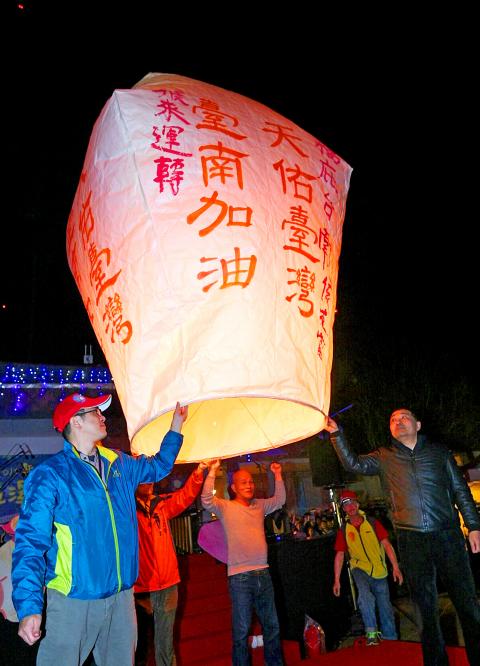
Photo: Chang Chia-ming, Taipei Times
She said that the additional weight of the excavator could further crush the bodies of the victims still under the rubble.
Tainan Mayor William Lai (賴清德) apologized to the relatives of the missing, saying the leader of a rescue team had mistakenly allowed the large piece of machinery to be moved into a cordoned-off area.
He said he had asked that the excavator be removed immediately.
However, Lai defended the use of large excavators, saying that they were being used to save lives by helping clear the way for search teams to find survivors and preserve the bodies of the deceased.
Structural engineers assisting the rescue teams at the site said that having an excavator on top of the building should not hurt any possible survivors or bodies because the building was supported by at least two beams and a wall.
Heavy rainfall did impede the search efforts later in the day and military personnel covered several locations with tarps in an attempt to prevent the rain from triggering further collapses inside the rubble.
Meanwhile, the electronics store chain TsannKuen Co (燦坤實業) denied that it had remodeled a store on the ground floor of the Weiguang Jinlong complex.
TsannKuen general manager Chang Yueh-long (張岳龍) showed reporters photographs of the store when they leased it as well as the contract banning the firm from making structural changes.
“We have rented the ground floor and the second floor since 2004 and never remodeled them,” Chang said.
There have been allegations that the landlord who owned the first four floors of buildings A, B and C in the complex had removed all of the beams and columns on those floors, which might have made the buildings less stable in an earthquake.

FREEDOM OF NAVIGATION: The UK would continue to reinforce ties with Taiwan ‘in a wide range of areas’ as a part of a ‘strong unofficial relationship,’ a paper said The UK plans to conduct more freedom of navigation operations in the Taiwan Strait and the South China Sea, British Secretary of State for Foreign, Commonwealth and Development Affairs David Lammy told the British House of Commons on Tuesday. British Member of Parliament Desmond Swayne said that the Royal Navy’s HMS Spey had passed through the Taiwan Strait “in pursuit of vital international freedom of navigation in the South China Sea.” Swayne asked Lammy whether he agreed that it was “proper and lawful” to do so, and if the UK would continue to carry out similar operations. Lammy replied “yes” to both questions. The
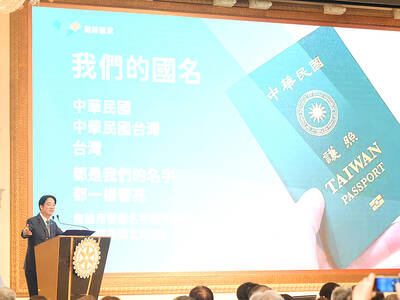
‘OF COURSE A COUNTRY’: The president outlined that Taiwan has all the necessary features of a nation, including citizens, land, government and sovereignty President William Lai (賴清德) discussed the meaning of “nation” during a speech in New Taipei City last night, emphasizing that Taiwan is a country as he condemned China’s misinterpretation of UN Resolution 2758. The speech was the first in a series of 10 that Lai is scheduled to give across Taiwan. It is the responsibility of Taiwanese citizens to stand united to defend their national sovereignty, democracy, liberty, way of life and the future of the next generation, Lai said. This is the most important legacy the people of this era could pass on to future generations, he said. Lai went on to discuss
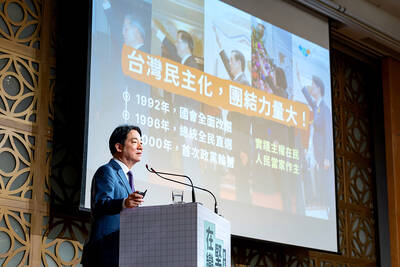
SECOND SPEECH: All political parties should work together to defend democracy, protect Taiwan and resist the CCP, despite their differences, the president said President William Lai (賴清德) yesterday discussed how pro-Taiwan and pro-Republic of China (ROC) groups can agree to maintain solidarity on the issue of protecting Taiwan and resisting the Chinese Communist Party (CCP). The talk, delivered last night at Taoyuan’s Hakka Youth Association, was the second in a series of 10 that Lai is scheduled to give across Taiwan. Citing Taiwanese democracy pioneer Chiang Wei-shui’s (蔣渭水) slogan that solidarity brings strength, Lai said it was a call for political parties to find consensus amid disagreements on behalf of bettering the nation. All political parties should work together to defend democracy, protect Taiwan and resist
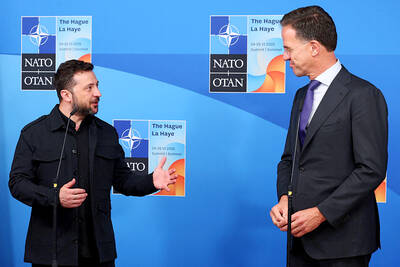
By refusing to agree spending increases to appease US President Donald Trump, Spanish Prime Minister Pedro Sanchez threatened to derail a summit that NATO Secretary-General Mark Rutte needs to run smoothly for the sake of the military alliance’s future survival. Ahead of yesterday’s gathering in The Hague, Netherlands, things were going off the rails. European officials have expressed irritation at the spoiler role that Sanchez is playing when their No. 1 task is to line up behind a pledge to raise defense spending to 5 percent of GDP. Rutte needed to keep Spain in line while preventing others such as Slovakia


 RSS
RSS