


The Tainan District Prosecutors’ Office yesterday sent a team of four prosecutors to inspect the ruins of the Weiguan Jinlong building in Tainan’s Yongkang District (永康) to investigate allegations of shoddy workmanship that may have caused its collapse in Saturday’s earthquake.
The bulk of the complex was left lying on its side after the magnitude 6.4 earthquake hit southern Taiwan at 3:57am on Saturday, and it has been the site of most of the casualties from the temblor.
An unknown number of people were believed to be still trapped in the rubble and rescue operations were ongoing at press time last night.
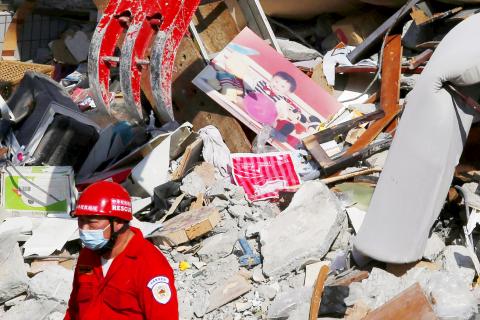
Photo: Tyrone Siu, Reuters
Advisers from the Tainan Civil Engineers’ Association volunteered to help at the site to provide rescue workers with their expertise to facilitate the use of equipment.
Government records show that a construction license was issued 1992 and building was completed in 1994.
The complex was built by the now-defunct Weiguan Construction Co (維冠建設公司), Construction and Planning Agency Director-General Hsu Wun-long (許文龍) said.
Minister of the Interior Chen Wei-zen (陳威仁) said a full legal investigation would be launched after the conclusion of rescue operations to find if anyone was to blame for the disaster.
Tainan Mayor William Lai (賴清德) said in a Facebook post that the city government is helping the prosecutors in their investigation, and that three engineering associations had agreed to help evaluate articles of evidentiary value and keep the items safe.
If and when prosecutors file charges, “the city government will be at the side of its residents and protect the public interest,” he said.
The city government has prioritized compensation to families affected by the disaster in handling the donations that have been pouring in, and some money has already been distributed, he said.
Sources have said Lee Ming-hui (李明輝) was the owner of Weiguang Construction at the time the complex was built. He reportedly has a reputation in the construction industry for being able to obtain contracts, but also for his controversial managerial style.
The quality of Lee’s construction projects has been called into question following the collapse of the Weiguan Jinlong building and the discovery of empty cans in its cracked pillars.
Building residents were quoted by the Chinese-language Apple Daily as saying that during the quake, the building rocked “up and down” and then began to sway “left and right” before the collapse, raising suspicion that the building’s short sides and height meant it lacked the necessary depth to provide adequate support for its weight in a quake.
They said the collapse appears to have begun at the building’s arcade, which contained a smaller number of pillars and struts than the rest of the building.
Tainan Civil Engineers’ Association director-general Cheng Ming-chang (鄭明昌) said the 21-year-old building’s arcade on the east side appeared to have contained fewer struts, pillars and walls than needed for structural support during a quake.
The hollowed-out ground floor of the building is reminiscent of several buildings that collapsed during the 921 Earthquake in 1999.
The mother of one of the injured residents was quoted by Reuters as saying that residents had long complained of many problems such as tiles falling from walls, malfunctioning elevators and blocked pipes.
Additional reporting by Reuters

Japan has deployed long-range missiles in a southwestern region near China, the Japanese defense minister said yesterday, at a time when ties with Beijing are at their lowest in recent years. The missiles were installed in Kumamoto in the southern region of Kyushu, as Japan is attempting to shore up its military capacity as China steps up naval activity in the East China Sea. “Standoff defense capabilities enable us to counter the threat of enemy forces attempting to invade our country ... while ensuring the safety of our personnel,” Japanese Minister of Defense Shinjiro Koizumi said. “This is an extremely important initiative for
Chinese Nationalist Party (KMT) Chairwoman Cheng Li-wun (鄭麗文) today accepted an invitation from Chinese President Xi Jinping (習近平) to lead a delegation to China next month, saying she hopes to promote the peaceful development of cross-strait relations and bring stability to the Taiwan Strait. “I am grateful and happy to accept this invitation,” Cheng said in a statement from the KMT chairperson’s office. Cheng said she hopes both sides can work together to promote the peaceful development of cross-strait relations, enhance exchange and cooperation, bring stability to the Taiwan Strait and improve people’s livelihoods. At today's news conference, Cheng said any efforts to

MORE POPULAR: Taiwan Pass sales increased by 59 percent during the first quarter compared with the same period last year, the Tourism Administration said The Tourism Administration yesterday said that it has streamlined the Taiwan Pass, with two versions available for purchase beginning today. The tourism agency has made the pass available to international tourists since 2024, allowing them to access the high-speed rail, Taiwan Railway Corp services, four MRT systems and four Taiwan Tourist Shuttles. Previously, five types of Taiwan Pass were available, but some tourists have said that the offerings were too complicated. The agency said only two types of Taiwan Pass would be available, starting from a three-day pass with the high-speed rail and a three-day pass with Taiwan Railway Corp. The former costs NT$2,800

The nation’s fastest supercomputer, Nano 4 (晶創26), is scheduled to be launched in the third quarter, and would be used to train large language models in finance and national defense sectors, the National Center for High-Performance Computing (NCHC) said. The supercomputer, which would operate at about 86.05 petaflops, is being tested at a new cloud computing center in the Southern Taiwan Science Park in Tainan. The exterior of the server cabinet features chip circuitry patterns overlaid with a map of Taiwan, highlighting the nation’s central position in the semiconductor industry. The center also houses Taiwania 2, Taiwania 3, Forerunner 1 and


 RSS
RSS