


Taipei Mayor Ko Wen-je’s (柯文哲) approval ratings have dipped below 50 percent, a survey by the Chinese-language China Times showed, with Ko attributing the fall to public complaints about traffic congestion because of the city’s bicycle lane construction project.
The results released on Thursday showed that 47.7 percent of respondents were satisfied with Ko’s governance, while 30.1 percent said otherwise.
The figures represented a major fall in the mayor’s approval rating compared with polls conducted by the city’s Research, Development and Evaluation Commission in December, in which he garnered a satisfaction rating of 69.3 percent.
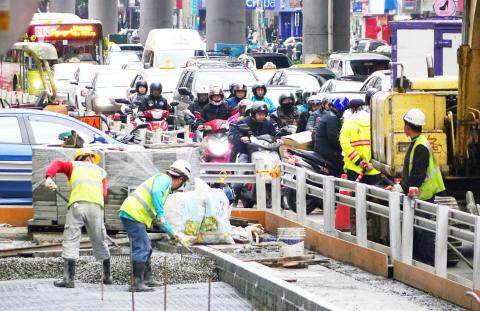
Photo: Lin Cheng-kun, Taipei Times
Asked to comment on his sliding ratings, Ko said: “I think this is due to the recent traffic situation.”
Asked if he would make changes to his governance style, Ko said that his administration would, in addition to reflecting on its mistakes, compile a list of items that might have contributed to the recent traffic congestion and give priority to problems that can be resolved in the short term.
“Sometimes you stride fearlessly forward. Other times you need to turn around and make amends. I think this will take some time,” Ko said.
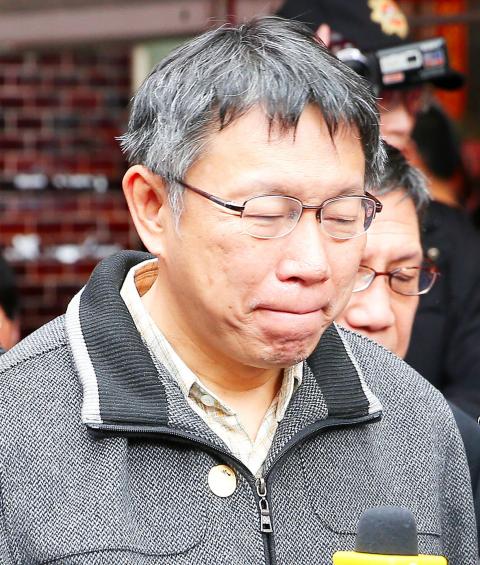
Photo: CNA
During a radio interview a day earlier, the mayor admitted that the city’s “three latitudinal, three longitudinal” bicycle network project has “hit a snag” because of the work being carried out simultaneously at various locations.
The media and some residents have cited the constructions as a factor behind heavy traffic jams since late last month.
Taipei Department of Transportation Commissioner Chung Hui-yu (鍾慧諭) said that the department is mulling levying “congestion charges” on vehicles entering Neihu District (內湖) during rush hours.
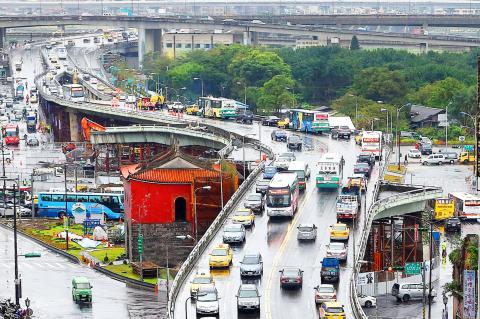
Photo: Chien Jung-fong, Taipei Times
The fees would likely be charged through a device similar to those used in the eTag toll system, she said.
The policy is being considered, along with a proposed high occupancy scheme that would require vehicles in the district to carry at least two passengers.
Ko said the congestion fee has to be approved by the city council and is unlikely to be implemented soon.
Department division chief Huang Hui-ju (黃惠如) said that an average of 28,000 vehicles enter Neihu every day during the morning peak hours from 7am to 9am.
More than 70 percent of these vehicles do not carry any passengers, Huang said.
Another likely contributing factor to Neihu’s frequent traffic jams is parking convenience, with many businesses in the area providing free parking spaces for their employees, she said.
Huang added that 48 percent of car parking spaces and 66 percent of scooter parking spaces in the district are free.
In related news, the department yesterday unveiled plans to alleviate potential traffic congestion caused by the demolition of an onramp connected to the Zhongxiao Bridge (忠孝橋), which is scheduled to take place between tomorrow and Sunday next week.
Department division chief Chang Sheng-wan (張生萬) said the project’s contractor would deploy personnel to hold up placards at nine locations in Sanchong (三重) and 10 other locations in New Taipei City to inform drivers about the demolition and advise them to take detours.
Chang said that if congestion in Sanchong spans 3km, vehicles taking the bridge would be barred from accessing Zhongxiao W Road and would be directed to the ramp leading to Huanhe Expressway.
If congestion extends 5km, two onramps on Jhongjheng S Road in New Taipei City and Zhonghua Road would be closed, he said.
Taipei Police Department Traffic Division head Wu Yao-nan (吳耀南) said the department would bring the time officers and volunteer traffic directors work forward to 3pm throughout this month.
Officers at Wanhua, Datong and Zhongzheng First precincts near the demolition would work extended hours from 7am to 12am at major road intersections, such as the Zhongxiao W Road and Chongqing S Road intersection, and the Zhongxiao W Road and Poai Road intersection to direct traffic, Wu said.
Department Deputy Commissioner Chang Jer-yang (張哲揚) said that traffic in the area between Sanchong, Jianguo Overpass, Minquan W and E roads and Aiguo E Road is expected to be affected by the demolition project.

‘NO SECURITY RISK’: The Railway Bureau reassured the public that the technicians’ activities were limited to technical guidance and did not involve sensitive systems The Railway Bureau yesterday said it had invited eight Chinese technicians to assist with an airport MRT construction project. The bureau issued the confirmation after an Internet user said Chinese nationals had entered the construction zone of Taiwan Taoyuan International Airport’s Terminal 3 project. They asked why “individuals from an enemy state” were allowed access to such a major national infrastructure project, which raised serious concerns over Taiwan’s industrial safety, sensitive systems and information security. The bureau’s Northern Region Engineering Branch Office said subcontractor Taiwan Handle Industrial Co (台灣手把工業) of the Taoyuan airport MRT’s “Contract No. CU05 Project A14 Station Civil, MEP &

The National Chungshan Institute of Science and Technology yesterday showcased its locally developed variants of the Vision 60 robotic patrol dog, which it plans to deploy on the nation’s outlying territories in the South China Sea. The variants were produced under the Joint Lab project — created by the institute and domestic companies — and assembled with domestically produced motors, lenses and artificial intelligence (AI) systems alongside licensed tech from the US, Missile and Rocket Systems Research Division deputy director Jen Kuo-kang (任國光) told the media event at a military base in Taipei’s Dazhi (大直) area. Taiwan has built up its strengths

NOT IMMEDIATE: Taiwan has a chance to appeal the proposed 10 percent tariff before it starts, while other countries face a 12.5 percent tariff from the trade office Taiwan is among 60 economies determined by the US to have failed to impose or enforce a ban on the importation of goods produced with forced labor, according to a notice released on Tuesday by the Office of the US Trade Representative (USTR), which proposed imposing an additional 10 percent or more tariff on them. The USTR in a statement said that following an investigation, it had determined under Section 301 of the Trade Act of 1974 that the failure of the 60 economies to impose and effectively enforce a prohibition on the importation of goods produced with forced labor is

RIGHT DIRECTION: Taiwan’s efforts to prevent forced labor include a proposal to ‘fully prohibit’ employers from withholding workers’ documents, an official said Taiwan is to establish a mechanism to restrict imports of goods linked to forced labor, the Executive Yuan said yesterday, after the US proposed imposing additional tariffs on Taiwanese goods over labor concerns. “The Ministry of Labor and the Ministry of Economic Affairs are to establish an interministerial review procedure,” Executive Yuan spokesperson Michelle Lee (李慧芝) said at a news briefing in Taipei. “The government is to use the Foreign Trade Act [貿易法] as the legal basis to restrict imports of goods produced with forced labor” and bring its supply chain governance more in line with international standards on human rights, resilience


 RSS
RSS