


The Chinese Nationalist Party (KMT) government’s failure to win the trust and support of the public through its policies was yesterday identified by the party as its primary reason for losing the presidential and legislative elections on Jan. 16.
The report, presented at the weekly meeting of the party’s Central Standing Committee, said the party had previously enjoyed strong support, holding the presidency for eight years and holding a majority in the Legislative Yuan for its entire tenure, and up until the nine-in-one elections in 2014, it had party members in charge of most of the municipalities and townships across the nation.
Despite criticism of its Economic Cooperation Framework Agreement (ECFA) leading to a slight drop in legislative seats and presidential votes in the 2012 elections, there was still majority support for the KMT, the report said.
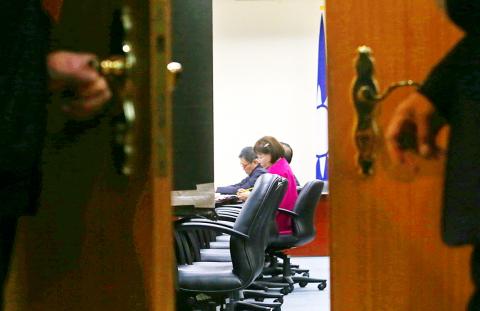
Photo: CNA
However, since 2012, the party’s policies and administrative procedures have gone awry, leading to a series of unpopular decisions, such as the capital gains tax, the hiking of gas and electricity prices and trying to force through the cross-strait service trade accord, which greatly damaging the party’s popularity, it said.
The 2013 death of army corporal Hung Chung-chiu (洪仲丘) just days before his discharge from compulsory military service, and the slew of food safety incidents further damaged the government’s credibility, the report said, adding that high housing prices, a widening wealth gap and the stalling and even falling of wages fueled public anger.
In addition, the inability of the government to gauge the influence of media and Internet forums has cost the party its chance to speak out and clarify its stance on the issues of the day, the report said.
The report added that the party’s cross-strait policies were not distinctive enough compared with the Democratic Progressive Party (DPP), adding that it was unable to find consensus within the party on many issues, which disappointed supporters, and that it could not get through to young people.
In terms of cross-strait policies, while the DPP gained traction by backing away from its pro-Taiwan independence stance and moving toward the “status quo,” the KMT lost ground as its policies were made out to be pandering to China and not standing up for Taiwan’s sovereignty, the report said.
The party’s ineffectual distribution of the benefits of trade with China to the public also counted against it, the report said, adding that the Chou Tzu-yu (周子瑜) incident was the last straw.
Chou, a Taiwanese K-pop singer, was allegedly forced by her South Korean management to apologize for carrying a Republic of China (ROC) flag and to say: “There is only ‘one China’... I have always felt proud of being Chinese” in a video uploaded to YouTube the night before the election.
Her public shaming allegedly led to support for the DPP.
“The KMT is facing far more difficult challenges than when it first lost the presidential elections in 2000, and we must face the reality that we have lost public support,” the report said.
The party must recognize the necessity of handing over the reins of power to newer generations to keep up with the times, and in the future, it needs to endeavor to defend the public’s interests, step up its presence on the Internet, facilitate communication with the public, change its party structure, allow more young people to have a say in party affairs and introduce internal reforms, the report said.

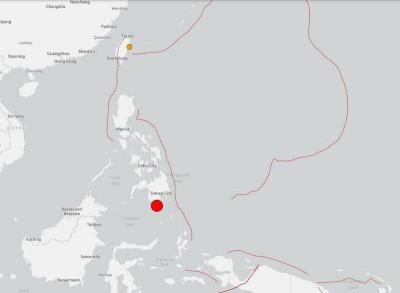
A magnitude 7.8 earthquake struck off the southern coast of Mindanao in the Philippines at 7:38am today, prompting the US Tsunami Warning System to issue an alert for neighboring countries, including Taiwan. The system issued a purple alert indicating a "tsunami threat." The potential threat zone includes Taiwan, the Philippines, Papua New Guinea, Yap and Palau. A spokesperson for Indonesia disaster mitigation agency said there were no reports of damage so far. Arlene Hollero, disaster chief of Maasim town in the Philippines' Sarangani Province, said their evacuation was underway in coastal villages and there were no reported casualties so far. DZBB radio, broadcasting from the

RESILIENCE: Taiwan plays a key role in semiconductors, energy, information infrastructure and advanced manufacturing, AIT Director Raymond Greene said Taiwan’s continued investment in deterrence and resilience remains vital, especially in uncrewed systems and other emerging technologies, American Institute in Taiwan (AIT) Director Raymond Greene said yesterday. Greene made the remarks at the annual National Strategic Summit on Supply Chain Resilience held by the Research Institute for Democracy, Society and Emerging Technology (DSET), a government-backed think tank. As Taiwan last year became the US’ fourth-largest trading partner and supply chain security is becoming more important, cooperation in emerging technologies continues to deepen between the two countries, he said. The US is committed to accelerating innovation, building key infrastructure, strengthening cooperation

The National Chungshan Institute of Science and Technology yesterday showcased its locally developed variants of the Vision 60 robotic patrol dog, which it plans to deploy on the nation’s outlying territories in the South China Sea. The variants were produced under the Joint Lab project — created by the institute and domestic companies — and assembled with domestically produced motors, lenses and artificial intelligence (AI) systems alongside licensed tech from the US, Missile and Rocket Systems Research Division deputy director Jen Kuo-kang (任國光) told the media event at a military base in Taipei’s Dazhi (大直) area. Taiwan has built up its strengths

RIGHT DIRECTION: Taiwan’s efforts to prevent forced labor include a proposal to ‘fully prohibit’ employers from withholding workers’ documents, an official said Taiwan is to establish a mechanism to restrict imports of goods linked to forced labor, the Executive Yuan said yesterday, after the US proposed imposing additional tariffs on Taiwanese goods over labor concerns. “The Ministry of Labor and the Ministry of Economic Affairs are to establish an interministerial review procedure,” Executive Yuan spokesperson Michelle Lee (李慧芝) said at a news briefing in Taipei. “The government is to use the Foreign Trade Act [貿易法] as the legal basis to restrict imports of goods produced with forced labor” and bring its supply chain governance more in line with international standards on human rights, resilience


 RSS
RSS