


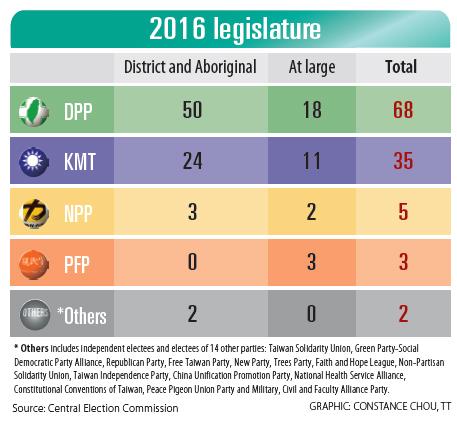
The Democratic Progressive Party (DPP) yesterday won an absolute majority in the 113-seat legislature for the first time, with 60 percent of its regional legislative candidates winning in their respective electoral districts and securing more than 44 percent of the vote.
The Chinese Nationalist Party (KMT) has lost the 64-seat majority it won in 2012, retaining 35 seats in the legislature.
The newly formed New Power Party (NPP) had spectacular success, winning all three districts where it fielded regional legislative candidates and crossing the 5-percentage-point threshold to be awarded legislator-at-large seats.
Graphic: Constance Chou and June Hsu, Taipei Times
The most attention-grabbing legislators-elect are the NPP’s Huang Kuo-chang (黃國昌), Hung Tzu-yung (洪慈庸) and Freddy Lim (林昶佐), as well as the DPP’s Hsiao Bi-khim (蕭美琴) in Hualien County, who had all been predicted to have tough battles in traditional KMT strongholds.
The DPP achieved a home run in the cities and counties south of the Jhuoshuei River (濁水溪) — Yunlin and Chiayi counties, Tainan, Kaohsiung and Pingtung City — winning a total of 21 seats.
Former Taipei mayor Hau Lung-bin (郝龍斌) was defeated in Keelung by the DPP’s Tsai Shih-ying (蔡適應).
Graphic: Constance Chou, Taipei Times
In New Taipei City, which has 12 electoral districts and where KMT presidential candidate Eric Chu (朱立倫) serves as mayor, the KMT lost eight seats that it formerly held, with only two lawmakers — Luo Ming-tsai (羅明才) and Lin Te-fu (林德福) — retaining their seats.
The DPP won seven more seats than it had four years ago, securing nine seats, while the NPP secured one.
Huang, one of the leading Sunflower movement activists, defeated incumbent KMT Legislator Lee Ching-hua (李慶華), who had been elected seven times in a row, in New Taipei City’s Sijhih District (汐止).
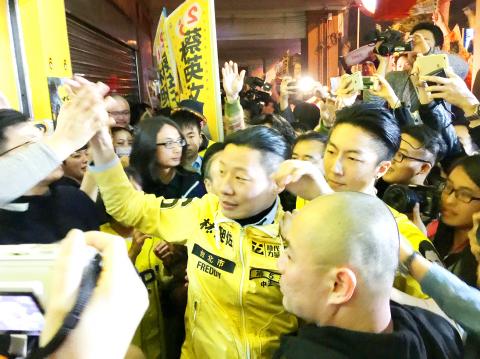
Photo: CNA
KMT Legislator Chang Ching-chung (張慶忠), whose “30-second ramming through” of the cross-strait service trade agreement in 2014 helped spark the Sunflower movement and who was seeking his fourth term, lost his seat to the DPP’s Chiang Yung-chang (江永昌).
In Taoyuan, where the KMT had won all six electoral districts in 2012, the DPP gained three seats, while the KMT retained two and an independent won one.
DPP caucus whip Ker Chien-ming (柯建銘) snatched a seat in Hsinchu City, which had belonged to the KMT.
In Hsinchu County, former commissioner Cheng Yung-chin (鄭永金), a non-affiliated candidate supported by the DPP, was defeated by KMT legislative candidate Lin Wei-chou (林為洲).
The KMT managed to retain two seats each in Miaoli and Nantou counties.
In Taichung, the KMT won three out of eight districts — dropping from five in 2012 — while the DPP won four, with Hung winning the final seat.
In Changhua County’s four electoral districts, the DPP gained three seats, while the KMT won one, a reversal of what the two parties won in the county four years ago.
In eastern Taiwan, both electoral districts in Hualien and Taitung counties saw their respective DPP candidates elected.
The outlying islands — Penghu, Kinmen and Matsu — elected DPP, KMT and KMT lawmakers respectively.
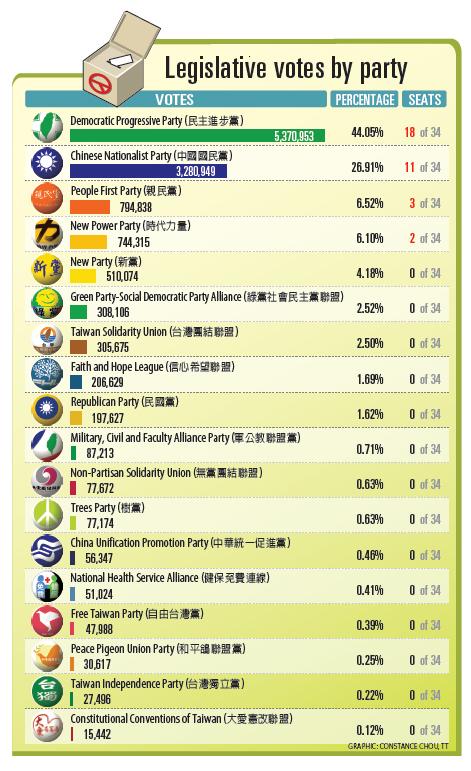
The DPP, KMT, People First Party (PFP) and NPP were the only four parties to cross the 5-percentage-point threshold for legislator-at-large seats.
A total of 18 candidates on the DPP’s legislator-at-large candidate list secured seats with the party’s 44 percent of party representation vote.
The KMT received 11 seats through 26.9 percent of party votes.
The PFP, with 6.5 percent of party votes, won 3 seats, while the NPP garnered 6.1 percent for 2 seats.
Japan has deployed long-range missiles in a southwestern region near China, the Japanese defense minister said yesterday, at a time when ties with Beijing are at their lowest in recent years. The missiles were installed in Kumamoto in the southern region of Kyushu, as Japan is attempting to shore up its military capacity as China steps up naval activity in the East China Sea. “Standoff defense capabilities enable us to counter the threat of enemy forces attempting to invade our country ... while ensuring the safety of our personnel,” Japanese Minister of Defense Shinjiro Koizumi said. “This is an extremely important initiative for
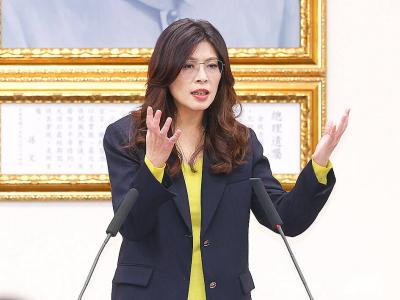
Chinese Nationalist Party (KMT) Chairwoman Cheng Li-wun (鄭麗文) today accepted an invitation from Chinese President Xi Jinping (習近平) to lead a delegation to China next month, saying she hopes to promote the peaceful development of cross-strait relations and bring stability to the Taiwan Strait. “I am grateful and happy to accept this invitation,” Cheng said in a statement from the KMT chairperson’s office. Cheng said she hopes both sides can work together to promote the peaceful development of cross-strait relations, enhance exchange and cooperation, bring stability to the Taiwan Strait and improve people’s livelihoods. At today's news conference, Cheng said any efforts to
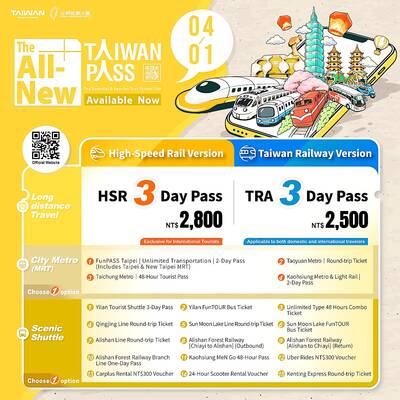
MORE POPULAR: Taiwan Pass sales increased by 59 percent during the first quarter compared with the same period last year, the Tourism Administration said The Tourism Administration yesterday said that it has streamlined the Taiwan Pass, with two versions available for purchase beginning today. The tourism agency has made the pass available to international tourists since 2024, allowing them to access the high-speed rail, Taiwan Railway Corp services, four MRT systems and four Taiwan Tourist Shuttles. Previously, five types of Taiwan Pass were available, but some tourists have said that the offerings were too complicated. The agency said only two types of Taiwan Pass would be available, starting from a three-day pass with the high-speed rail and a three-day pass with Taiwan Railway Corp. The former costs NT$2,800
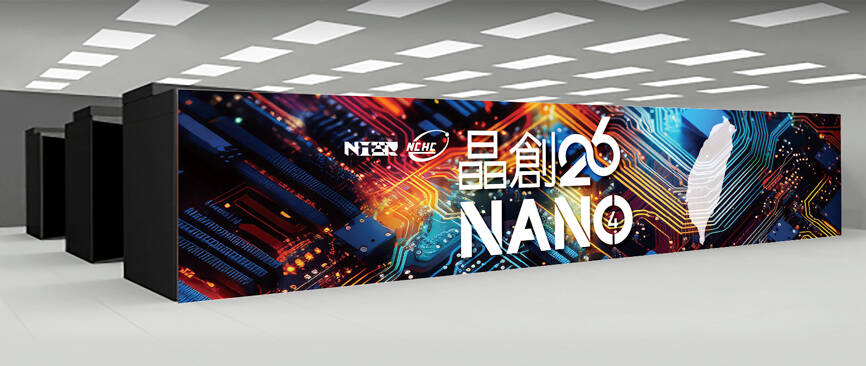
The nation’s fastest supercomputer, Nano 4 (晶創26), is scheduled to be launched in the third quarter, and would be used to train large language models in finance and national defense sectors, the National Center for High-Performance Computing (NCHC) said. The supercomputer, which would operate at about 86.05 petaflops, is being tested at a new cloud computing center in the Southern Taiwan Science Park in Tainan. The exterior of the server cabinet features chip circuitry patterns overlaid with a map of Taiwan, highlighting the nation’s central position in the semiconductor industry. The center also houses Taiwania 2, Taiwania 3, Forerunner 1 and


 RSS
RSS