


Disregarding a mist of rain as well as a cold front, People First Party (PFP) presidential candidate James Soong (宋楚瑜) was yesterday determined to do all in his power to canvass votes for the PFP and its legislative candidates.
Earlier yesterday morning, during a campaign stop at the Lugang Tianhou Temple in Changhua County’s Lugang Township (鹿港), Soong accepted every opportunity to sign his autograph and have his photograph taken with supporters in order to promote his party and presidential bid.
Soong said that he was the safest presidential choice for Taiwan and that citizens could rest assured that if he were elected president, cross-strait conflict would not resume and Taiwan would retain its democratic liberties.
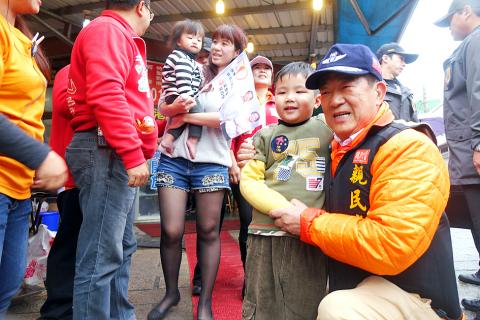
Photo: Liu Hsiao-hsin, Taipei Times
Soong also revealed that he had been contacted by the US government and that he would also receive a visit from US officials.
He said that the nation must let the US know that it would stay on the middle path by electing a stable and solid head of state.
“Such a leader would play a role in maintaining the careful balance existing between the US, Japan and China, as well as offering to be a buffer,” Soong said.
He said that by “buffer” he meant that Taiwan would be an anchor in terms of geopolitics, adding that it should also act as a buffer against time and change.
The ongoing changes in China cannot assuage Taiwanese concerns, Soong said, adding that this concern is why Taiwan should maintain its status as a free democracy.
When asked about the 18 parties vying for voters’ support in the legislator-at-large vote, Soong said he was confident the PFP’s votes would not be scattered.
However, the number of competing political parties highlights problems in Taiwan’s political system, Soong said.
The Chinese National Party (KMT) and the Democratic Progressive Party should not overshadow the plurality of opinions in Taiwanese society, Soong said, adding that should he be elected into office, he would seek to negotiate with the heads of the parties.
There are many aspects in the current system that should be tweaked, he said.
Later yesterday, Soong headed to Beidou Township (北斗) to campaign alongside PFP legislative candidate Chen Chao-jung (陳朝容).
Both men stuck to their campaign plan, despite heavy rain during the last leg of the event.
Soong wrapped up the night with a large rally in Taipei, touting his competence and administrative experiences as a leader of state who is able to hold the steering wheel steadily.
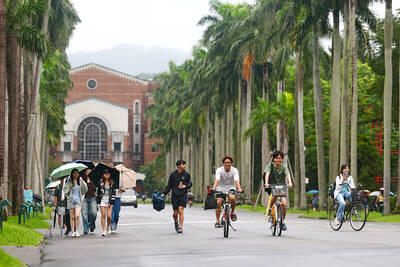
National Taiwan University (NTU) yesterday said it disqualified a person from an entrance examination for using AI smart glasses to cheat, along with two others for making untruthful statements in their curriculum vitae. The three applicants were given null scores, Taiwan’s highest-ranked university said, calling on prospective students to be honest in the admissions process. NTU registrar Lee Hung-sen (李宏森) said that the cheating applicant wore a hat and thick-rimmed glasses to the second written exam for medical school, claiming that they felt cold. Suspicions were aroused when the applicant stared oddly at the test for long stretches while steadily bringing the paper
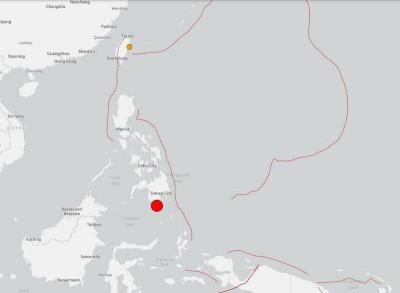
A magnitude 7.8 earthquake struck off the southern coast of Mindanao in the Philippines at 7:38am today, prompting the US Tsunami Warning System to issue an alert for neighboring countries, including Taiwan. The system issued a purple alert indicating a "tsunami threat." The potential threat zone includes Taiwan, the Philippines, Papua New Guinea, Yap and Palau. Philippine authorities were assessing the damage from the quake, with the office of civil defense seeking to verifying initial reports that 15 people had been killed and 129 injured in the region, mostly from falling debris. Arlene Hollero, disaster chief of Maasim town in the Philippines' Sarangani Province,
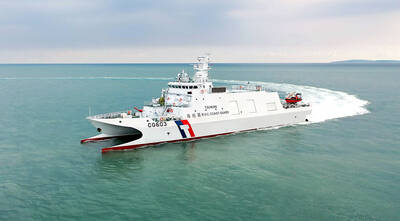
‘GRAY ZONE’ PRESSURE: Beijing’s activities are intended to create the deceitful impression that China has jurisdiction over the area around Taiwan, the CGA said Taiwan’s rights over its territorial waters and exclusive economic zone must not be violated by any country, the Mainland Affairs Council said yesterday, adding that it will not accept any unprovoked actions. The council issued the remarks in response to the China Coast Guard conducting maritime enforcement drills near eastern Taiwan and claiming to fully exercise China’s maritime administrative law enforcement authority. The Coast Guard Administration (CGA) has been closely monitoring the situation and is taking concrete steps to defend the nation’s sovereignty and secure its waters, the council said. China has no sovereign rights over the waters off eastern
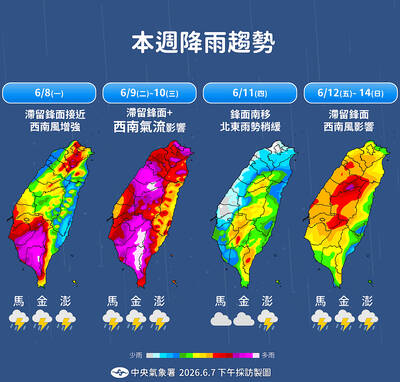
Heavy rain is expected to affect parts of Taiwan this week, the Central Weather Administration (CWA) said yesterday as a meteorologist said the active part of the annual plum rain season has started. A stationary plum rain front and southwesterly winds would bring unstable weather and abundant moisture to Taiwan from today for about a week, with the heaviest rainfall forecast for tomorrow and Wednesday, the CWA said. The agency said western and northeastern Taiwan, and mountainous areas in the east and southeast, could expect showers or thunderstorms on those two days, with localized heavy rain possible. Other parts of


 RSS
RSS