


Several members of the Chinese Nationalist Party’s (KMT) Hsinchu City chapter were summoned for questioning by prosecutors yesterday, as a judicial probe got under way to investigate allegations of vote-buying and other prohibited campaign activities at a year-end “thanksgiving” party hosted by the chapter on Saturday.
The Hsinchu District Prosecutors’ Office initiated the judicial probe after examining video footage and other evidence and 19 people were brought in to conduct the inquiry.
Among those summoned by prosecutors yesterday were KMT Hsinchu City chapter director Hsieh Po-yi (謝柏意), Hsinchu City Council caucus chief secretary Lin Keng-jen (林耕仁) and Hsinchu City Councilor Wu Ching-shan (吳青山).
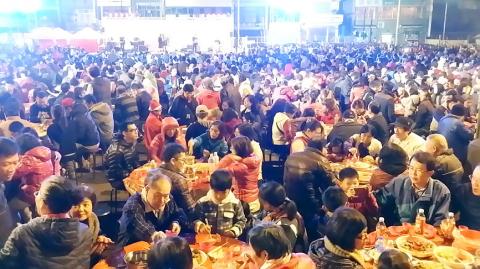
Photo: Tsai Chang-sheng, Taipei Times
“We dispatched judicial police officers to monitor and video the proceedings at last Saturday’s banquet hosted by the KMT’s Hsinchu City chapter. The video footage was compiled onto CDs for examination by prosecutors,” Hsinchu District Prosecutors’ Office spokesman Lin Li-chia (林李嘉) said.
Lin Keng-jen said the office had summoned the organizers of the banquet, guests, caterers and other companies that provided services at the event to clarify their roles and to investigate if vote-buying had occurred.
When questioned, Lin Keng-jen said he chaired the organizing committee for the event, which was a year-end “thanksgiving” banquet and party for KMT members and local residents.
“I have nothing to hide. The banquet was paid for out of my own money,” he said, adding that the banquet was not extravagant and that “regular fare” was served.
The banquet took place in the plaza of Hsinchu City’s Shulintou Night Market (樹林頭夜市) and the video footage showed KMT Hsinchu legislative candidate Cheng Cheng-chien (鄭正鈐) and KMT Secretary-General Lee Shu-chuan (李四川) walking between the tables wearing campaign vests, talking to diners in an apparent bid to solicit their support.
Cheng was quoted as saying that “as a member of KMT, it is natural for me to attend a banquet hosted by the party. I was invited by the organizers. I did not make a speech, nor did I distribute campaign material. I was only there to greet and talk briefly with local residents and I left shortly after it started.”
However, the competing legislative candidates in Hsinchu City did not see it that way and accused the KMT of vote-buying by treating local residents to lavish meals at a traditional banquet, at which 1,035 tables were set up for more than 10,000 guests.
Democratic Progressive Party anti-vote-buying supervision task force head Lian Li-jian (連立堅) said that banquet staff made every effort to coverup election campaigning, such as asking the crowd not to yell dongsuan (凍蒜) — a Hoklo (commonly known as Taiwanese) phrase for “get elected” — “the chanting of the phrase still occurred.”

The Tourism Administration yesterday announced that it would reward repeat international visitors with incentives of up to NT$8,000 to boost inbound tourism. The incentives are available to all international tourists, it said, adding that repeat visitors would be rewarded with NT$5,000 and would receive an additional NT$3,000 if they bring travel companions. The nation received 2,990,657 inbound visitors during the first quarter, marking a 3.8 percent increase from the same period last year, agency data showed. Japanese nationals are among groups visiting Taiwan the most. About 1.48 million Japanese tourists arrived last year, a year-on-year increase of more than 12
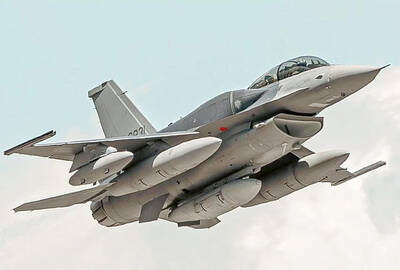
66 FIGHTER JETS: The aircraft is likely undergoing preparations for its transfer to Taiwan — a significant step forward in the nation’s modernization program, a lawmaker said The first of Taiwan’s order of F-16V Block 70 aircraft has been sighted in Texas ahead of delivery, Democratic Progressive Party (DPP) Legislator Wang Ting-yu (王定宇) said. Taiwan’s first F-16V Block 70 two-seat aircraft, tail number 6831, was seen flying from Lockheed Martin’s production facility in Greenville, South Carolina, to Naval Air Station Joint Reserve Base Fort Worth in Texas, Wang wrote on Facebook yesterday. The plane is likely undergoing preparations for its transfer to Taiwan, marking a significant step forward in the Republic of China Air Force’s modernization program, Wang said, citing military analysts. The F-16V Block 70 is a new-build version
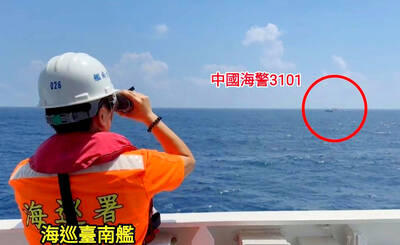
‘BRAZEN’: The holiday did not stop China from activities that infringe on Taiwan’s maritime jurisdiction, but the CGA is ready to defend the nation, Kuan Bi-ling said Beijing is intensifying maritime pressure on Taiwan, but the nation will never yield, Ocean Affairs Council Deputy Minister Sung Chen-en (宋承恩) said. The Coast Guard Administration (CGA) has adopted a “shadowing and monitoring” approach to avoid falling into a Chinese trap to escalate tensions and deepen the conflict, Sung said in an interview published yesterday in the Chinese-language Liberty Times (the Taipei Times’ sister newspaper). China Coast Guard formations patrolling waters east of Taiwan, as well as official Chinese vessels entering areas around Itu Aba Island (Taiping Island, 太平島) and Pratas Islands (Dongsha Islands, 東沙群島) show Beijing’s attempts to significantly step up
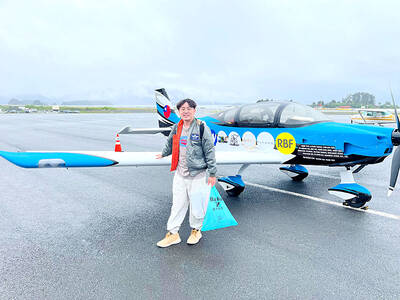
Taiwanese aviator Roger Lin (林睿哲) returned to Taiwan on Saturday after completing a nine-day round-the-world journey in a single-engine aircraft, becoming the first Taiwanese pilot to achieve the feat. Lin departed on June 5 from Los Angeles, California, and continued through Alaska, Japan, Taiwan, the Philippines, Indonesia, Malaysia, Thailand, Nepal, Jordan, Norway, Iceland and Canada before landing at the Taipei International Airport (Songshan) via Los Angeles and Japan. Lin shared numerous photos and videos of his journey on a Facebook page titled “Pilot Roger’s Around the World Flight,” including a video showing his aircraft flying over the Danjiang Bridge and


 RSS
RSS