


Ministry of National Defense Political Warfare Bureau Director Wen Chen-kuo (聞振國) yesterday pledged to review all dealings involving military housing units to ascertain whether any of them were sold during the five-year prohibition period.
Wen was responding to a request made by Democratic Progressive Party (DPP) Legislator Chiu Chih-wei (邱志偉) at a question-and-answer session at a meeting of the legislature’s Foreign and National Defense Committee in Taipei yesterday, during which Chiu urged the ministry to take a stance against real-estate agents’ blatant promotion of military apartment sales.
“Since the promulgation of the Act for Rebuilding Old Quarters for Military Dependents (國軍老舊眷村改建條例) in 1996, [owners of military houses] are barred from transferring the units to another person within five years of the registration of the property,” Wen said.

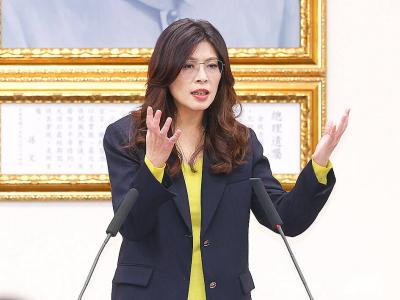
Photo: CNA
The ministry is entitled to repossess units sold or transferred during the five-year prohibition period, Wen said, adding that the ministry is not aware of any owner who has broken the law.
“Prearranged sales agreements do not show up in land administration records. They can only be detected by reviewing tax returns or property declaration documents,” Wen said, vowing to launch a thorough investigation.
Wen made the remarks amid the controversy surrounding Chinese Nationalist Party (KMT) vice presidential candidate Jennifer Wang’s (王如玄) alleged speculative sales of several military housing units.
DPP Legislator Tuan Yi-kang (段宜康) has alleged that Wang purchased at least 19 military housing units, which were subsidized and converted by the government from old housing for military dependents for the sole purpose of improving their living conditions and providing housing for military veterans.
Tuan has also accused Wang of dodging the five-year ban by brokering transactions in which the buyer makes a cash payment or provides a promissory note in exchange for the future ownership of the property after the five-year prohibition period.
Wang retaliated by filing a slander lawsuit against Tuan on Wednesday.
On the sidelines of the meeting, Minister of National Defense Kao Kuang-chi (高廣圻) also promised to re-evaluate the Act for Rebuilding Old Quarters for Military Dependents and to lay down further restrictions.
“The ministry has been reviewing the law and working to devise ways to prevent prearranged sales since the Control Yuan pointed out the issue in 2013,” Kao said.
Kao said he had no comment about Wang’s personal conduct, but said that the intention of the act is to take care of residents of old military dependents’ villages, military veterans and active military personnel.
Separately yesterday, KMT presidential candidate Eric Chu (朱立倫) defended his selection of Wang as his running mate, saying that what the public cares about are Wang’s long-term efforts on the rights of women and disadvantaged people, as well as improving workers’ rights.
“The DPP’s negative campaign tactics are detrimental to Taiwanese democracy,” Chu said.

Japan has deployed long-range missiles in a southwestern region near China, the Japanese defense minister said yesterday, at a time when ties with Beijing are at their lowest in recent years. The missiles were installed in Kumamoto in the southern region of Kyushu, as Japan is attempting to shore up its military capacity as China steps up naval activity in the East China Sea. “Standoff defense capabilities enable us to counter the threat of enemy forces attempting to invade our country ... while ensuring the safety of our personnel,” Japanese Minister of Defense Shinjiro Koizumi said. “This is an extremely important initiative for
Chinese Nationalist Party (KMT) Chairwoman Cheng Li-wun (鄭麗文) today accepted an invitation from Chinese President Xi Jinping (習近平) to lead a delegation to China next month, saying she hopes to promote the peaceful development of cross-strait relations and bring stability to the Taiwan Strait. “I am grateful and happy to accept this invitation,” Cheng said in a statement from the KMT chairperson’s office. Cheng said she hopes both sides can work together to promote the peaceful development of cross-strait relations, enhance exchange and cooperation, bring stability to the Taiwan Strait and improve people’s livelihoods. At today's news conference, Cheng said any efforts to

MORE POPULAR: Taiwan Pass sales increased by 59 percent during the first quarter compared with the same period last year, the Tourism Administration said The Tourism Administration yesterday said that it has streamlined the Taiwan Pass, with two versions available for purchase beginning today. The tourism agency has made the pass available to international tourists since 2024, allowing them to access the high-speed rail, Taiwan Railway Corp services, four MRT systems and four Taiwan Tourist Shuttles. Previously, five types of Taiwan Pass were available, but some tourists have said that the offerings were too complicated. The agency said only two types of Taiwan Pass would be available, starting from a three-day pass with the high-speed rail and a three-day pass with Taiwan Railway Corp. The former costs NT$2,800

The nation’s fastest supercomputer, Nano 4 (晶創26), is scheduled to be launched in the third quarter, and would be used to train large language models in finance and national defense sectors, the National Center for High-Performance Computing (NCHC) said. The supercomputer, which would operate at about 86.05 petaflops, is being tested at a new cloud computing center in the Southern Taiwan Science Park in Tainan. The exterior of the server cabinet features chip circuitry patterns overlaid with a map of Taiwan, highlighting the nation’s central position in the semiconductor industry. The center also houses Taiwania 2, Taiwania 3, Forerunner 1 and


 RSS
RSS