


Several Chinese Nationalist Party (KMT) members yesterday ridiculed the party’s list of legislator-at-large nominees, which critics described as the worst lineup in history.
Prior to a meeting of the KMT’s Central Standing Committee yesterday afternoon, committee member Yao Chiang-lin (姚江臨) told reporters that while he dared not criticize the list as the worst in history, its rankings were undeniably unfair to grassroots workers.
“The Social Democratic Party gave its labor representative the top spot on its legislator-at-large list, while the Democratic Progressive Party put its in 14th place. However, the KMT placed Taiwan Confederation of Trade Unions director-general Chuang Chueh-an (莊爵安) 19th,” Yao said.
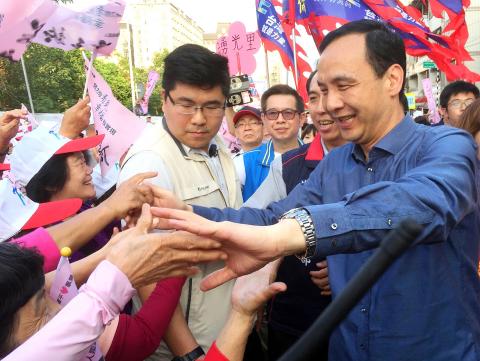
Photo: CNA
Yao said workers and farmers were the reasons the KMT was defeated by the Chinese Communist Party in the Chinese Civil War, forcing it out of China in 1949, and why it lost the 2000 presidential election.
The KMT has not learned its lesson and still disregards grassroots workers, Yao said, adding that the list included too many unfamiliar names and too few people who have made contributions to the party.
Central Standing Committee member Hou Tsai-feng (侯彩鳳) gave the list a score of 60 percent, saying that although the KMT leadership moved Chuang from 22nd spot to 19th, he was still excluded from the “safe list.”

Photo: Liu Hsin-de, Taipei Times
“If the nominees were selected for the purpose of boosting the KMT’s election prospects in the 2018 mayoral and county commissioner elections, then why are so many of them not running for a regional seat in the legislature?” Hou said, referring to Chu’s plan to recruit candidates from the list for the local elections in 2018 after they have accumulated experience during the first two years of their four-year legislative term.
“I beg of you, higher echelons of the KMT: Please give the party a break,” Hou added.
Committee member Tseng Wen-pei (曾文培) said the KMT leadership should explain its criteria for choosing the nominees, as many of them might serve as the party’s “small Cabinet” in the legislature should it lose power next year.
“The KMT’s 211-seat Central Standing Committee is to vote on each of the nominees tomorrow [today]. No one has ever been removed from the list by the committee, but I am not so sure about that this time,” Tseng said.
According to KMT regulations, nominees who receive votes of disapproval from more than half of the committee members attending a meeting would see their nomination annulled.
The KMT’s Huang Fu-hsing (黃復興) military veterans’ branch issued a press release yesterday saying it regrets the party’s decision to place Legislative Speaker Wang Jin-pyng (王金平) at the top of the list.
“While the decision was made out of respect for the speaker and due to some political considerations, it nevertheless failed people’s expectation for fundamental reform of the legislature,” it said.
Legislative Deputy Speaker Hung Hsiu-chu (洪秀柱) gave a score of 100 when asked by reporters to grade the legislator-at-large list.
Asked if she was serious, Hung said: “Who still means what they say nowadays?”
Lee Kuang-yi (李光儀), a journalist with the Chinese-language United Daily Evening News, traditionally a pan-blue-leaning newspaper, called the list the “lamest ever in history.”
“There is nothing refreshing or new, only traces of wrangling between different KMT factions and pork-barrel politics. I believe no pan-blue supporter would be happy with the list,” Lee said in an editorial on Thursday.
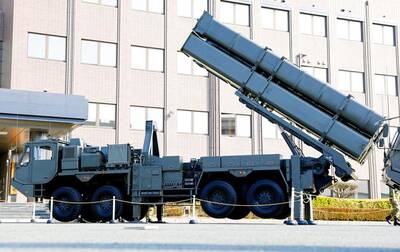
Japan has deployed long-range missiles in a southwestern region near China, the Japanese defense minister said yesterday, at a time when ties with Beijing are at their lowest in recent years. The missiles were installed in Kumamoto in the southern region of Kyushu, as Japan is attempting to shore up its military capacity as China steps up naval activity in the East China Sea. “Standoff defense capabilities enable us to counter the threat of enemy forces attempting to invade our country ... while ensuring the safety of our personnel,” Japanese Minister of Defense Shinjiro Koizumi said. “This is an extremely important initiative for
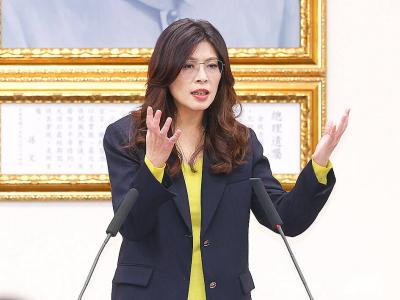
Chinese Nationalist Party (KMT) Chairwoman Cheng Li-wun (鄭麗文) today accepted an invitation from Chinese President Xi Jinping (習近平) to lead a delegation to China next month, saying she hopes to promote the peaceful development of cross-strait relations and bring stability to the Taiwan Strait. “I am grateful and happy to accept this invitation,” Cheng said in a statement from the KMT chairperson’s office. Cheng said she hopes both sides can work together to promote the peaceful development of cross-strait relations, enhance exchange and cooperation, bring stability to the Taiwan Strait and improve people’s livelihoods. At today's news conference, Cheng said any efforts to

The nation’s fastest supercomputer, Nano 4 (晶創26), is scheduled to be launched in the third quarter, and would be used to train large language models in finance and national defense sectors, the National Center for High-Performance Computing (NCHC) said. The supercomputer, which would operate at about 86.05 petaflops, is being tested at a new cloud computing center in the Southern Taiwan Science Park in Tainan. The exterior of the server cabinet features chip circuitry patterns overlaid with a map of Taiwan, highlighting the nation’s central position in the semiconductor industry. The center also houses Taiwania 2, Taiwania 3, Forerunner 1 and
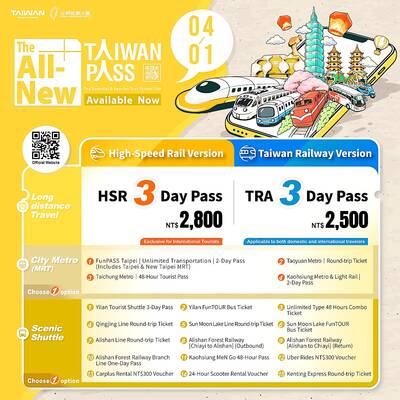
MORE POPULAR: Taiwan Pass sales increased by 59 percent during the first quarter compared with the same period last year, the Tourism Administration said The Tourism Administration yesterday said that it has streamlined the Taiwan Pass, with two versions available for purchase beginning today. The tourism agency has made the pass available to international tourists since 2024, allowing them to access the high-speed rail, Taiwan Railway Corp services, four MRT systems and four Taiwan Tourist Shuttles. Previously, five types of Taiwan Pass were available, but some tourists have said that the offerings were too complicated. The agency said only two types of Taiwan Pass would be available, starting from a three-day pass with the high-speed rail and a three-day pass with Taiwan Railway Corp. The former costs NT$2,800


 RSS
RSS