


Chinese Nationalist Party (KMT) Chairman Eric Chu (朱立倫) met with President Ma Yin-jeou (馬英九) before Chu left for the US on Tuesday and is to deliver some messages about Ma’s meeting with Chinese President Xi Jinping (習近平) — if asked — during his trip, KMT caucus whip Lai Shyh-bao (賴士葆) said yesterday.
Lai told a press conference in Taipei that, “as he understood it from indirect sources,” Chu met with the president on Tuesday, with Ma asking him to explain to the US the meeting in Singapore.
The first message that Ma wants Chu to convey is that he clearly told Xi that the “[so-called] 1992 consensus is ‘one China, different interpretations’ and is a historic fact based on the Constitution of the Republic of China,” Lai said.
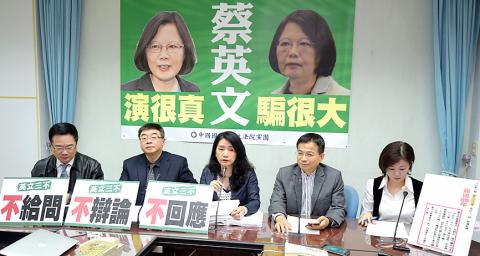
Photo: Wang Min-wei, Taipei Times
“The second message is that the two leaders on the two sides of the Taiwan Strait confirmed that the ‘1992 consensus’ is the cross-strait consensus and is meant to build a bridge for future presidents to ensure cross-strait peace, prosperity and stability,” Lai said. “The bridge is the ‘1992 consensus.’”
The third message is one that “he has derived from the first two,” which is that “without the bridge, a meeting in the future between the leaders of the two sides would be very, very difficult,” Lai said.
Other KMT lawmakers at the press conference accused Democratic Progressive Party (DPP) presidential candidate Tsai Ing-wen (蔡英文) of “deceptive performances,” saying that according to legislative documents, Tsai has always known that the “1992 consensus” is “one China, different interpretations.”
“She recognized [the ‘1992 consensus’] when she was Mainland Affairs Council chairperson [in former president Chen Shui-bian’s (陳水扁) administration]. We might as well ask today’s Tsai whether her words from then still count,” KMT Legislator Alicia Wang (王育敏) said.
KMT Legislator Alex Tsai (蔡正元) said Tsai was “dodging cross-strait affairs,” which he said was “a scam,” as she could only “avoid answering sensitive questions by saying ‘next question please,’ talking nonsense, repeating herself and reciting statements.”
The “1992 consensus,” a term former KMT lawmaker Su Chi (蘇起) admitted in 2006 that he had made up in 2000, when he was chairman of the Mainland Affairs Council, refers to a tacit understanding between the KMT and the Chinese government that both sides of the Strait acknowledge there is “one China,” with each side having its own interpretation of what “China” means.
The DPP and many others do not accept the validity of the “consensus.”
Also in the press conference, when asked about a Time magazine article by Zoher Abdoolcarim on the Ma-Xi meeting that labeled Ma a “yesterday man” and “a cipher” and said the KMT considered him “a loser,” KMT lawmakers rejected that description.
Alex Tsai said he would not comment on Zohar’s personal column “just as we would not care too much about what Apple Daily Taiwan editor-in-chief Jesse Ma (馬維敏) writes in its editorials.”
“[Time] is almost bankrupt in the US,” he said. “It is a loser in the US market. That is for sure… I would recommend a tycoon in Taiwan to buy the company, if the US government does not object.”
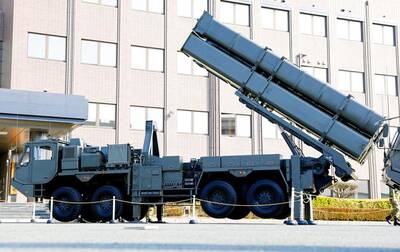
Japan has deployed long-range missiles in a southwestern region near China, the Japanese defense minister said yesterday, at a time when ties with Beijing are at their lowest in recent years. The missiles were installed in Kumamoto in the southern region of Kyushu, as Japan is attempting to shore up its military capacity as China steps up naval activity in the East China Sea. “Standoff defense capabilities enable us to counter the threat of enemy forces attempting to invade our country ... while ensuring the safety of our personnel,” Japanese Minister of Defense Shinjiro Koizumi said. “This is an extremely important initiative for
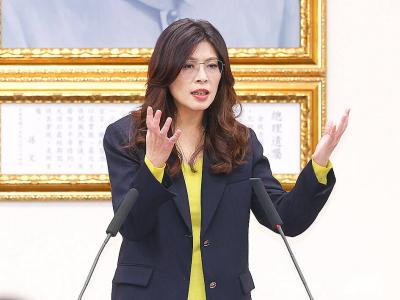
Chinese Nationalist Party (KMT) Chairwoman Cheng Li-wun (鄭麗文) today accepted an invitation from Chinese President Xi Jinping (習近平) to lead a delegation to China next month, saying she hopes to promote the peaceful development of cross-strait relations and bring stability to the Taiwan Strait. “I am grateful and happy to accept this invitation,” Cheng said in a statement from the KMT chairperson’s office. Cheng said she hopes both sides can work together to promote the peaceful development of cross-strait relations, enhance exchange and cooperation, bring stability to the Taiwan Strait and improve people’s livelihoods. At today's news conference, Cheng said any efforts to
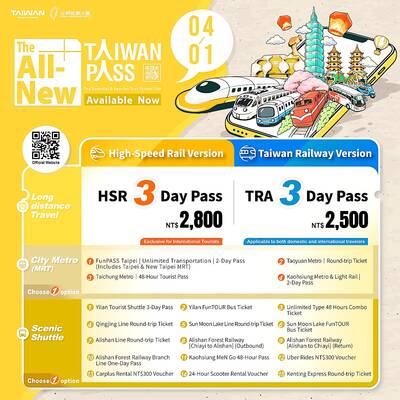
MORE POPULAR: Taiwan Pass sales increased by 59 percent during the first quarter compared with the same period last year, the Tourism Administration said The Tourism Administration yesterday said that it has streamlined the Taiwan Pass, with two versions available for purchase beginning today. The tourism agency has made the pass available to international tourists since 2024, allowing them to access the high-speed rail, Taiwan Railway Corp services, four MRT systems and four Taiwan Tourist Shuttles. Previously, five types of Taiwan Pass were available, but some tourists have said that the offerings were too complicated. The agency said only two types of Taiwan Pass would be available, starting from a three-day pass with the high-speed rail and a three-day pass with Taiwan Railway Corp. The former costs NT$2,800
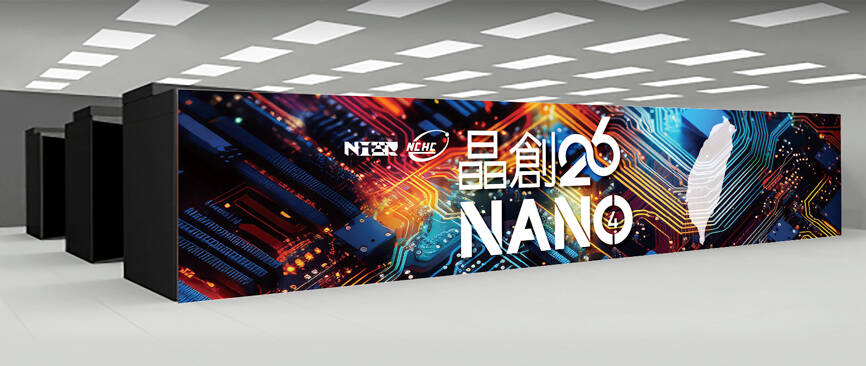
The nation’s fastest supercomputer, Nano 4 (晶創26), is scheduled to be launched in the third quarter, and would be used to train large language models in finance and national defense sectors, the National Center for High-Performance Computing (NCHC) said. The supercomputer, which would operate at about 86.05 petaflops, is being tested at a new cloud computing center in the Southern Taiwan Science Park in Tainan. The exterior of the server cabinet features chip circuitry patterns overlaid with a map of Taiwan, highlighting the nation’s central position in the semiconductor industry. The center also houses Taiwania 2, Taiwania 3, Forerunner 1 and


 RSS
RSS