


As polls closed on Myanmar’s historic election day, diplomats and other observers said the vote was largely free and fair, with no reports so far of violence or major fraud, just a solid turnout from a lively and informed electorate.
“From the dozens of people we have spoken to since 6am today [yesterday], everybody feels they have been able to vote for whoever they wanted to in security and safety,” said Durudee Sirichanya, an international observer with the ASEAN Secretariat.
Factory manager Shein Win and his wife, Khin Myat Maw, arrived holding hands to cast their votes in Yangon in Myanmar’s first credible general election in 25 years. Both now aged 46, they took part in a 1988 democracy protest that brought Burmese opposition leader Aung San Suu Kyi to prominence.
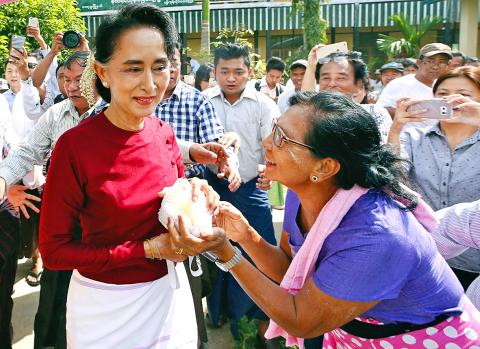
Photo: EPA
“We’ve been waiting for this day for a long time,” Khin Myat Maw said as they stood in line.
There were cheers from crowds of well-wishers, who held up ink-stained fingers to show they had voted, as Aung San Suu Kyi made a whistle-stop tour of polling booths in her constituency near Myanmar’s commercial capital.
Roughly 30 million people were eligible to vote yesterday, many expressing joy at the milestone their country had reached after nearly half a century of dictatorship, and a sense of duty to be part of it. One man who works as an accountant in Singapore said he had flown home just to vote and would head back the next day.
In a downtown neighborhood of northern city Mandalay, Myint Myint, 95, was perched on a plastic chair carried by three men along a dirt path and past a snaking line of voters to the local polling station.
“A vote is a vote,” her granddaughter, Phyo Kyaw, said. “Come on, this is our responsibility.”
However, there was also anxiety, as many voters recalled the election in 1990, when a landslide victory for Aung San Suu Kyi’s National League for Democracy (NLD) party was brushed aside by military rulers.
Khin May Oo, a 73-year-old doctor who voted in Yangon, said the election might have brought Myanmar to a turning point, but spoke nervously of the generals who retain significant power: “I’m not sure whether they will accept the election results.”
The military’s commander-in-chief yesterday told reporters the outcome of the vote would be respected, even if — as is widely expected — Aung San Suu Kyi’s NLD emerges as the winner.
Indeed, at a military base in the capital, Naypyidaw, Captain Wai Yan Aung said that when his duty shift ended, he would change from his uniform into traditional dress and cast his vote.
Dampening the celebration was the cancelation of voting in areas of the country affected by ethnic violence, which activists estimate has cut about 4 million people out of the electoral process.
In Mandalay, about 100 people were stopped from voting after election officials discovered they were outsiders who had been added to the voter list by a third party and then bussed in to vote.
“It was an attempt at fraud, that’s why we didn’t let them vote,” said Hla Soe of Myanmar’s Union Election Commission.
There was also indignation about voter lists riddled with errors.
Linn Htet Aung, 25, who works for an non-governmental organization in Yangon, said he was excited about the potential for change in the country, but disappointed because his name was omitted from the voter list in a slum area on the outskirts of the city.
“I am angry,” he said. “All my friends are voting today, but I can’t. I want to choose the government I like, but I can’t.”
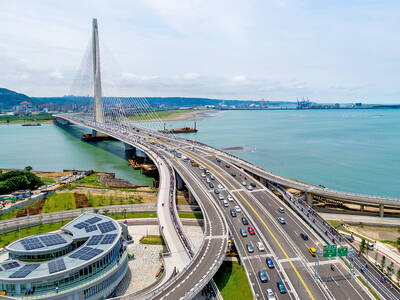
The Ministry of Transportation and Communications yesterday inaugurated the Danjiang Bridge across the Tamsui River in New Taipei City, saying that the structure would be an architectural icon and traffic artery for Taiwan. Feted as a major engineering achievement, the Danjiang Bridge is 920m long, 211m tall at the top of its pylon, and is the longest single-pylon asymmetric cable-stayed bridge in the world, the government’s Web site for the structure said. It was designed by late Iraqi-British architect Zaha Hadid. The structure, with a maximum deck of 70m, accommodates road and light rail traffic, and affords a 200m navigation channel for boats,
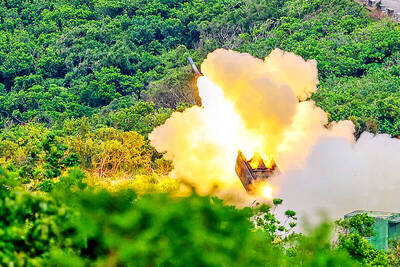
PRECISION STRIKES: The most significant reason to deploy HIMARS to outlying islands is to establish a ‘dead zone’ that the PLA would not dare enter, a source said A High Mobility Artillery Rocket System (HIMARS) would be deployed to Penghu County and Dongyin Island (東引) in Lienchiang County (Matsu) to force the Chinese military to retreat at least 100km from the coastline, a military source said yesterday. Taiwan has been procuring HIMARS and Army Tactical Missile Systems (ATACMS) from the US in batches. Once all batches have been delivered, Taiwan would possess 111 HIMARS units and 504 ATACMS, which have a range of 300km. Considering that “offense is the best defense,” the military plans to forward-deploy the systems to outlying islands such as Penghu and Dongyin so that

WHAT WAS ALL THAT FOR? Jaw Shaw-kong said that Cheng Li-wen had pushed for more drastic cuts and attacked him, just for the outcome to be nearly identical to his bill The legislature yesterday passed a supplementary budget bill to fund the purchase of separate packages of US military equipment, with the combined amount of spending capped at NT$780 billion (US$24.8 billion). The Chinese Nationalist Party (KMT) and Taiwan People’s Party (TPP) used their legislative majority to pass the bill, which runs until 2033 and has two main funding provisions. One was for NT$300 billion of arms sales already approved by the US for Taiwan on Dec. 17 last year, the other was for NT$480 billion for another arms package expected to be announced by Washington. The bill, which fell short of the NT$1.25

‘CLEAR MESSAGE’: The bill would set up an interagency ‘tiger team’ to review sanctions tools and other economic options to help deter any Chinese aggression toward Taiwan US Representative Young Kim has introduced a bill to deter Chinese aggression against Taiwan, calling for an interagency “tiger team” to preplan coordinated sanctions and economic measures in response to possible Chinese military or political action against Taiwan. “[Chinese President] Xi Jinping [習近平] has directed the People’s Liberation Army to be ready to invade Taiwan by 2027. China has a plan. America should have one too,” Kim said in a news release on Thursday last week. She introduced the “Deter PRC [People’s Republic of China] aggression against Taiwan act” to “ensure the US has a coordinated sanctions strategy ready should


 RSS
RSS