


The annual Taiwan Gay Pride Parade took place in Taipei yesterday afternoon, with the event centering on the theme of “no age limits,” with event organizers saying that members of the lesbian, gay, bisexual and transgender (LGBT) community and their supporters were invited to attend the event and explore ways in which society’s attitudes toward age and gender prevent people from freely expressing themselves.
People who contravene society’s “norms” are often seen as irresponsible and ostracized, the organizers said, adding that teenagers and older people often suffer the worst of this treatment, as society is more rigid in its expectations of these age groups.
Many participants at the parade, now in its 13th year, wore colorful costumes and waved rainbow flags or handmade signs calling for marriage equality.

Photo: AFP
Organizers said nearly 80,000 people attended the event.
However, the organizer’s call for “no age limits” sparked concerns over its interpretaion.
Lee Tsung-hua (李宗華) of the Warm Breeze Caring Association, a Taichung-based group advocating child welfare, said the association has always supported the LGBT community, but it could not disagree more with calls for young people to be liberated of age restrictions placed on their behavior.
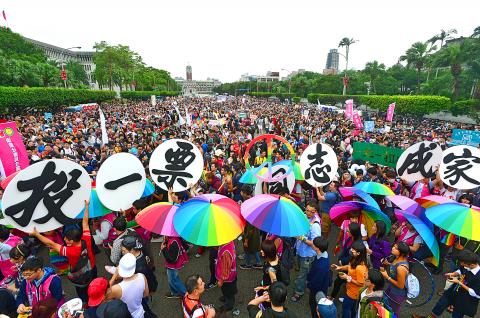
Photo: Wang Yi-sung, Taipei Times
Yeh Chun-hsing (葉春幸), a legislative candidate of the Faith and Hope League, also opposed the group’s call for “no age limit,” saying that repeated calls to lower the legal age for sexual consent on the grounds of sexual autonomy would only lead to an increase in social problems such as abortions and sexual assault.
Earlier in the day, Democratic Progressive Party Chairwoman and presidential candidate Tsai Ing-wen (蔡英文) posted a video on Facebook, saying she supported marriage equality, and that all are equal before love.
Later, in response to media queries about the issue of regulations recognizing unions between same-sex couples, Tsai said it is an issue that society must confront, adding that as there are supporters and opponents, she hopes everyone can view the matter rationally.
Chinese Nationalist Party (KMT) spokesperson Lin Yi-hua (林奕華) said KMT presidential candidate Eric Chu (朱立倫) agreed with the broad direction of the LGBT activists’ stance on equal opportunities for marriage rights, but added that there should be more discussion over the issue due to the diverse range of opinions held in society.
A consensus must emerge among the public before matters can proceed toward legal amendments, Lin said.
People First Party Chairperson James Soong (宋楚瑜) said via party spokesperson Chen Yi-chieh (陳怡潔) that the PFP favors respect and acceptance on the issue of gay rights.
Additional reporting by Su Fang-ho and Chen Yen-ting

Japan has deployed long-range missiles in a southwestern region near China, the Japanese defense minister said yesterday, at a time when ties with Beijing are at their lowest in recent years. The missiles were installed in Kumamoto in the southern region of Kyushu, as Japan is attempting to shore up its military capacity as China steps up naval activity in the East China Sea. “Standoff defense capabilities enable us to counter the threat of enemy forces attempting to invade our country ... while ensuring the safety of our personnel,” Japanese Minister of Defense Shinjiro Koizumi said. “This is an extremely important initiative for

Chinese Nationalist Party (KMT) Chairwoman Cheng Li-wun (鄭麗文) today accepted an invitation from Chinese President Xi Jinping (習近平) to lead a delegation to China next month, saying she hopes to promote the peaceful development of cross-strait relations and bring stability to the Taiwan Strait. “I am grateful and happy to accept this invitation,” Cheng said in a statement from the KMT chairperson’s office. Cheng said she hopes both sides can work together to promote the peaceful development of cross-strait relations, enhance exchange and cooperation, bring stability to the Taiwan Strait and improve people’s livelihoods. At today's news conference, Cheng said any efforts to

MORE POPULAR: Taiwan Pass sales increased by 59 percent during the first quarter compared with the same period last year, the Tourism Administration said The Tourism Administration yesterday said that it has streamlined the Taiwan Pass, with two versions available for purchase beginning today. The tourism agency has made the pass available to international tourists since 2024, allowing them to access the high-speed rail, Taiwan Railway Corp services, four MRT systems and four Taiwan Tourist Shuttles. Previously, five types of Taiwan Pass were available, but some tourists have said that the offerings were too complicated. The agency said only two types of Taiwan Pass would be available, starting from a three-day pass with the high-speed rail and a three-day pass with Taiwan Railway Corp. The former costs NT$2,800

The nation’s fastest supercomputer, Nano 4 (晶創26), is scheduled to be launched in the third quarter, and would be used to train large language models in finance and national defense sectors, the National Center for High-Performance Computing (NCHC) said. The supercomputer, which would operate at about 86.05 petaflops, is being tested at a new cloud computing center in the Southern Taiwan Science Park in Tainan. The exterior of the server cabinet features chip circuitry patterns overlaid with a map of Taiwan, highlighting the nation’s central position in the semiconductor industry. The center also houses Taiwania 2, Taiwania 3, Forerunner 1 and


 RSS
RSS