


Chinese Nationalist Party (KMT) Chairman Eric Chu (朱立倫) yesterday bowed twice in apology to Deputy Legislative Speaker Hung Hsiu-chu (洪秀柱), as the party’s Central Standing Committee passed a proposal endorsed by a majority of committee members that calls for the rescission of Hung’s presidential nomination.
It is the second apology Chu has issued to Hung in a week over the KMT leadership’s decision to force her out of the presidential election scheduled for Jan. 16.
“My heart has been very heavy. I believe every KMT member present at the meeting or elsewhere also feels the same,” Chu said at an afternoon meeting of the committee in Taipei.
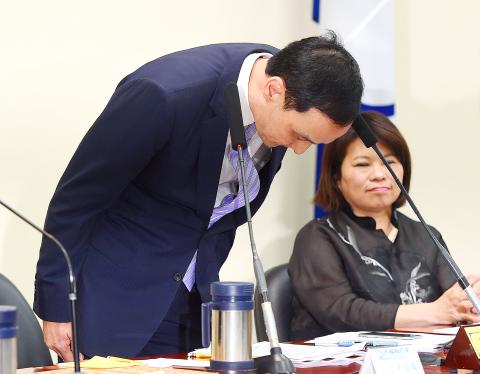
Photo: Liao Chen-huei, Taipei Times
Bowing to a room packed with committee members and reporters, Chu said that the time has come for the party to make a painful, but necessary decision, for which he, as KMT chairman, must apologize to all members of the party.
Chu said he also needed to extend his most sincere apologies to Hung for all the frustration and trouble the party has caused her.
“This Saturday’s party congress is the time to save the KMT from collapse and ensure its survival,” Chu said. “It is definitely not the time to contest for power or pander for favors.”
Chu said he cannot sit back and let the KMT fade into history and head toward failure.
“Like Hung and every one of you, I love this party, I love Taiwan and I love the Republic of China. I shall aim to reunite and seek a consensus among all party members and our supporters,” Chu said, adding that the KMT’s enemies lie outside the party.
Following Saturday’s conference, the KMT would become a united party that jointly shoulders responsibility and endeavors to bring together Taiwanese with its cross-strait policies, shared values and beliefs, Chu said.
At yesterday’s meeting, the committee passed a motion proposing the annulment of Hung’s nomination, with the motion backed by 26 of its 39 members. The proposal is an effort to create a basis for the plan to put Hung’s candidacy to a vote at the upcoming party congress.
As the KMT will not accept any motions filed on the day of the congress due to the “special nature” of the convention, yesterday’s proposal is to be the only item on the meeting’s agenda.
The proposal states that while the KMT is indebted to Hung’s completion of her “current mission” and her dedication to the KMT, the party’s dismal election prospects have unnerved many of its grassroots members and legislative candidates.
“To address the severe challenges faced by the KMT in terms of its survival and future development, we propose nullifying the party’s nomination of Hung as its candidate for the upcoming 14th presidential election,” the motion said.
It goes on to acknowledge Hung’s efforts and hard work in the past few months, before urging for party solidarity to prop up the momentum of the KMT’s campaign.
The passage of the proposal came one week after the committee unanimously passed a motion to hold an extempore party congress with the stated aims of changing the presidential candidate and forging a party consensuses.
In response, Hung said in a press release yesterday that while she agrees with Chu’s remarks that the KMT’s enemies lie elsewhere and understands the party leadership’s anxiety over the upcoming presidential and legislative elections, there should be no confusion between right and wrong.
“My love and loyalty to the KMT will remain unwavering and I will respect whatever decision is reached by the party congress,” Hung said. “Nevertheless, the party should safeguard its principles and its democratic procedures, and it should not let down its grassroots members.”
Meanwhile, in related developments, the Special Investigation Division (SID) of the Supreme Prosecutors’ Office yesterday said that it has charged Chu with violating election laws by allegedly secretly maneuvering to have Hung replaced.
Also listed as a defendant by the SID was KMT Secretary-General Lee Shu-chuan (李四川).
Article 84 of the Presidential and Vice Presidential Election and Recall Act (總統副總統選舉罷免法) stipulates that anyone who asks for a promise or asks a candidate or a person with the qualifications to be a candidate to abandon the campaign or conduct certain actions by offering bribes or other undue benefits faces fixed-term imprisonment.
Additional reporting by CNA
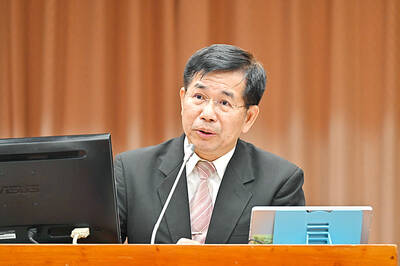
The International Industrial Talents Education Special (INTENSE) Program to attract foreigners to study and work in Taiwan will provide scholarships and a living allowance of up to NT$440,000 per person for two years beginning in August, Minister of Education Pan Wen-chung (潘文忠) told a meeting of the legislature’s Education and Culture Committee yesterday. Pan was giving an update on the program’s implementation, a review of universities’ efforts to recruit international students and promotion of the Taiwan Huayu Bilingual Exchanges of Selected Talent (BEST) program. Each INTENSE Program student would be awarded a scholarship of up to NT$100,000 per year for up to

BASIC OPERATIONS: About half a dozen navy ships from both countries took part in the days-long exercise based on the Code for Unplanned Encounters at Sea An unpublicized joint military exercise between Taiwan and the US in the Pacific Ocean last month was carried out in accordance with an international code, the Ministry of National Defense (MND) said yesterday. According to a Reuters report citing four unnamed sources, the two nations’ navies last month conducted joint drills in the Western Pacific. The drills were not made public at the time, but “about half-a-dozen navy ships from both sides, including frigates and supply and support vessels, participated in the days-long exercises,” Reuters reported, citing the sources. The drills were designed to practice “basic” operations such as communications, refueling and resupplies,

‘MONEY PIT’: The KMT’s more than NT$2 trillion infrastructure project proposals for eastern Taiwan lack professional input and financial transparency, the DPP said The Democratic Progressive Party (DPP) caucus yesterday said it would ask the Executive Yuan to raise a motion to oppose the Chinese Nationalist Party (KMT) caucus’ infrastructure proposals and prepare to file for a constitutional interpretation if the KMT-dominated legislature forces their passage. The DPP caucus described the three infrastructure plans for transportation links to eastern Taiwan proposed by the KMT as “three money pit projects” that would cost more than NT$2 trillion (US$61.72 billion). It would ask the Executive Yuan to oppose public projects that would drain state financial resources, DPP caucus secretary-general Rosalia Wu (吳思瑤) said. It would also file for
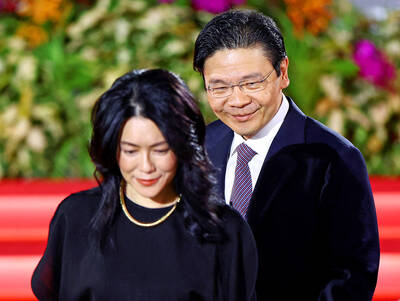
Singapore yesterday swore in Lawrence Wong (黃循財) as the city-state’s new prime minister in a ceremony broadcast live on television after Lee Hsien Loong (李顯龍) stepped down following two decades in office. Wong, formerly deputy prime minister, was inaugurated at the Istana government office shortly after 8pm to become the second person outside the Lee family to lead the nation. “I ... do solemnly swear that I will at all times faithfully discharge my duties as prime minister according to law, and to the best of my knowledge and ability, without fear or favor, affection or ill-will. So help me God,” the


 RSS
RSS