


The Taipei City Government yesterday unveiled three options for its urban renewal project in the Shezidao (社子島) peninsula, which are to be put to a plebiscite via the city’s “i-voting” system.
The Shezidao Special Project Office said the three options were designed to balance biodiversity, residents’ living space, and space needed for development and transportation systems.
The first option involves the construction of four canals connecting the Keelung (基隆河) and Tamsui (淡水河) rivers, which would surround “settlement buildings” and a special zone dedicated to corporations planned in the area’s center, the office said. It would also involve the construction of public housing.
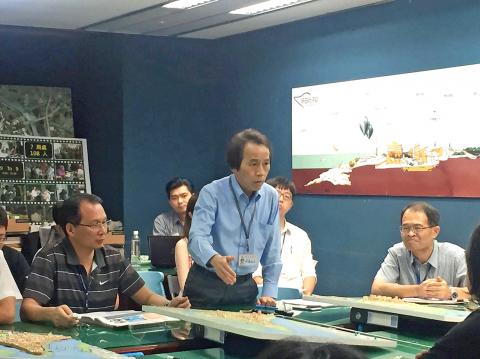
Photo: CNA
Settlement buildings refers to facilities the city government offers to people whose properties are expropriated, Taipei Deputy Mayor Charles Lin (林欽榮) said, adding that buildings would be offered at prices much lower than their market value.
Those who have properties vacated due to the project would receive compensation, he added.
The second option, entitled “ecological Shezidao,” would see the preservation of a canal that runs through the area.
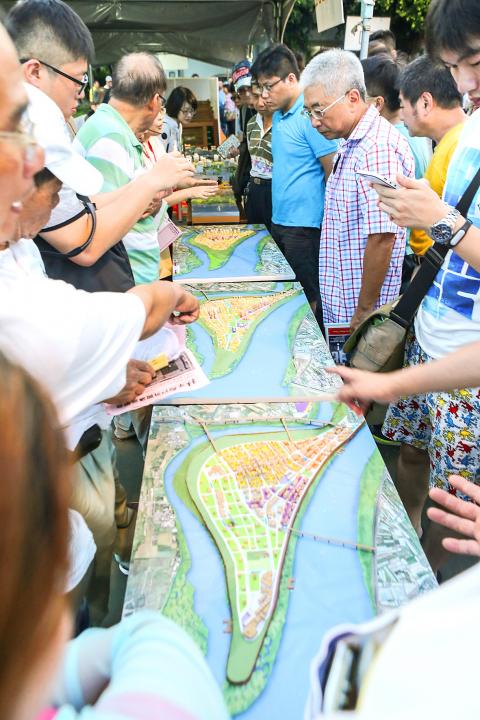
Photo: CNA
Lin said the city government plans to build a waterfront park on each side of the canal by cultivating artificial wetlands.
The third option, “our Shezidao,” would see expropriations carried out in tandem with rehousing efforts, along with a variety of developments, Lin said.
All three options would include plots reserved for ecological restoration, a light-rail system and 20 hectares for businesses, he said.
Lin said the city would launch an Internet-based plebiscite on Dec. 12 to poll Taipei residents’ opinions on the three options, adding that Shezidao residents’ votes would be assigned an 80 percent weighting.
Taipei residents aged 18 or older who hold a Taiwanese identification card would be eligible to vote, either at voting stations or at home, he said.
Taipei Department of Land Deputy Commissioner Yi Li-min (易立民) said that landowners with illegal structures built before 2005 would be eligible to purchase resettlement lodgings.
Yi said the city government would see to it that residents who have been instructed to deal with illegal structures predating 2005 could fulfill the requirements without penalty.
Because the Building Act (建築法) prohibits new buildings in Shezidao, which is a flood-prone area, owners of illegal structures have been unable to gain permission to make alterations to structures, as doing so would make the buildings illegal according to the act, Yi said.
That would force them to forfeit their right to purchase resettlement buildings, he added.

The National Chungshan Institute of Science and Technology yesterday showcased its locally developed variants of the Vision 60 robotic patrol dog, which it plans to deploy on the nation’s outlying territories in the South China Sea. The variants were produced under the Joint Lab project — created by the institute and domestic companies — and assembled with domestically produced motors, lenses and artificial intelligence (AI) systems alongside licensed tech from the US, Missile and Rocket Systems Research Division deputy director Jen Kuo-kang (任國光) told the media event at a military base in Taipei’s Dazhi (大直) area. Taiwan has built up its strengths

RIGHT DIRECTION: Taiwan’s efforts to prevent forced labor include a proposal to ‘fully prohibit’ employers from withholding workers’ documents, an official said Taiwan is to establish a mechanism to restrict imports of goods linked to forced labor, the Executive Yuan said yesterday, after the US proposed imposing additional tariffs on Taiwanese goods over labor concerns. “The Ministry of Labor and the Ministry of Economic Affairs are to establish an interministerial review procedure,” Executive Yuan spokesperson Michelle Lee (李慧芝) said at a news briefing in Taipei. “The government is to use the Foreign Trade Act [貿易法] as the legal basis to restrict imports of goods produced with forced labor” and bring its supply chain governance more in line with international standards on human rights, resilience

NOT IMMEDIATE: Taiwan has a chance to appeal the proposed 10 percent tariff before it starts, while other countries face a 12.5 percent tariff from the trade office Taiwan is among 60 economies determined by the US to have failed to impose or enforce a ban on the importation of goods produced with forced labor, according to a notice released on Tuesday by the Office of the US Trade Representative (USTR), which proposed imposing an additional 10 percent or more tariff on them. The USTR in a statement said that following an investigation, it had determined under Section 301 of the Trade Act of 1974 that the failure of the 60 economies to impose and effectively enforce a prohibition on the importation of goods produced with forced labor is

TIT-FOR-TAT: The US allegedly revoked the visa of a Chinese national working at Xinhua News Agency in the US in response to Beijing’s expulsion of Vivian Wang The Presidential Office yesterday condemned China for expelling a New York Times correspondent from Beijing following the newspaper’s interview with President William Lai (賴清德), saying the move highlighted Beijing’s suppression of press freedom and its threat to international news media. Taiwan has noted a series of recent incidents in which Beijing used similar tactics to “threaten and pressure international media outlets and journalists,” Presidential Office spokeswoman Karen Kuo (郭雅慧) said in a statement. “This concerns not only press freedom and freedom of expression, but also the safety of journalists, and Taiwan and relevant partners are paying close attention to the situation,” she


 RSS
RSS