


It is a historical fact that the then-Chinese Nationalist Party (KMT) government led the war against Japanese aggression from 1937 to 1945, whether on the front lines or behind enemy lines, Presidential Office spokesperson Charles Chen (陳以信) said yesterday.
Chen was responding to remarks by former vice president Lien Chan (連戰), who said during a meeting with Chinese President Xi Jinping (習近平) in Beijing yesterday that the KMT under the leadership of former president Chiang Kai-shek (蔣介石) engaged directly with Japanese troops in major battles, handing the latter a major setback, and that Chinese Communist Party (CCP) troops led by former Chinese leader Mao Zedong (毛澤東) also tied down the enemy behind their lines and eventually defeated the Japanese aggressors.
“The Nationalist forces ... fought a series of decisive and major battles on the front lines and dealt the Japanese military a heavy blow,” Lien told Xi, according to Shanghai news Web site guancha.cn.
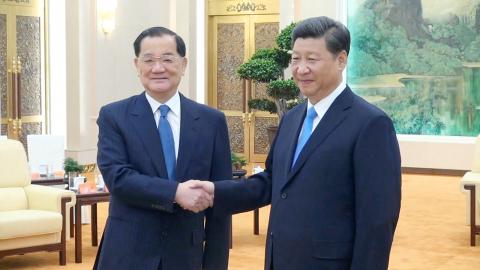
Photo: CNA
“The Chinese Communist Party forces led by Mao Zedong effectively pinned down and intercepted the Japanese and the collaborationist militaries on the battlefield behind enemy lines,” added Lien, a former KMT chairman.
Xi said Nationalists and Communists “cooperated and coordinated” in the campaign and that “both made significant contributions to the victory of [the so-called ‘Chinese People’s War of Resistance Against Japanese Aggression and the World Anti-Fascist War’],” China’s Xinhua news agency reported.
“Chinese across the Taiwan Strait must keep history in mind, remember national heroes and become united to savor the fruits of victory and jointly advance the peaceful development of our relations,” Xinhua quoted Xi as saying.
The Presidential Office said that the CCP did little to resist Japanese aggression during the Second Sino-Japanese War.
“Whether it came to engaging in combat with Japanese troops on the front lines or behind enemy lines, it was all led by the Nationalist government, which is a historical fact that cannot be denied,” Chen said.
Chen said that the government’s stance is that “it is inappropriate” for Taiwanese to attend China’s military parade tomorrow — at which Lien is expected to be present.
Beijing has held a series of events to mark the 70th anniversary of the end of World War II, with tomorrow’s military parade considered to be the highlight of the festivities.
The CCP — which defeated the KMT in the Chinese Civil War, forcing the latter to flee to Taiwan — depicts itself as having played the lead role in defeating Japan.
Taiwan said events being held by Beijing distort historical facts, as it was the KMT who fought all the major battles against Japan during an eight-year war before Allied forces intervened.
KMT presidential candidate Hung Hsiu-chu (洪秀柱) yesterday said that she has great respect for Lien, who she said has made significant contributions toward cross-strait peace.
However, Hung added that, given his position, Lien should consider the Taiwanese perspective when making public comments.
Additional reporting by Chang Hsiao-ti
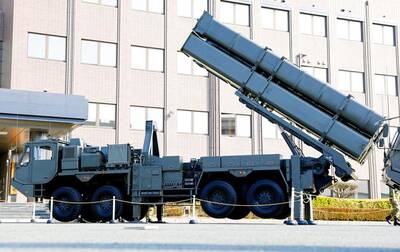
Japan has deployed long-range missiles in a southwestern region near China, the Japanese defense minister said yesterday, at a time when ties with Beijing are at their lowest in recent years. The missiles were installed in Kumamoto in the southern region of Kyushu, as Japan is attempting to shore up its military capacity as China steps up naval activity in the East China Sea. “Standoff defense capabilities enable us to counter the threat of enemy forces attempting to invade our country ... while ensuring the safety of our personnel,” Japanese Minister of Defense Shinjiro Koizumi said. “This is an extremely important initiative for
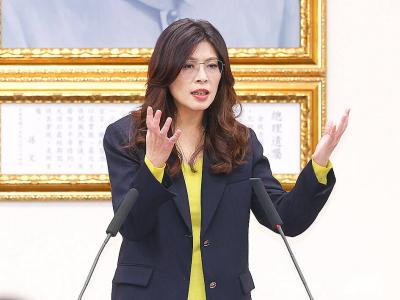
Chinese Nationalist Party (KMT) Chairwoman Cheng Li-wun (鄭麗文) today accepted an invitation from Chinese President Xi Jinping (習近平) to lead a delegation to China next month, saying she hopes to promote the peaceful development of cross-strait relations and bring stability to the Taiwan Strait. “I am grateful and happy to accept this invitation,” Cheng said in a statement from the KMT chairperson’s office. Cheng said she hopes both sides can work together to promote the peaceful development of cross-strait relations, enhance exchange and cooperation, bring stability to the Taiwan Strait and improve people’s livelihoods. At today's news conference, Cheng said any efforts to
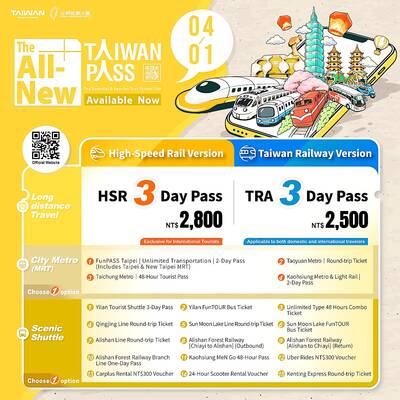
MORE POPULAR: Taiwan Pass sales increased by 59 percent during the first quarter compared with the same period last year, the Tourism Administration said The Tourism Administration yesterday said that it has streamlined the Taiwan Pass, with two versions available for purchase beginning today. The tourism agency has made the pass available to international tourists since 2024, allowing them to access the high-speed rail, Taiwan Railway Corp services, four MRT systems and four Taiwan Tourist Shuttles. Previously, five types of Taiwan Pass were available, but some tourists have said that the offerings were too complicated. The agency said only two types of Taiwan Pass would be available, starting from a three-day pass with the high-speed rail and a three-day pass with Taiwan Railway Corp. The former costs NT$2,800

The nation’s fastest supercomputer, Nano 4 (晶創26), is scheduled to be launched in the third quarter, and would be used to train large language models in finance and national defense sectors, the National Center for High-Performance Computing (NCHC) said. The supercomputer, which would operate at about 86.05 petaflops, is being tested at a new cloud computing center in the Southern Taiwan Science Park in Tainan. The exterior of the server cabinet features chip circuitry patterns overlaid with a map of Taiwan, highlighting the nation’s central position in the semiconductor industry. The center also houses Taiwania 2, Taiwania 3, Forerunner 1 and


 RSS
RSS