


Tens of thousands of Hong Kongers joined a candlelight vigil last night marking the 1989 student-led Tiananmen Square Massacre, an annual commemoration that takes on greater meaning for the territory’s young after last autumn’s pro-democracy demonstrations sharpened their sense of unease with Beijing.
For the first time in the vigil’s quarter-century history, some student groups did not take part and instead held their own memorials, a sign of an emerging rift between young and old over Hong Kong’s identity that took root during the Occupy Central protests.
The vigil is the only large-scale public commemoration of the victims on Chinese soil and the Tiananmen events remain a taboo topic on the mainland.
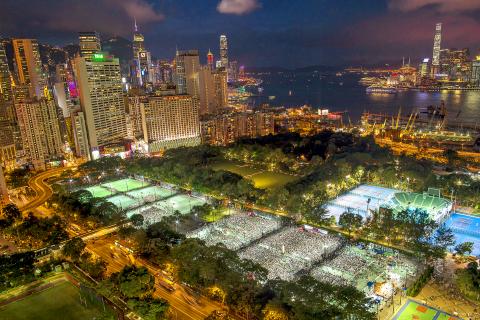
Photo: Reuters
Hundreds and possibly thousands of unarmed protesters and onlookers were killed when tanks and soldiers entered central Beijing on June 3 and June 4, 1989, to put down the student-led protests.
“June 4 and Occupy Central are very similar,” said Otto Ng, a 19-year-old student who planned to attend the vigil for the first time.
Ng said he had not known much about the events in Tiananmen Square, but tried to learn more after last year’s Hong Kong protests erupted.
In both cases, “we are all students, and we are pushing for democracy and freedom,” he said.
Eva Leung, 16, also attended the commemoration for the first time.
“This evening’s vigil adds to our desire to have a genuine democratic system,” she said.
Because of the Occupy Central protests, “I came to know what democracy is and what was happening in Hong Kong, and it made me come to this evening’s vigil,” she said.
Political tensions threaten to reignite in Hong Kong over the government’s plan to submit its electoral reform package for lawmakers to approve later this month, including Beijing’s demand that it screen candidates in future elections for the territory’s leader.
Local news reports say more than 7,000 police would be deployed to deal with protests ahead of the vote.
Each year, Hong Kongers gather in Victoria Park, holding candles aloft and calling for the Chinese government to overturn its stance that the Tiananmen Square protests were a counterrevolutionary riot. The vigil, which drew an estimated 180,000 last year, features a replica of the Goddess of Democracy statue that protesters erected in Beijing.
Vigil leaders laid a wreath at a makeshift memorial in the middle of the crowd as the names of the Tiananmen victims were read out. Everyone, including the crowd, then bowed three times.
The leaders then led the crowd in observing a minute of silence.
Organizers planned this year to show videos about Occupy Central and speakers were to talk about mainland activists detained for voicing support.
Hong Kong became a part of China in 1997 after a century and a half as a British colony, but it maintains freedom of speech and other civil liberties which not seen on the mainland.
However, three university student groups opted out of the vigil because of a disagreement over the need to build a democratic China, a guiding principle of the vigil’s organizer, the Hong Kong Alliance in Support of Patriotic Democratic Movements in China. The group was originally established to support the students protesting in Beijing.
The Hong Kong Federation of Students, a coalition of the territory’s universities that was one of the driving forces behind the Occupy protests, also opted not to take part. The group has been hit by turmoil over its leadership during the protests, and this year half of its eight university group members voted to leave.

Japan has deployed long-range missiles in a southwestern region near China, the Japanese defense minister said yesterday, at a time when ties with Beijing are at their lowest in recent years. The missiles were installed in Kumamoto in the southern region of Kyushu, as Japan is attempting to shore up its military capacity as China steps up naval activity in the East China Sea. “Standoff defense capabilities enable us to counter the threat of enemy forces attempting to invade our country ... while ensuring the safety of our personnel,” Japanese Minister of Defense Shinjiro Koizumi said. “This is an extremely important initiative for
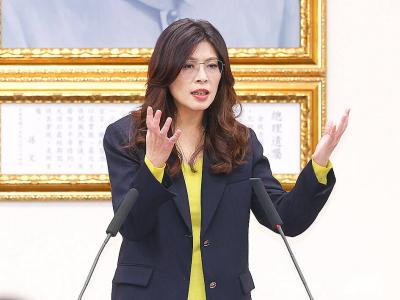
Chinese Nationalist Party (KMT) Chairwoman Cheng Li-wun (鄭麗文) today accepted an invitation from Chinese President Xi Jinping (習近平) to lead a delegation to China next month, saying she hopes to promote the peaceful development of cross-strait relations and bring stability to the Taiwan Strait. “I am grateful and happy to accept this invitation,” Cheng said in a statement from the KMT chairperson’s office. Cheng said she hopes both sides can work together to promote the peaceful development of cross-strait relations, enhance exchange and cooperation, bring stability to the Taiwan Strait and improve people’s livelihoods. At today's news conference, Cheng said any efforts to

MORE POPULAR: Taiwan Pass sales increased by 59 percent during the first quarter compared with the same period last year, the Tourism Administration said The Tourism Administration yesterday said that it has streamlined the Taiwan Pass, with two versions available for purchase beginning today. The tourism agency has made the pass available to international tourists since 2024, allowing them to access the high-speed rail, Taiwan Railway Corp services, four MRT systems and four Taiwan Tourist Shuttles. Previously, five types of Taiwan Pass were available, but some tourists have said that the offerings were too complicated. The agency said only two types of Taiwan Pass would be available, starting from a three-day pass with the high-speed rail and a three-day pass with Taiwan Railway Corp. The former costs NT$2,800
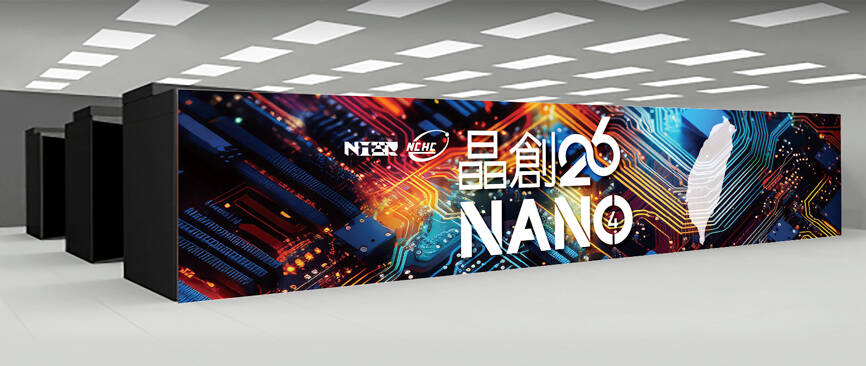
The nation’s fastest supercomputer, Nano 4 (晶創26), is scheduled to be launched in the third quarter, and would be used to train large language models in finance and national defense sectors, the National Center for High-Performance Computing (NCHC) said. The supercomputer, which would operate at about 86.05 petaflops, is being tested at a new cloud computing center in the Southern Taiwan Science Park in Tainan. The exterior of the server cabinet features chip circuitry patterns overlaid with a map of Taiwan, highlighting the nation’s central position in the semiconductor industry. The center also houses Taiwania 2, Taiwania 3, Forerunner 1 and


 RSS
RSS